
Modified cellulose catches lead in solar-cell recycling solvents
Sulfur-bearing binding sites work beyond water, but removal efficiency is not yet a closed metal-and-solvent recycling loop.
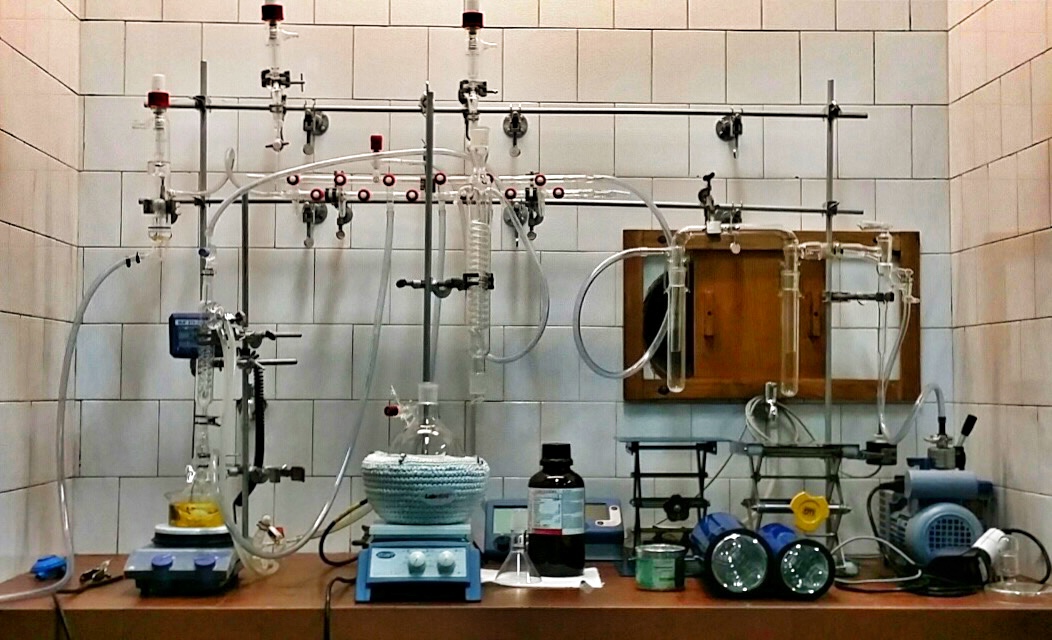
Emerging lead-containing perovskite solar cells create a different recycling challenge from conventional silicon panels. Commercial crystalline silicon modules present physical dismantling challenges focused on aluminum frames, tempered cover glass, copper ribbon, and ethylene vinyl acetate (EVA) encapsulants. While silicon recycling centers on thermal delamination and mechanical shredding, hybrid organic-inorganic perovskites (typically based on methylammonium lead iodide, formamidinium lead iodide, or cesium-doped variants) rely on thin-film architectures deposited from or stripped by organic solvents. Their processing and end-of-life deconstruction generate complex organic-solvent effluents, so a metal-removal method designed for municipal or industrial water treatment may behave very differently in practice.
Water treatment techniques routinely exploit precipitation, ion exchange, or hydroxide coagulation because water acts as a high-dielectric, predictable medium for ionic equilibria. In contrast, spent processing liquors from perovskite manufacturing and recycling are dominated by non-aqueous carriers. Solvents such as dimethylformamide (DMF), dimethyl sulfoxide (DMSO), gamma-butyrolactone (GBL), and low-boiling alcohols are used to dissolve, deposit, or rinse the perovskite crystal lattice. Introducing traditional aqueous capture resins or simple alkaline neutralisation into these solvent streams often triggers precipitation fouling, polymer degradation, or poor phase separation. Addressing toxic lead contamination from emerging photovoltaics demands sorbents engineered specifically to function within polar organic matrices.
Add metal-binding sites to cellulose
The reported DPE6 sorbent modifies cellulose with dithiocarbamate groups. Cellulose itself provides a high surface area, an abundant biopolymer backbone, and mechanical stability across varied fluid conditions, but native cellulose fibers possess only hydroxyl groups that display weak affinity for heavy metal cations. Functionalising the biopolymer by grafting dithiocarbamate chemistry fundamentally alters its surface behavior. Dithiocarbamates contain carbon atoms bonded to two sulfur atoms alongside an amine nitrogen. In organometallic and coordination chemistry, soft donor atoms like sulfur have a thermodynamic preference for soft and borderline Lewis acids, including divalent lead (Pb²⁺), forming robust bidentate chelate rings.
The sulfur atoms in these groups coordinate metal ions, creating binding sites on a renewable polymer scaffold. Because chelation relies on strong localized coordination rather than simple electrostatic attraction, the binding occurs rapidly when fluid transport and pore diffusion are favorable. The study reports that sorption equilibrium was reached within roughly ten minutes under the tested conditions, indicating that the mass transfer resistance within the modified cellulose network is modest in well-mixed batch testing.
Solvent matrix effects and coordination competition
When evaluating sorbent performance, the surrounding fluid phase is not a neutral spectator. The solvent constantly competes against the solid sorbent's chelating ligands to solvate the dissolved metal ion. This thermodynamic competition explains why the same functionalised material displays divergent capture performance across different industrial wash matrices.
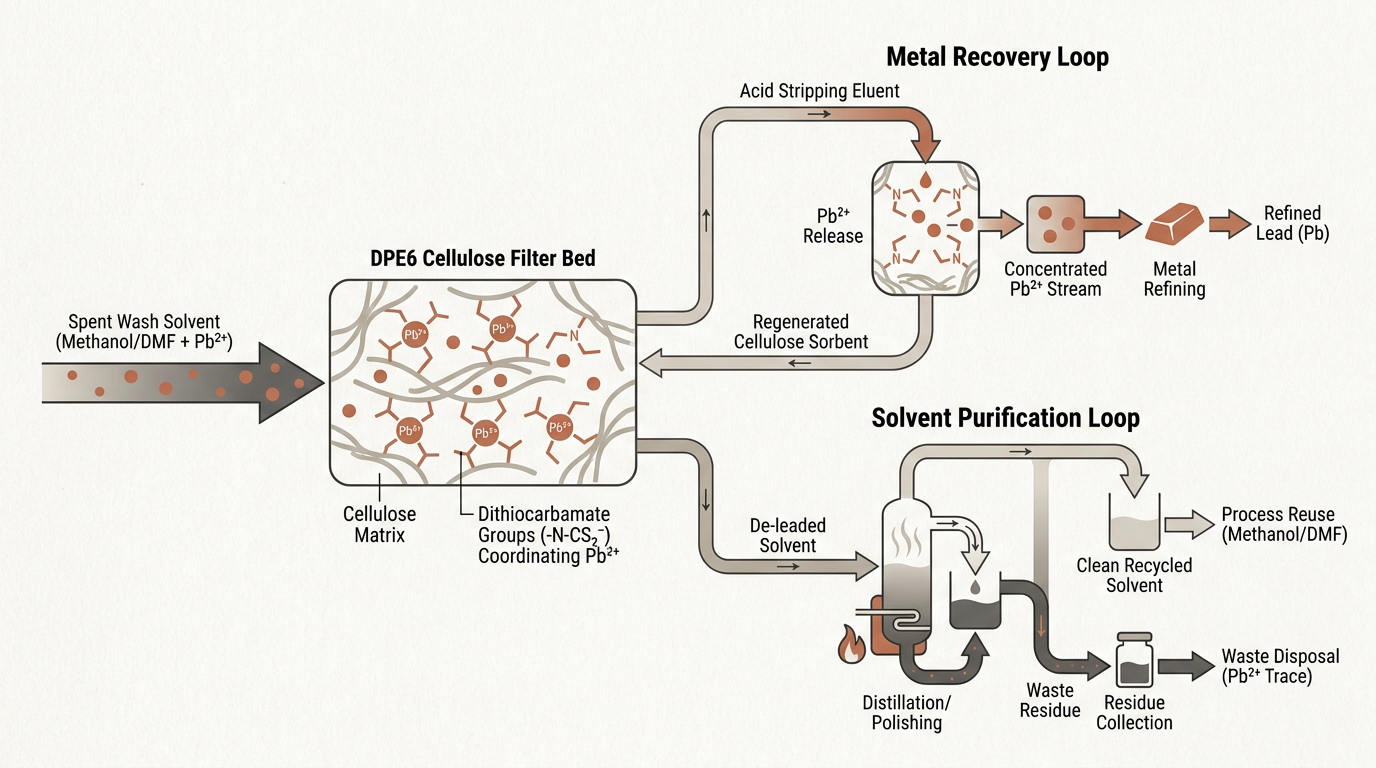
The study reports more than 99% lead removal from methanol-containing recycling effluent and about 91% from DMF-containing effluent, with sorption equilibrium reached within roughly ten minutes under the tested conditions. The difference between solvents is important evidence, not a detail to hide.
In methanol, a protic alcohol with a moderate donor number, lead cations are relatively weakly solvated. The sulfur-bearing dithiocarbamate ligands easily displace coordinated alcohol molecules, driving the equilibrium toward bound surface complexes and delivering higher than 99% extraction. Conversely, DMF is a strong, polar aprotic coordinating solvent with a high electron-donor capacity. DMF molecules coordinate strongly to vacant coordination sites on lead ions in solution, shielding them and competing directly against the sorbent's surface sites. This solvent coordination lowers the net thermodynamic driving force for adsorption, resulting in the lower 91% capture value observed.

Percentage removal is not discharge compliance
Process engineering must distinguish between relative extraction efficiency and absolute residual concentrations. Environmental discharge limits, hazardous waste thresholds, and solvent reuse specifications are governed by absolute parts-per-million or parts-per-billion metrics, not removal percentages.
High percentage removal of heavy metals from spent recycling solvent proves that an effective closed-loop process is complete.
Trapping metal ions onto an insoluble substrate merely transfers the pollutant from a liquid phase to a solid phase; closing the loop requires separating, recovering, and purifying the lead while regenerating the sorbent and cleaning the solvent for reuse.
The remaining concentration depends on the starting concentration. Removing 99% from a highly concentrated stream can still leave too much lead for its intended next use or discharge route. For instance, if an industrial strip liquor contains 5,000 milligrams of lead per liter from dissolved perovskite layers, a 99% removal efficiency leaves 50 milligrams per liter in the treated solvent. That residual concentration exceeds industrial wastewater discharge guidelines and hazardous waste thresholds by orders of magnitude. Flow, competing substances and solvent composition also affect practical performance. If the solvent stream contains co-extracted degradation products, ionic additives, or moisture, binding capacities will deviate sharply from single-solute laboratory trials.
Desorption, regeneration, and secondary waste
Capturing lead transfers it to the sorbent. Recovery requires a further step to release and purify the metal, or an appropriate route for managing the loaded material. Once the dithiocarbamate binding sites are saturated with lead ions, the operator faces an operational fork: elute and regenerate the solid material, or dispose of the loaded sorbent as hazardous chemical waste.
Elution requires stripping the lead from sulfur donor sites without destroying the organic dithiocarbamate graft or hydrolysing the cellulose backbone. Typically, this demands acid stripping or competing complexing agents such as ethylenediaminetetraacetic acid (EDTA). However, strong mineral acids can cleave dithiocarbamate groups, releasing carbon disulfide and rendering the cellulose inert for subsequent cycles. If the sorbent cannot endure multiple sorption-desorption cycles without significant capacity fade, it becomes a single-use consumable. Incinerating or landfilling lead-laden cellulose creates secondary hazardous emissions or leachable landfill hazards, undermining the primary environmental rationale for recycling.
Keep both loops visible
A complete process must account for solvent reuse or disposal as well as the lead. Cellulose being renewable does not make its chemical functionalisation, regeneration or end-of-life impact-free.
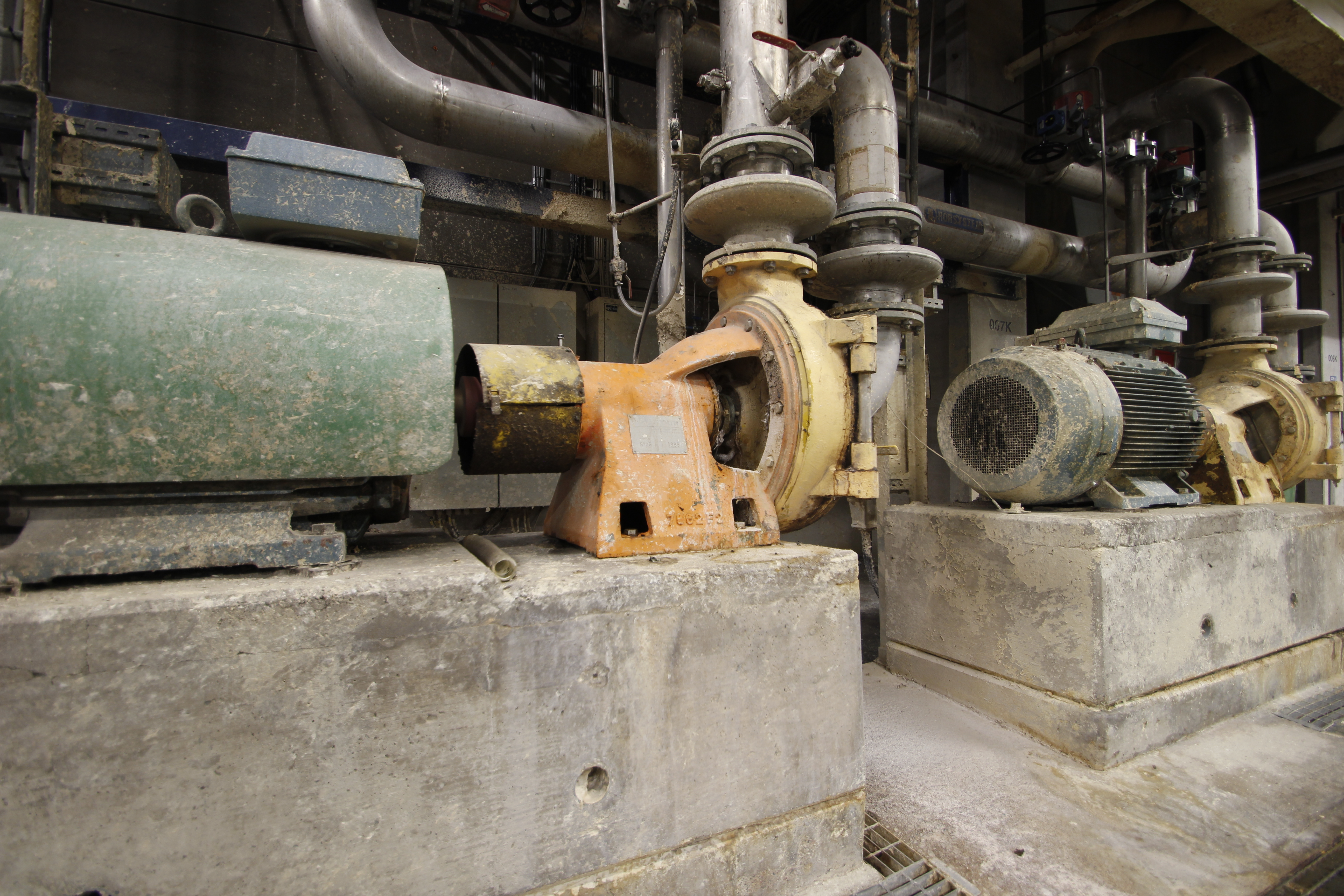
A sustainable recycling flowsheet requires two closed, circular loops operating in parallel: the metal reclamation loop and the organic solvent recovery loop. Extracting lead from the wash liquor does not automatically produce reusable solvent. The de-leaded effluent still contains residual organic decomposition products, water, and traces of lead that may interfere with upstream perovskite crystal synthesis if re-introduced into manufacturing. Distillation or membrane separation will still be required to recover technical-grade solvent, and those downstream thermal steps carry substantial energy footprints.
This is a useful laboratory demonstration of solvent-tolerant capture. The next proof is repeated operation with representative effluent, measured residual concentrations, regeneration cycles and a full lead-and-solvent balance. Conventional silicon-panel waste should not be treated as evidence for this emerging perovskite-specific stream.
References and image credits›
Photo: Miha Bukleski, CC BY 4.0 · Diagram: The Waste Stack · Photo: Bonvallite, CC BY-SA 3.0 · Photo: Work With Sounds, CC BY-SA 4.0, via Wikimedia Commons