
LaMa separates the gel problem from the plastic recycling stream
Superabsorbents complicate wet processing; reported 200 kg/hour operation does not establish a route for every used diaper or construction mat.
Superabsorbent polymers hold large quantities of liquid by swelling into a gel. That property is useful in products but troublesome when mixed with carrier plastics in a recycling process.
In products such as hygiene items, surgical pads, cable wraps, and specialized geotextiles, superabsorbent polymers (SAPs)—typically lightly cross-linked sodium polyacrylate networks—are engineered to bind hundreds of times their dry weight in water. They do this through osmotic pressure and electrostatic repulsion along their polymer backbones. When dry, these materials exist as granular particulates mechanically captured in synthetic matrices or cellulose fluff. Once exposed to moisture, they form hydrogels that resist mechanical dewatering, alter bulk rheology, and cling tenaciously to adjacent fibers and film surfaces.
For mechanical recyclers, that behavior is a processing nightmare. Conventional wash lines rely on density separation in water, mechanical friction, and centrifugal drying to segregate plastics. Introducing an agent designed specifically to absorb water and balloon into an unfilterable gel disrupts every unit operation along the line.
The mechanics of gel contamination in polymer recovery
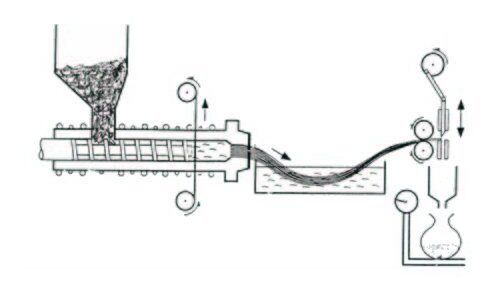
Standard mechanical reclamation lines handle mixed polymer packaging by shredding the input, floating polyolefins away from denser plastics in water baths, and drying the flake prior to melt extrusion. Superabsorbents fundamentally invert those process dynamics.
When a multi-component article containing superabsorbents enters an aqueous bath, the polyacrylate grains swell rapidly. Instead of cleanly sinking or floating, the expanding gel forms a viscous, mucilaginous slurry. The gel particles plug dewatering screens, blind centrifuge baskets, and bind carrier film fragments to cellulose fibers that would otherwise wash free.
Even when partial separation occurs, residual hydrogel particles present severe issues inside the melt extruder. Superabsorbents are thermoset networks; they do not melt alongside thermoplastic carrier polymers like polyethylene (PE) or polypropylene (PP). When heated to typical polyolefin extrusion temperatures between 180°C and 230°C, trapped gel particles dehydrate violently, generating steam pockets that induce foaming, melt instability, and severe structural voids in the extruded strands. Any dry residual polyacrylate acts as an infusible solid contaminant that rapidly clogs screen packs, causes pressure spikes at the die, and creates critical stress concentrators in final regranulate.
Separate components before remelting
A mixture containing absorbent material, plastic and sometimes cellulose is not a clean melt feedstock. Wet handling can make the absorbent fraction swell, complicating separation and contaminating other recovered material.
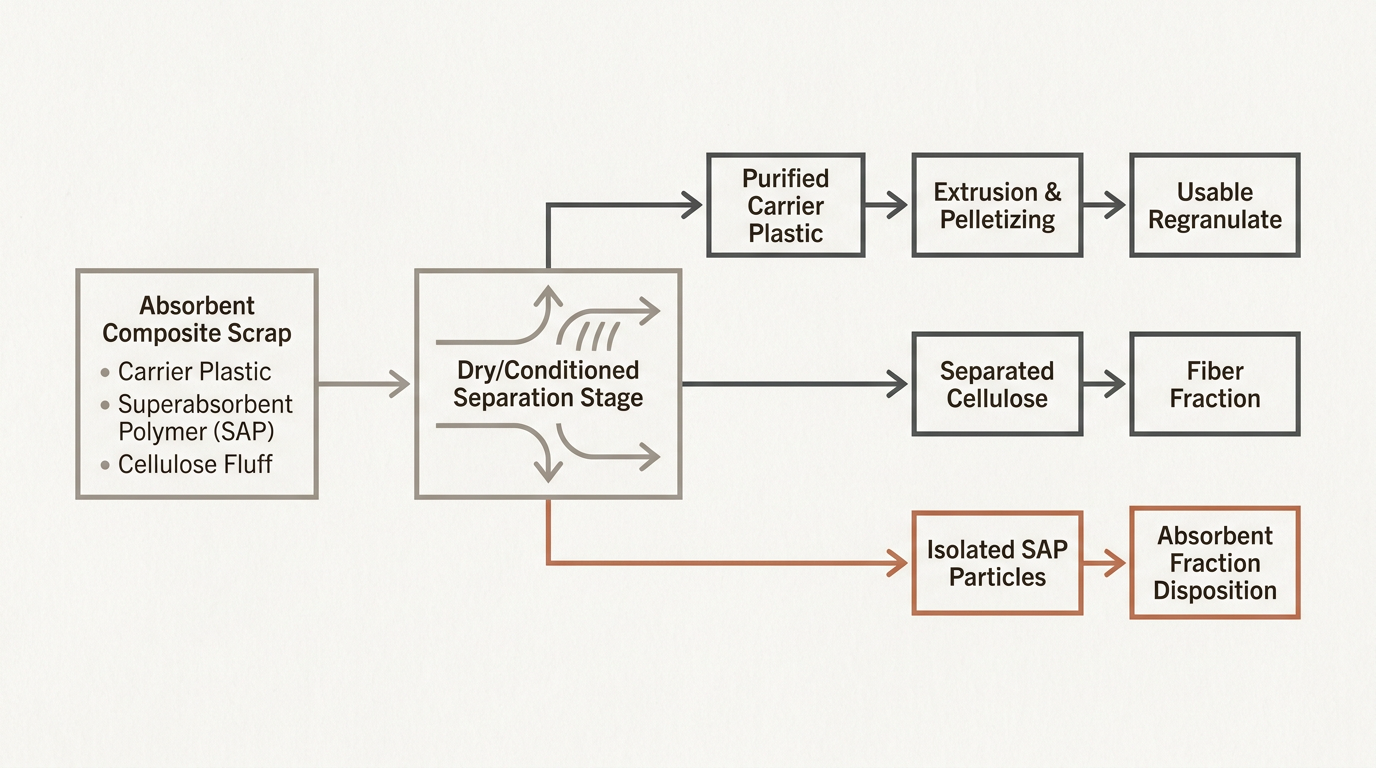
LaMa Recycling’s described process separates the carrier plastic from the superabsorbent so that a usable regranulate can be produced. The public description does not disclose every processing condition; it should not be filled in with an invented chemical mechanism.
In broad engineering terms, reclaiming composite streams of this type requires preventing the SAP from swelling uncontrollably, or dislodging it through tailored mechanical, thermal, or dry classification phases before aggressive wet agitation takes place. If chemical conditioning agents or dry mechanical attrition are deployed, their goal must be identical: liberate the trapped polymer film from both the absorbent grains and any carrier cellulose matrix without allowing cross-contamination.
Once the carrier plastic is isolated from the gel-forming chemistry, downstream processing resembles standard regranulation. The polyolefin fractions can be washed, dried, filtered, and pelletized into secondary resins suitable for non-critical extrusion or injection molding, provided thermal degradation was minimized during separation.
What the throughput establishes
Scale is the pivot point on which recycling innovations either become industrial realities or remain engineering curiosities. The Plastics Center SKZ reports on operational progress for the LaMa development effort, providing concrete metrics for the system's capacity.
SKZ reports operation around 200 kilograms an hour and a 500-kilogram-an-hour target. Those rates describe a processing scale, not annual output: operating hours, downtime, input composition and yield determine saleable tonnes.
A line running at 200 kilograms per hour operates at pilot-to-demonstration scale. If run continuously on a standard industrial schedule of 7,000 to 8,000 operating hours annually, a 200 kg/h line represents a theoretical nameplate processing capacity of 1,400 to 1,600 tonnes of raw feedstock per year. Advancing to the targeted 500 kilograms per hour would scale that nominal intake toward 3,500 to 4,000 tonnes annually.
However, nameplate throughput rarely translates directly into recovered resin volume. Composite absorbent articles possess low bulk densities, meaning feeding systems, shredders, and conveyors must manage high physical volumes per unit of mass. Furthermore, total mass yield depends on input composition: if the incoming material contains significant proportions of cellulose fluff, superabsorbent gel, and moisture, the recovered thermoplastic fraction represents only a portion of the processed intake.
Scrap versus post-consumer complexity
A working line on controlled manufacturing scrap is an important milestone. It does not prove the same result for used diapers, dirty geotextiles or every construction product containing water-managing materials.
Demonstrating separation on composite industrial scrap proves that post-consumer absorbent hygiene products and construction waste are fully circular.
Clean pre-consumer production scrap eliminates biological contamination, moisture variability, and unpredictable mineral loadings, leaving the far harsher challenge of soiled post-consumer waste unresolved.
Industrial conversion scrap—such as edge trimmings, off-spec production rolls, and assembly rejections from hygiene factories—arrives dry, unsoiled, and chemically uniform. The polymers are known, the cellulose-to-SAP ratios are consistent, and biological contaminants are entirely absent. Processing scrap validates that the machine geometry, shear rates, and separation stages function under idealized conditions.
By contrast, post-consumer absorbent hygiene products (AHP) arrive saturated with bodily fluids, pathogens, and soluble salts. Sodium chloride in biological fluids alters the osmotic swelling behavior of polyacrylates, transforming loose granules into collapsed, tacky gels. In civil engineering and construction applications, materials like water-blocking cable tapes or swellable dewatering mats incorporate road dirt, concrete dust, and heavy minerals. These abrasive particulates accelerate equipment wear and skew density-based separation equipment.
Keep each recovered fraction accountable
The quality of the plastic output matters, but so do the separated absorbent and cellulose fractions. A claim of circular recovery should state their destinations, losses and whether they meet specifications for reuse.
A complete process mass balance must account for every output stream leaving the plant:
- Carrier plastic: Does the recovered polyolefin meet commercial purity, melt flow index (MFI), and odor standards for blow molding, pipe extrusion, or film production?
- Superabsorbent fraction: Is the isolated polyacrylate intact, or has it suffered irreversible shear degradation or chemical poisoning that forces it into landfill or incineration?
- Cellulosic fibers: Can the fluff pulp be extracted cleanly enough for paperboard packaging or fiberboard markets, or is it discarded as an unsellable moist cake?
- Wastewater and residues: Does the process generate a chemical effluent loaded with dissolved salts, surfactant residues, or suspended micro-gels that burden municipal treatment infrastructure?
The next proof is representative post-use feedstock testing, consistent output quality and full costs. The opportunity is real because a hidden component can obstruct recovery; the solution still needs a defined input stream rather than a blanket claim that the whole category is now recyclable.
References and image credits›
Photo: Wikimedia Commons, CC BY-SA · Diagram: The Waste Stack · Photo: Wikimedia Commons, CC BY-SA 4.0 · Photo: Miha Bukleski, CC BY 4.0