
Hereon puts breaking points into a styrene-based plastic
Bio-based content and deliberate chain cleavage change material design; fragments are not yet proof of a closed recycling loop.
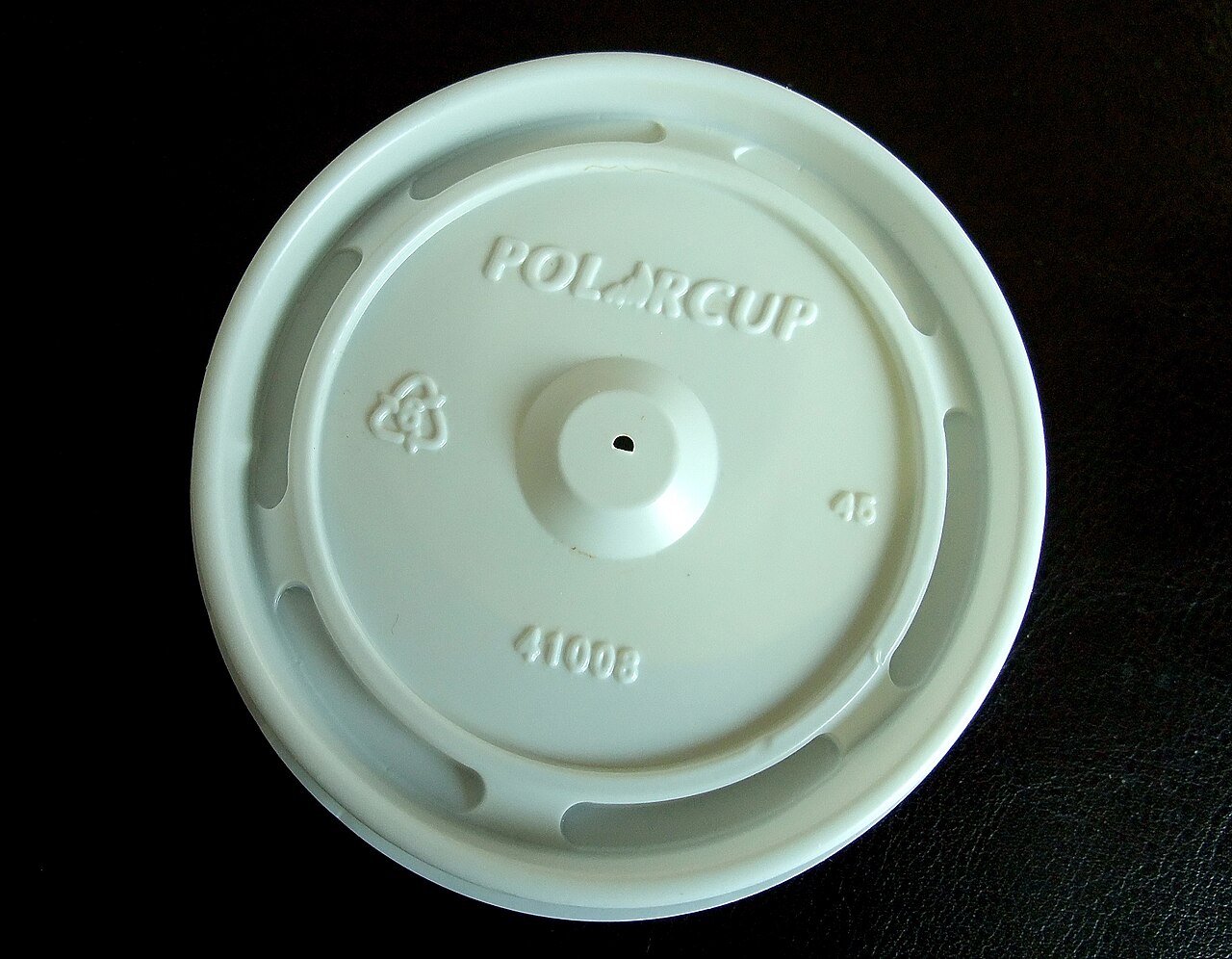
Conventional polystyrene is technically recyclable, but collection and economically viable recovery remain limited for many products. In consumer packaging, food service ware, and protective foams, polystyrene products frequently end up discarded in municipal solid waste streams or downcycled into low-value secondary goods. The polymer’s chemistry explains much of the operational bottleneck. Polystyrene consists of a durable, saturated all-carbon backbone decorated with bulky pendant phenyl rings. This hydrocarbon architecture gives the polymer its rigidity, optical clarity, and thermal insulation characteristics. However, that identical structural durability makes polystyrene stubbornly resistant to chemical solvolysis and biological degradation.
Mechanical recycling struggles because post-consumer polystyrene is often light, bulky, and heavily contaminated by food residues. Decontaminating and re-extruding the resin causes thermal degradation, yellowing, and loss of mechanical toughness. Pyrolysis and thermochemical depolymerization, meanwhile, demand high energetic inputs to break unactivated carbon-carbon single bonds. They typically yield complex mixtures of styrene monomer, dimers, trimers, and unwanted aromatic byproducts that require expensive post-fractionation. Hereon’s reported research takes a different approach: redesign the material so that its molecular structure is easier to break at end-of-life.
Change the chain at manufacture
The team combines styrene with a plant-derived component, itaconic anhydride, and incorporates DOT-based groups that introduce cleavable links. The resulting material is reported as approximately half bio-based.
Conventional free-radical polymerization of pure styrene yields long macromolecules formed entirely of persistent carbon-carbon bonds. By introducing functional comonomers during synthesis, the research team modifies this continuous chain. Itaconic anhydride, obtained from industrial fungal fermentation of carbohydrates, provides a bio-based building block with reactive cyclic anhydride functionality. The inclusion of DOT-based (dioxothiepane or related cyclic acetal/ester structures capable of radical ring-opening) groups intersperses hydrolytically or chemically vulnerable heteroatom linkages directly into the vinyl backbone.
Bio-based content describes the feedstock contribution. It does not automatically mean compostability, low lifecycle emissions or acceptance in an existing recycling programme. A macromolecule derived from biological sugars can remain non-biodegradable if its chemical links mimic conventional petrochemicals. Conversely, entirely synthetic resins can be fully biodegradable if their linkages match environmental enzymes. A polymer that is roughly half bio-based by mass still carries the aromatic residue of styrene alongside its bio-derived fractions, and mixing these components alters the physical and chemical behaviour across every phase of the material's lifecycle.
Breaking the chain is only one stage
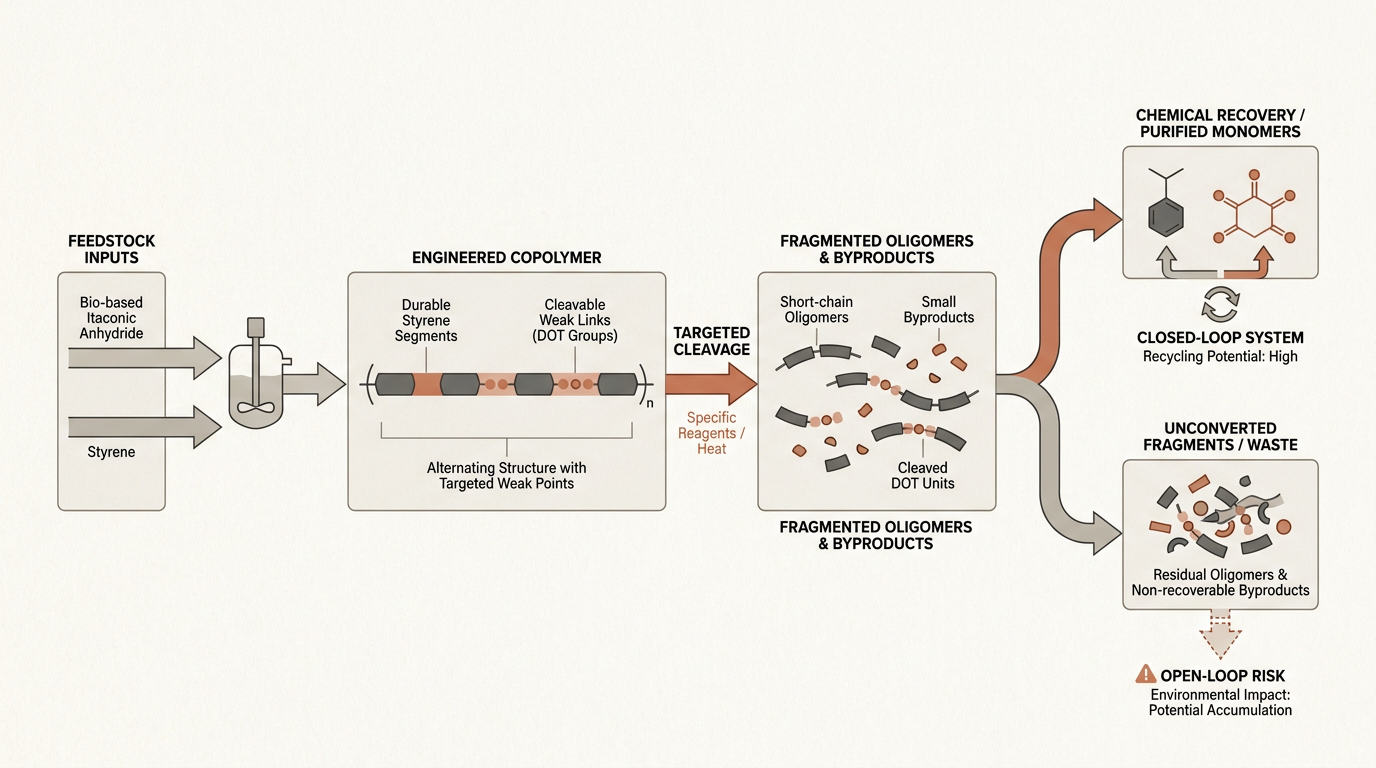
Deliberate weak points can make cleavage possible under selected treatment conditions. The resulting fragments then need a defined route: chemical recovery, further processing or demonstrated biological conversion.
Synthesizing plastics with cleavable weak links solves the persistent waste problem of traditional polystyrene.
Breaking high-molecular-weight polymers into lower-mass oligomers is merely an initial chemical step; true circularity requires demonstrating that those breakdown products can be separated, purified, and re-polymerized or completely mineralized.
When a polymer chain with built-in trigger sites encounters specific reagents, heat, or catalysts, the vulnerable linkages rupture. This process collapses high-molecular-weight plastics into short oligomers, functionalized aromatics, or dicarboxylic acid derivatives. Yet generating lower-molecular-weight fragments in a test tube does not constitute an industrial recovery system.
Fragmentation alone is not complete biodegradation. It is also not proof that the material’s carbon returns to a new product. Those outcomes require measurement of recovered products or final biological transformation, not merely smaller pieces. In environmental settings, polymer fragmentation without full metabolic mineralization merely creates microplastics and functionalized organic residues. In an industrial recovery stream, a liquid or slurry of heterogeneous oligomers represents a chemical separation challenge. Unless the process delivers high yields of pure, repolymerizable monomer or converts the carbon into defined chemical feedstocks without exorbitant solvent or energy footprints, the recycling loop remains open.
What the small dishes show
The researchers report injection-moulded miniature dishes and cell-testing results. These indicate processing and application potential under particular tests. They do not establish commercial packaging performance, regulatory approval for every use or an industrial recycling loop.
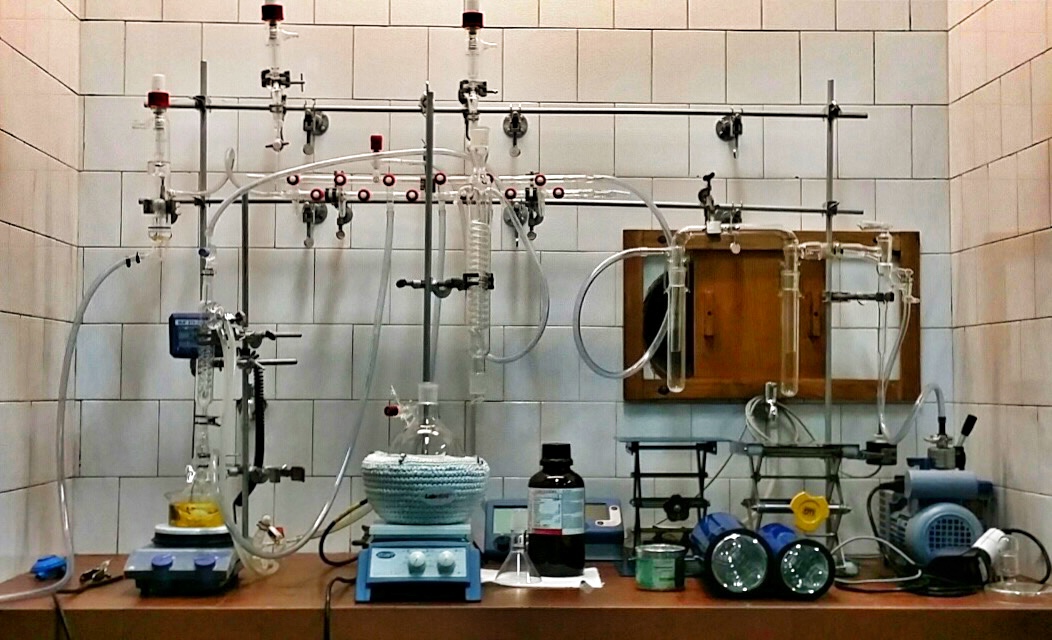
Laboratory cell-culture dishes demonstrate that the synthesized resin can melt, flow through an injection nozzle, and solidify into a transparent, structurally cohesive shape capable of supporting cellular adhesion without immediate acute toxicity. This is a standard baseline check for laboratory plastics and medical devices. However, engineering a commodity packaging plastic requires an entirely different set of performance verifications. Industrial resin conversion demands tight tolerances on melt flow index, flexural modulus, drop-impact resistance, and gas barrier properties.
Furthermore, packaging resins that contact consumables require rigorous migration testing under national and international regulatory frameworks. Modifying the styrene chain with reactive anhydrides and cleavable heteroatoms alters thermal stability and increases the probability of small-molecule leachates migrating into oily or acidic food simulants. Demonstrating that a material does not immediately kill cells in vitro is an encouraging preliminary result, but it sits years away from compliance with packaging migration standards.
Energetics, recovery, and the road to scale
Microwave-assisted synthesis is another reported development, but its scale-up energy advantage needs a full process comparison. The design is interesting because it creates an end-of-life option at the beginning. The next proof is useful recovery from realistic products, with compatible manufacturing economics and clearly defined treatment conditions.
Microwave heating often accelerates batch kinetics in research chemistry by providing rapid, volumetric thermal transfer without wall-temperature gradients. In high-throughput industrial chemical manufacturing, however, scaling microwave reactors introduces complex dielectric penetration limits, non-uniform field distributions, and safety management considerations. When evaluating overall sustainability, the energy saved during polymerization must be weighed against the thermal and catalytic demands of the downstream depolymerization step.
If the material enters mixed waste streams, sorting facilities using near-infrared (NIR) sensors may not distinguish this modified copolymer from standard polystyrene, contaminating existing mechanical recycling bales. Alternatively, if it requires dedicated chemical cleavage plants running proprietary catalysts or elevated temperatures, the logistical infrastructure must capture enough clean material to justify capital expenditures. The chemistry proves that targeted chain weakness can be integrated into styrene copolymers; now, chemical engineers must demonstrate that the recovered fragments yield usable products at realistic operating costs.
References and image credits›
Photo: Mk2010, CC BY-SA 3.0 · Photo: Shimbaleo, CC0, via Wikimedia Commons · Diagram: The Waste Stack · Photo: Miha Bukleski, CC BY 4.0