
Seventeen towers recover caesium and rubidium — from ore waste, not batteries
The reported recoveries are impressive; feedstock, solvent balances and independently checked operating data determine their meaning.
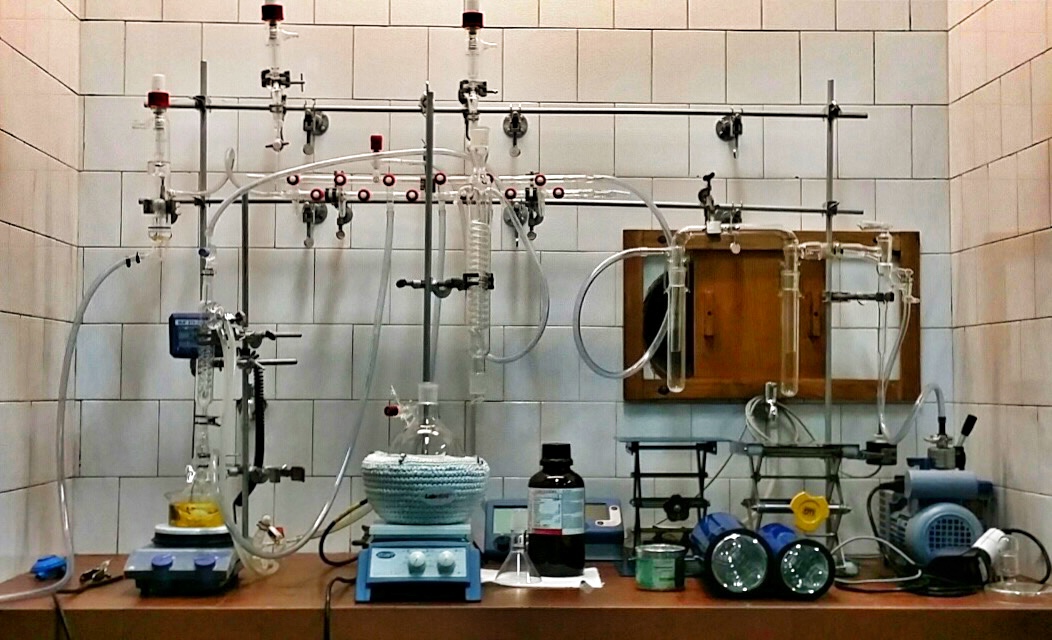
“Lithium waste” is an ambiguous headline. In contemporary industrial reporting, the term routinely conjures images of spent lithium-ion battery packs, shredded black mass, or hydrometallurgical recycling circuits designed to capture cobalt, nickel, and lithium carbonate from degraded cathode matrices. This project addresses a completely distinct segment of the supply chain: the residual solution from processing lithium-bearing lepidolite ore, not a pile of discarded lithium-ion batteries.
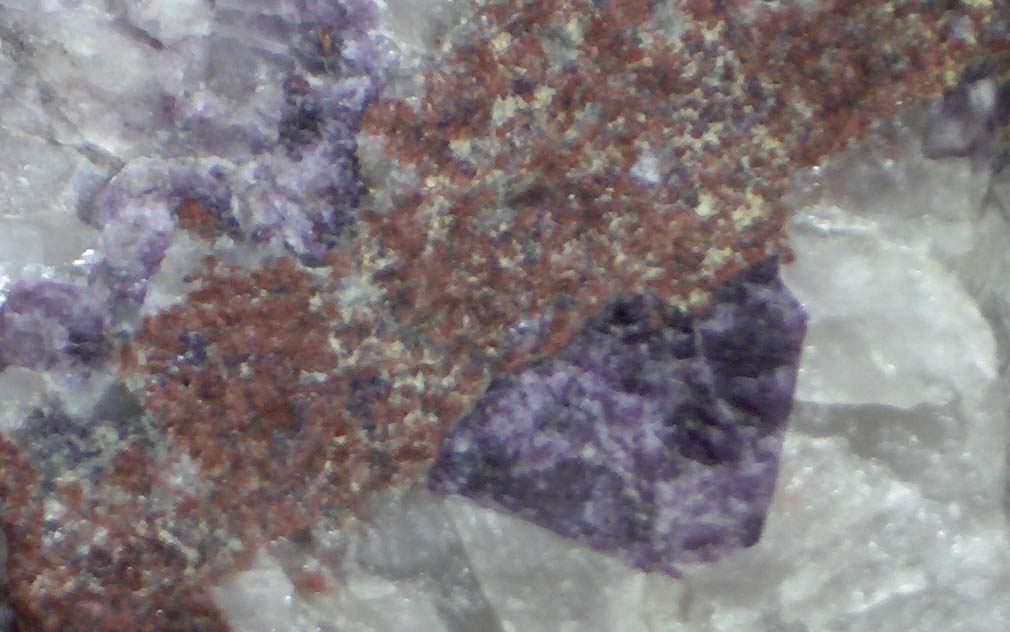
That distinction is far more than semantic. It defines which metals are available in the feedstock, what chemical interferences must be managed, and whether the underlying technology can realistically migrate to another waste stream. Hard-rock lithium ores such as lepidolite—a complex potassium-lithium aluminosilicate mineral—naturally carry minor quantities of other alkali metals that share physical and chemical properties with lithium. When miners roast and leach lepidolite to extract lithium, those trace alkali elements enter the liquid effluent. Calling the resulting effluent "lithium waste" obscures the reality that this is primary mining tailing liquor, rich in competing geogenic ions, rather than end-of-life electronic scrap.
The process demonstrates a universal closed-loop breakthrough for critical metal recovery from industrial lithium waste.
The system operates specifically on liquid tailings from Jiangxi lepidolite digestion; its chemical separation mechanisms cannot be directly transplanted into battery recycling or brines.
How the towers separate the metals
The Chinese Academy of Sciences describes a continuous extraction system developed with Ganfeng Lithium in Jiangxi. In hydrometallurgical operations of this scale, liquid-liquid extraction relies on counter-current contact: an aqueous mineral solution and an organic extractant move in opposing directions through vertical contactors. Chemical affinity transfers selected ions between phases, while successive stages improve separation.
Because caesium, rubidium, potassium, and sodium share identical outer-shell electron configurations and exhibit similar ionic hydration enthalpies, isolating them from one another in an aqueous matrix represents one of the most stubborn separation problems in industrial chemistry. Traditional precipitation techniques struggle with poor selectivity and generate bulky, contaminated sludges. Liquid-liquid extraction addresses this by pairing synthetic organic extractants—frequently functionalised crown ethers, calixarenes, or specialty organophosphates diluted in kerosene or aromatic diluents—with precise physical staging.
The reported seventeen towers cover extraction, scrubbing, stripping and de-oiling. Extracting a metal is only the first step: unwanted material must be washed away, the selected metal released from the extractant and the solvent managed for reuse. The products are caesium and rubidium carbonates.
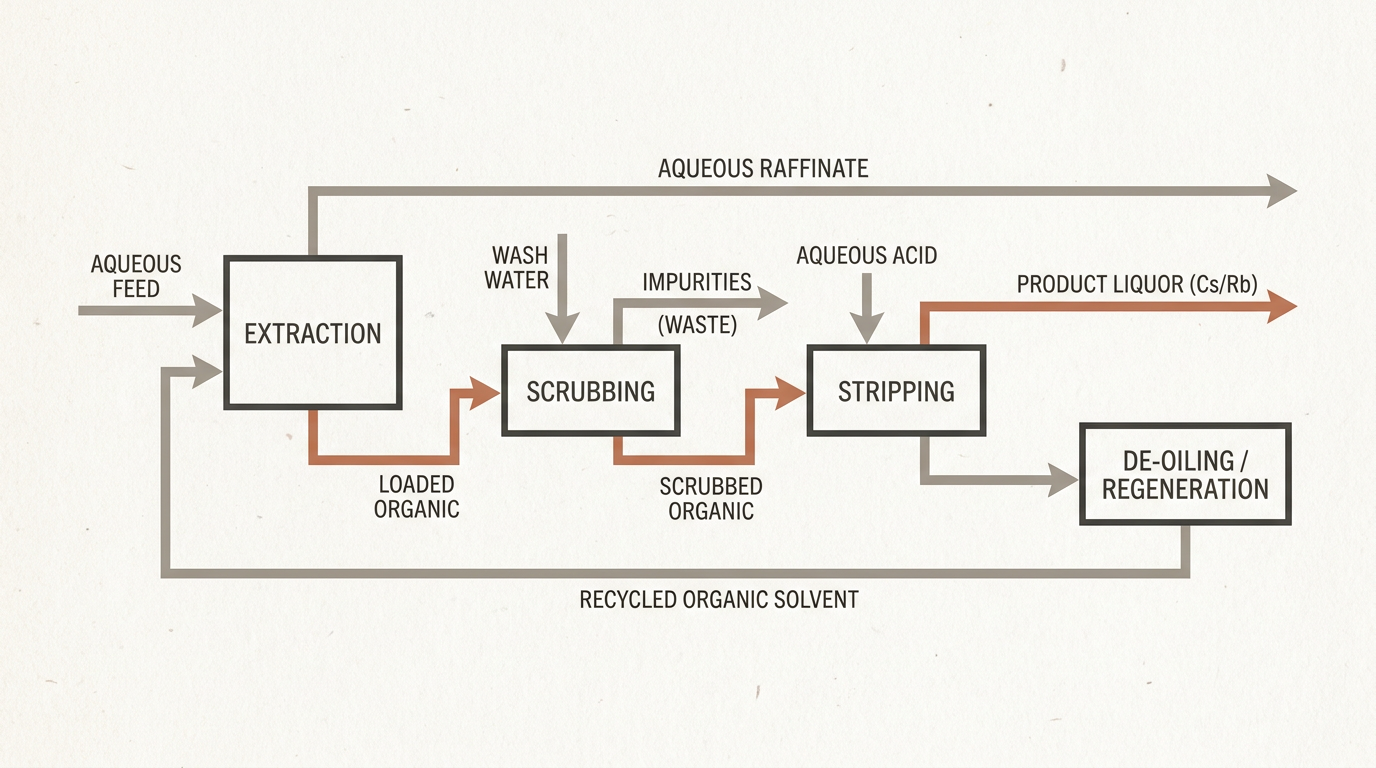
In the extraction stages, the barren organic phase meets the incoming aqueous tailing liquor, selectively binding caesium and rubidium cations into the organic complex. From there, the loaded organic stream moves into scrubbing towers, where mild wash liquors strip out weakly bound co-extracted contaminants, primarily residual potassium and sodium. Next, stripping towers treat the purified organic stream with dilute mineral acids or specialised aqueous stripping agents, reversing the thermodynamic equilibrium to force the caesium and rubidium back into a clean, concentrated aqueous phase. Finally, the organic carrier passes through de-oiling and solvent-regeneration towers to eliminate aqueous entrainment and solvent breakdown products before cycling back to the front of the cascade.
Recovery is not purity, and neither is capacity
Recovering high-value trace elements from mineral tailings does not neutralise the underlying environmental footprint of hard-rock lithium extraction.
The project reports over 98% caesium recovery, over 95% rubidium recovery and carbonate purity above 99.9%. Each figure answers a different question. Recovery measures how much of the target metal enters the product; purity measures what else is in that product. A stated combined capacity of 500 tonnes a year is not a measurement of actual annual sales or sustained output.
High recovery values simply indicate that very little of the metal originally present in the tailing stream escapes into the final barren aqueous effluent. This metric is driven primarily by the number of counter-current equilibrium stages in the extraction section: add enough contact volume and recirculation, and the recovery percentage rises. Purity, by contrast, is dictated by the selectivity of the scrub circuit. Achieving 99.9% purity in the final carbonate precipitates means that interference from competing alkali ions—principally potassium, which typically outnumbers rubidium and caesium by orders of magnitude in lepidolite—has been reduced to parts-per-thousand levels.
Furthermore, nameplate capacity represents peak theoretical engineering throughput under ideal feedstock composition and zero process downtime. In chemical processing plants handling complex leachates, sustained commercial production rarely mirrors nameplate limits. Fouling, solvent emulsion formation, fluctuations in mine-site ore grades, and planned maintenance cycles systematically erode operational output.
These figures come from project reporting. They should not be presented as independently audited performance or extrapolated to global mineral supply.
The unanswered balance
The extractant chemistry, solvent losses, energy demand and remaining wastewater burden matter as much as tower count. Recovering a valuable minority component does not automatically make the rest of the lithium process environmentally benign.
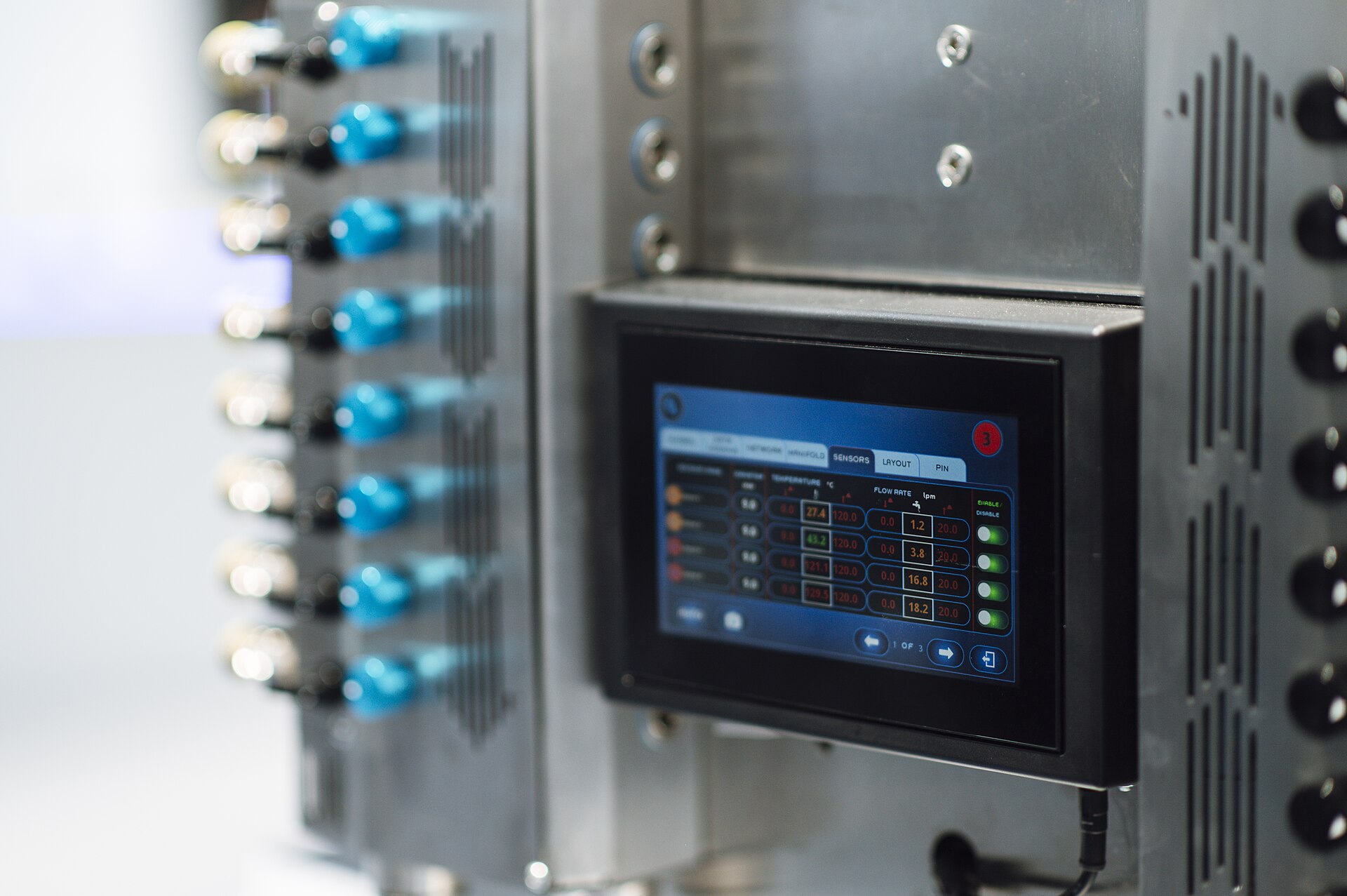
Solvent extraction systems are notorious for operational vulnerabilities that rarely appear in initial press releases. Organic extractants, especially specialised macrocyclic molecules engineered to match the ionic radii of rubidium and caesium, are expensive to manufacture and degrade over time under exposure to acidic solutions, trace oxidants, and mechanical shear. Trace solubility of these organic carriers in the outgoing aqueous raffinate presents both an economic liability—through continuous solvent make-up costs—and an environmental hazard, as solvent-contaminated wastewater must undergo advanced oxidation or carbon adsorption before discharge.
Thermal and chemical mass balances also remain opaque. Converting stripped caesium and rubidium chlorides or sulphates into 99.9% pure carbonates involves substantial chemical consumption, including carbonate precipitating agents, washing stages, and energy-intensive crystallisers. The remaining volume of the lepidolite tailing—millions of tonnes of silica, alumina, and fluoride-bearing residues generated by Chinese processing hubs—remains an unresolved solid-waste liability, regardless of how thoroughly rubidium and caesium are skimmed from the liquid phase.
The claim is stronger than a bench experiment if commercial batches are being sold, as reported. The next evidence to ask for is a sustained operating balance: input composition, output split, product quality, losses and waste treatment. This is a specialised ore-processing recovery loop, not a universal battery-recycling breakthrough.
References and image credits›
Photo: Miha Bukleski, CC BY 4.0 · Diagram: The Waste Stack · Photo: Mike Beauregard, CC BY 2.0 · Photo: Shixart1985, Wikimedia Commons, CC BY 2.0