
Methane to succinate: why LLNL puts bacteria in a printed scaffold
A porous support tackles gas transfer, but a one-litre demonstration is not a landfill-ready chemical plant.
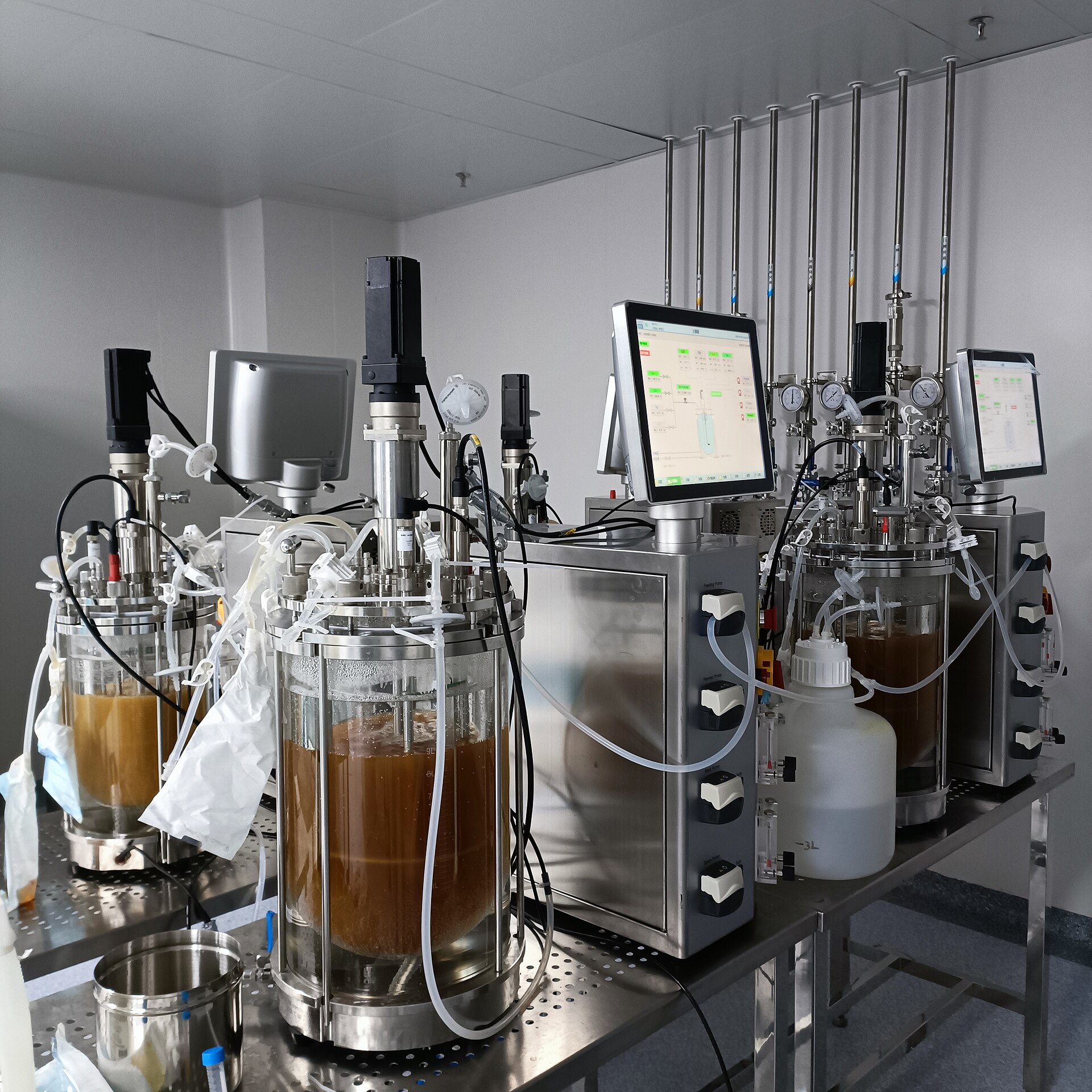
Methane is a useful feedstock only if it reaches the organism doing the conversion. That sounds obvious, but it is the central engineering difficulty in methane fermentation: the gas dissolves poorly in water. A stirred broth spends energy trying to bring bubbles and cells together.
In standard aerobic bioprocesses, gases such as oxygen and methane must dissolve across the gas-liquid interface before cells suspended in the liquid medium can take them up. Henry's law governs this transfer, dictating that methane has exceptionally low aqueous solubility under ambient conditions. Industrial fermenters typically try to overcome this physical barrier by using high-shear mechanical impellers, fine-bubble spargers, or elevated head pressure. While these interventions shear gas bubbles into smaller diameters to increase the specific surface area, they demand substantial mechanical power. A significant fraction of operating expenditure in conventional gas fermentation is spent simply forcing inert, sparingly soluble gas bubbles through dense aqueous columns, generating waste heat rather than product.
Move the cells closer to the gas
Lawrence Livermore researchers describe immobilising methane-consuming bacteria in hydrogel supported by a 3D-printed lattice. Thin scaffold walls provide a large contact area. Gas can move through the lattice instead of depending entirely on transport through a deep, stirred liquid volume.
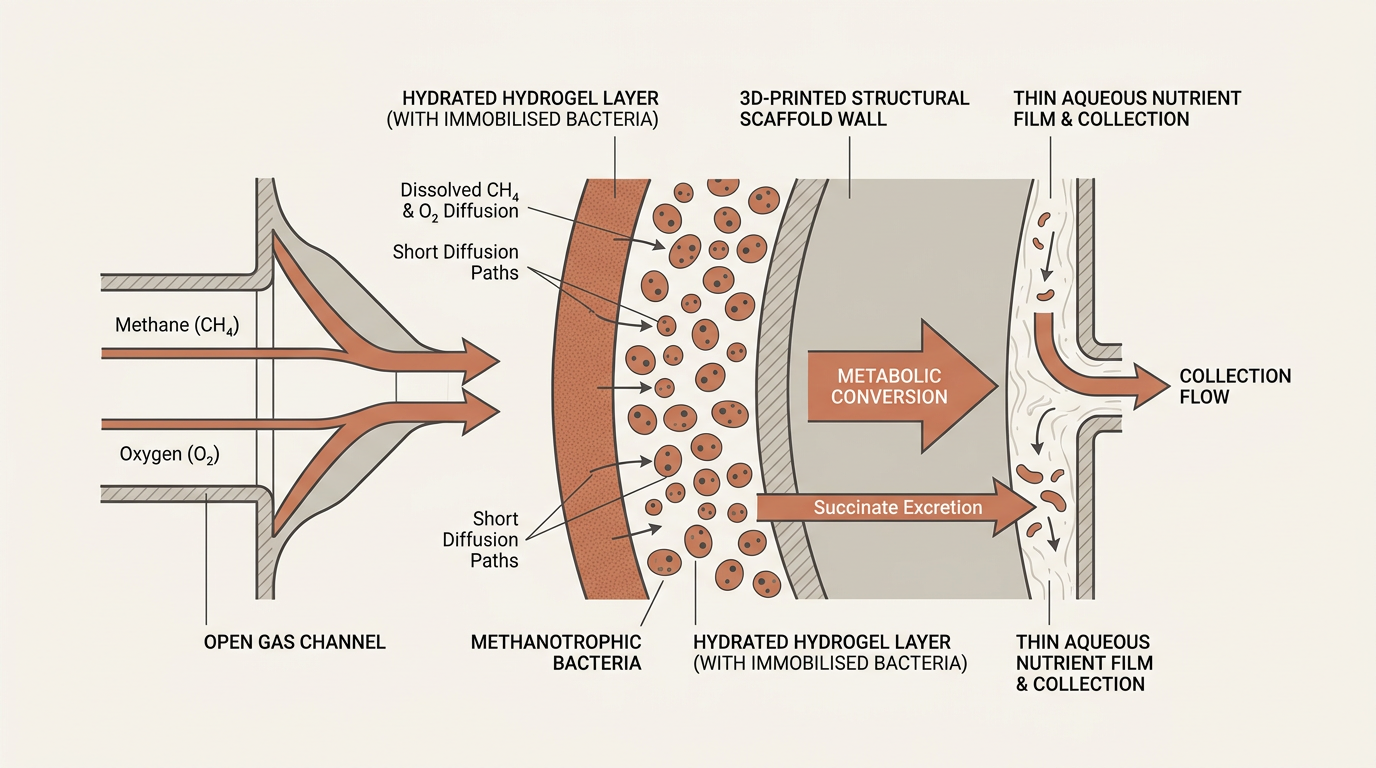
This does not mean bacteria no longer need water or that methane skips every diffusion step. Cells remain in a hydrated environment; the design shortens the transport path. Methanotrophs metabolise the methane and the system is configured to produce succinate, a chemical feedstock used in several industries.
Hydrogels act as a protective, water-rich matrix that supports biological function while remaining stationary relative to the gas channels. By confining the aqueous phase to a micro-scale boundary layer on a rigid, printed polymeric skeleton, the design bypasses bulk liquid resistance entirely. Rather than diffusing across tens of centimetres of agitated broth, methane gas flows through open void networks within the printed lattice. The molecules only have to travel across microscopic diffusion distances to reach the active bacterial metabolic sites.
What the reported improvement means
The report describes performance more than ten times that of its liquid-system comparison and a scale-up from millilitres to one litre. That is evidence for the reactor architecture, not evidence that ten times more revenue or ten times less energy follows at industrial scale. Those conclusions need conversion, product concentration, recovery and energy data on consistent boundaries.
When laboratory researchers report order-of-magnitude improvements in volumetric productivity, the baseline against which they measure matters immensely. Standard shake flasks or unoptimised stirred-tank reactors are notoriously poor performers for methane mass transfer. Improving upon an inefficient baseline by an order of magnitude confirms that the printed geometry resolves diffusion bottlenecks in a confined space. It does not, however, prove that a cubic-metre-scale facility will yield identical performance per unit volume.
Furthermore, high volumetric productivity inside a reactor cell does not automatically equate to process efficiency. In bioprocessing, titre, yield, and rate exist in constant operational tension. If high conversion yields dilute product streams, the energy saved by eliminating mechanical stirrers can easily be surrendered downstream during chemical concentration and purification.
Mass transport physics versus metabolic limits
Methanotrophic bacteria rely on the methane monooxygenase enzyme system to cleave the exceptionally strong carbon-hydrogen bonds in methane. This enzymatic conversion requires molecular oxygen in addition to methane, introducing a delicate gas mixing challenge into reactor design. Supplying both methane and oxygen simultaneously into a single vessel introduces both safety considerations regarding flammability limits and biological competition for active mass transfer areas.
A porous 3D-printed hydrogel scaffold fundamentally eliminates mass transfer limits, enabling commercial-scale biogas upgrading in modular units.
The scaffold shortens the diffusion path across the liquid boundary layer, but volumetric scale-up, long-term matrix fouling, and downstream separation economics remain unproven.
Immobilisation changes how bacterial cells behave over time. While suspended cells are constantly diluted, harvested, or replenished in continuous stirred tanks, immobilised bacteria reside permanently within the printed hydrogel matrix. This stability protects cells against mechanical shear, but it introduces issues with nutrient diffusion, metabolic waste clearance, and biomass accumulation. If dead cell mass or extracellular polymeric substances accumulate inside the printed pores, the carefully calculated void fractions will close, degrading gas transfer rates over extended operating runs.
A reactor still needs a whole process
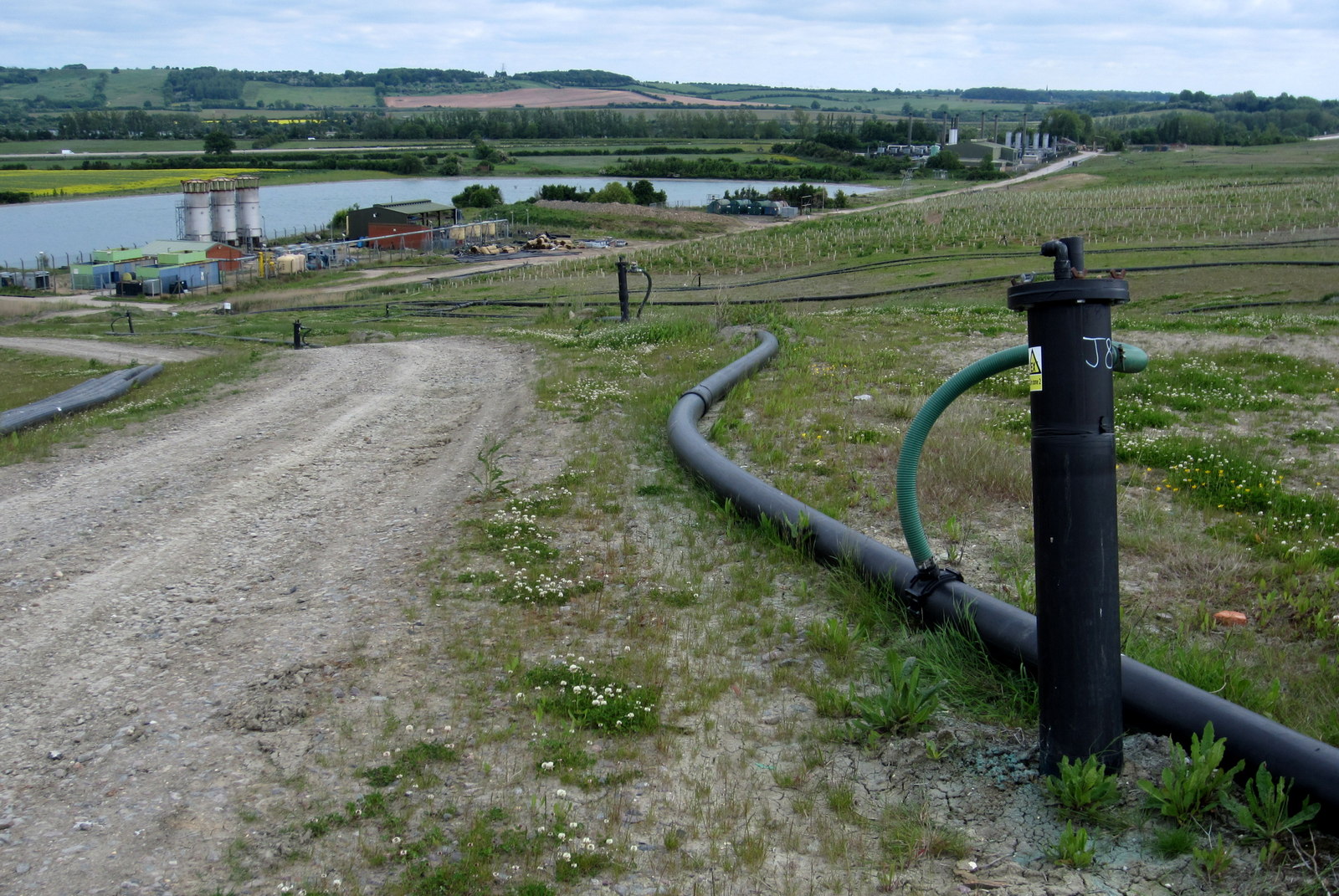
Landfill gas is not a laboratory methane bottle. Flow and composition fluctuate; contaminants require attention. The biology also needs nutrients, appropriate oxygen management and reliable long-term cell viability. A useful succinate stream must be separated and purified after production.
Raw landfill gas typically emerges from decaying municipal waste as a complex blend: roughly half methane, half carbon dioxide, saturated with water vapour, and laced with hydrogen sulphide, siloxanes, and volatile organic compounds. Methanotrophs are delicate biocatalysts that can be inhibited or poisoned by trace sulphides and halogenated species. Any realistic deployment requires an upstream gas scrubbing train to remove these poisons before they coat the hydrogel or kill the culture.
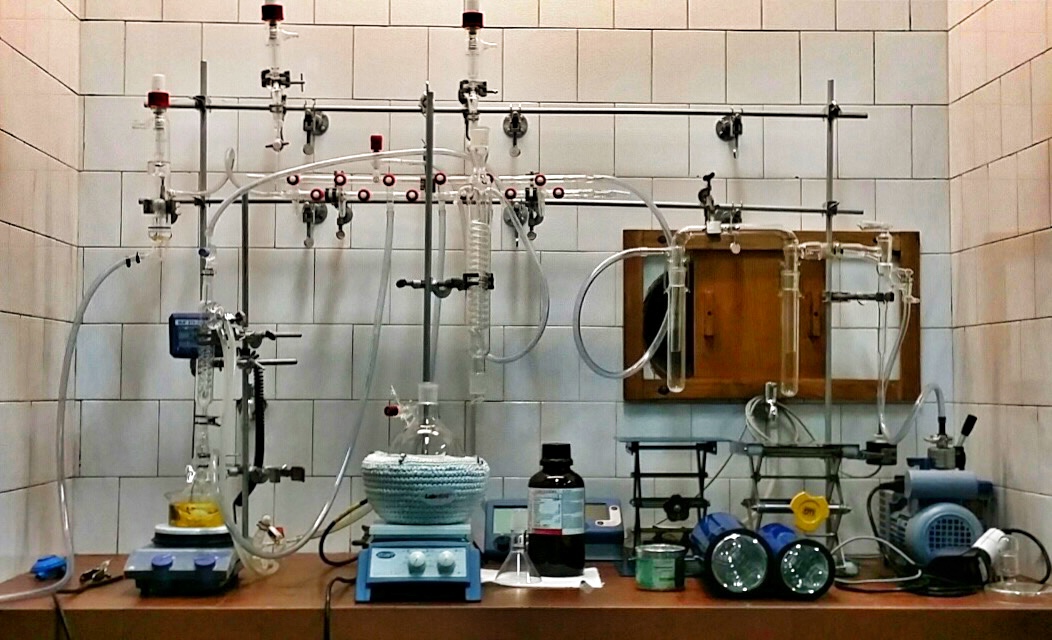
Downstream processing presents an equally formidable challenge. Succinate—a versatile dicarboxylic acid used to manufacture bioplastics, solvents, and polymers—must be recovered from the effluent liquid. Because succinate is produced at near-neutral pH as a succinate salt, acidification, filtration, chromatography, and crystallization are necessary to recover high-purity succinic acid. If the concentration of succinate exiting the lattice reactor is dilute, the thermal energy demanded by evaporation and distillation will dwarf the carbon benefits of capturing fugitive landfill methane.
The path beyond laboratory demonstration
Replacing flaring could be valuable at sites too small for conventional gas infrastructure. But the next milestone is sustained operation with representative waste gas and a complete product balance. A litre-scale scaffold demonstrates a mechanism; a working landfill installation must demonstrate uptime, product quality and costs.
Small-scale or remote landfills often generate volumes of methane that are insufficient to justify connection to a high-pressure natural gas transmission grid or the installation of expensive combined heat and power engines. At these sites, gas is simply flared into the atmosphere to avoid unmitigated fugitive emissions. Deploying containerised, low-power bioconversion units that consume low-pressure, low-quality gas to produce transportable chemical intermediates like succinate is an attractive distributed manufacturing vision.
Yet transitioning from a pristine one-litre laboratory column fed on synthetic gas mixtures to an outdoor skid operating through freeze-thaw cycles on fluctuating biogas requires overcoming practical engineering barriers. The structural durability of printed hydrogels under hydraulic stress, resistance to biofouling, and parasitic electrical loads from auxiliary pumps and chillers must all be quantified. Demonstrating the physics of shortened diffusion paths is an essential first chapter, but industrial engineering requires proving that the system can run continuously for thousands of hours without losing its printed architecture or poisoning its bacterial workforce.
References and image credits›
Photo: Habin Zhang, Wikimedia Commons, CC BY-SA 4.0 · Diagram: The Waste Stack · Photo: via Wikimedia Commons, CC BY-SA · Photo: Miha Bukleski, CC BY 4.0