
India’s e-waste tax notice: paperwork is not a material balance
Reported allegations involving appliance companies reveal why invoices, recycling certificates and physical processing need separate verification.
A recycling invoice records a transaction. It does not independently establish that a truck arrived, a machine ran or recovered materials reached a legitimate buyer. That separation sits at the centre of reported Indian tax-authority allegations involving Haier, Godrej & Boyce and Blue Star.
In circular economy regulation, it is common to treat documentation as a proxy for physical conversion. A certificate is stamped, an invoice is settled, and an input tax credit is claimed. Yet in metallurgical and mechanical processing, material balance is governed by physical conservation laws rather than ledger accounting. When tax authorities scrutinise the paper trail of waste management, they frequently reveal a basic operational disconnect: legal instruments and accounting vouchers can circulate entirely independently of the heavy, dirty work of shredding, sorting and refining electronic scrap.
What the report alleges
Reuters reports that investigators questioned roughly $714,000 in input tax credits for recycling services they said had not been performed, with recycler photographs and documentation allegedly fabricated. These are attributed allegations in a tax notice, not a finding here of criminal guilt. The notice and any responses or subsequent decisions must be distinguished.
According to the reporting, tax authorities flagged discrepancies where manufacturers claimed goods and services tax (GST) input tax credits on fees paid to contracted recyclers. The core of the allegation is that the underlying processing never occurred at the stated scale, leaving the financial paperwork unsupported by actual physical operations. In industrial taxation, claiming an input tax credit requires an underlying supply of goods or services; if the service was fictitious, the tax credit is invalid.
A valid commercial invoice and photographic records demonstrate that electronic waste was dismantled and recycled.
An invoice confirms only that a financial transaction took place; without mass reconciliation and utility cross-checks, paperwork and staged photographs can exist without any physical processing.
India’s producer-responsibility system gives recycling documentation commercial significance. However, a GST input tax credit and an EPR recycling certificate are not the same instrument. A story about one should not imply that authorities have conclusively invalidated every related environmental obligation. The two systems run on parallel tracks: tax authorities evaluate revenue flows and service authenticity, whereas pollution control boards monitor environmental compliance targets. Yet both systems rely on the same foundational premise—that the recycler actually handled the tonnage claimed.
The anatomy of paper recycling
Fabricating an invoice costs pennies in administration, whereas mechanically processing mixed electronic scrap incurs immediate, non-negotiable energy, labour and disposal costs.
Why does waste management generate paperwork that drifts away from physical reality? The answer lies in the cost structure of genuine e-waste recycling. De-manufacturing a refrigerator, air conditioner or washing machine is labour-intensive and mechanically demanding. Hazardous fractions, such as polyurethane foam blown with ozone-depleting substances, refrigerants, mercury switches and leaded glass, carry net disposal costs. Mechanical separation of complex electronic assemblies yields low-margin plastics and mixed metals that require capital-intensive downstream refining.
By contrast, producing synthetic documentation costs virtually nothing. When producers are mandated to demonstrate compliance, or when contracted service fees unlock corporate tax deductions and input credits, paperwork acquires immediate cash value. If regulatory enforcement inspects filed forms rather than operating facilities, a market incentive emerges to trade documents rather than scrap.
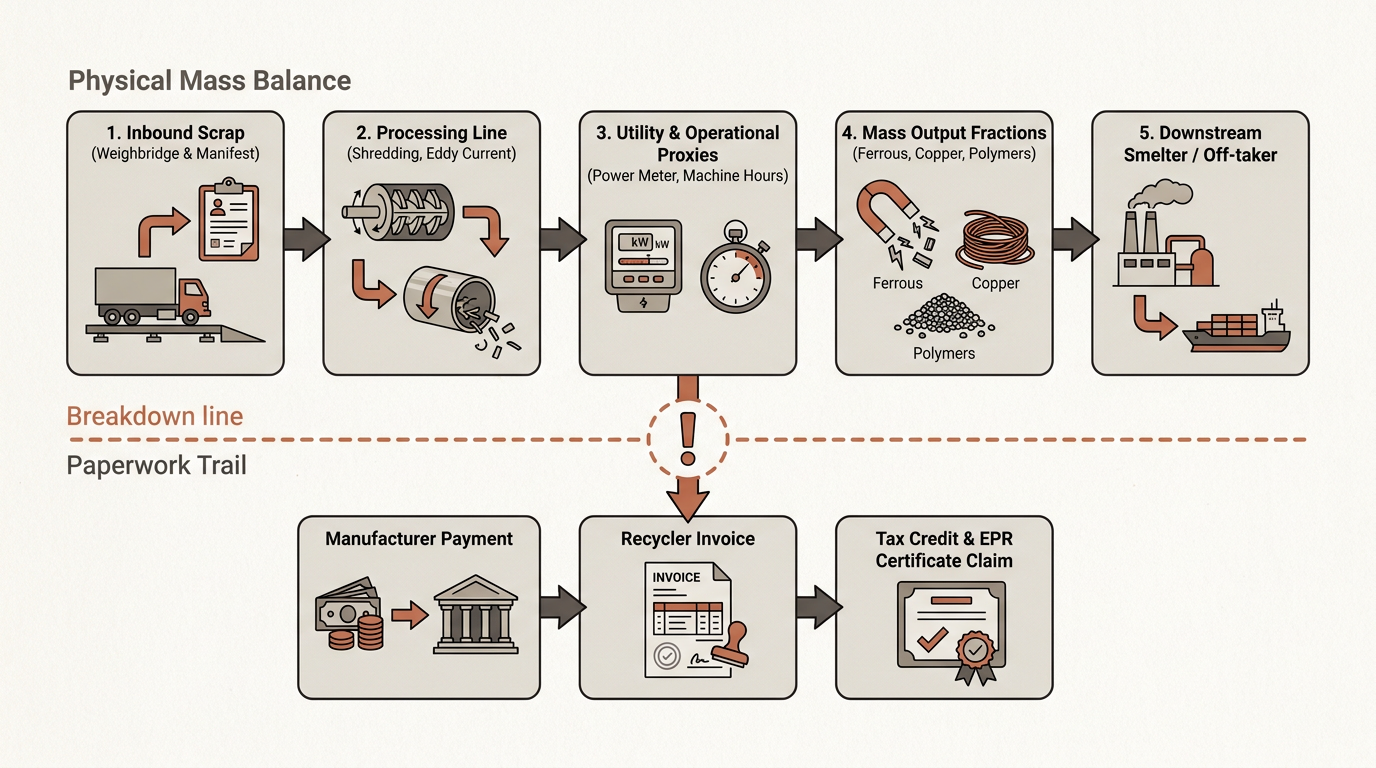
This structural tension exposes why statutory circularity fails when compliance is divorced from process engineering. In a functional industrial operation, mass in must equal mass out plus internal inventory accumulation and unavoidable losses. A document-only system bypasses conservation of mass entirely.
Follow the physical chain
Credible verification starts with incoming weights and identifiable shipments. It continues through processing records, equipment capacity, power use, residual waste and sales of recovered fractions. The figures should reconcile: a facility cannot consistently sell more recovered metal than its inputs could contain.
To establish whether recycling actually took place, an auditor must follow thermodynamic and material proxies rather than accounting stamps:
- Weighbridge and logistics cross-referencing: Incoming manifest weights must correspond to licensed transport vehicles whose registered payload capacities match the reported tonnage. Discrepancies between vehicle tare weights, gross weights and transit permits are the first indicator of synthetic records.
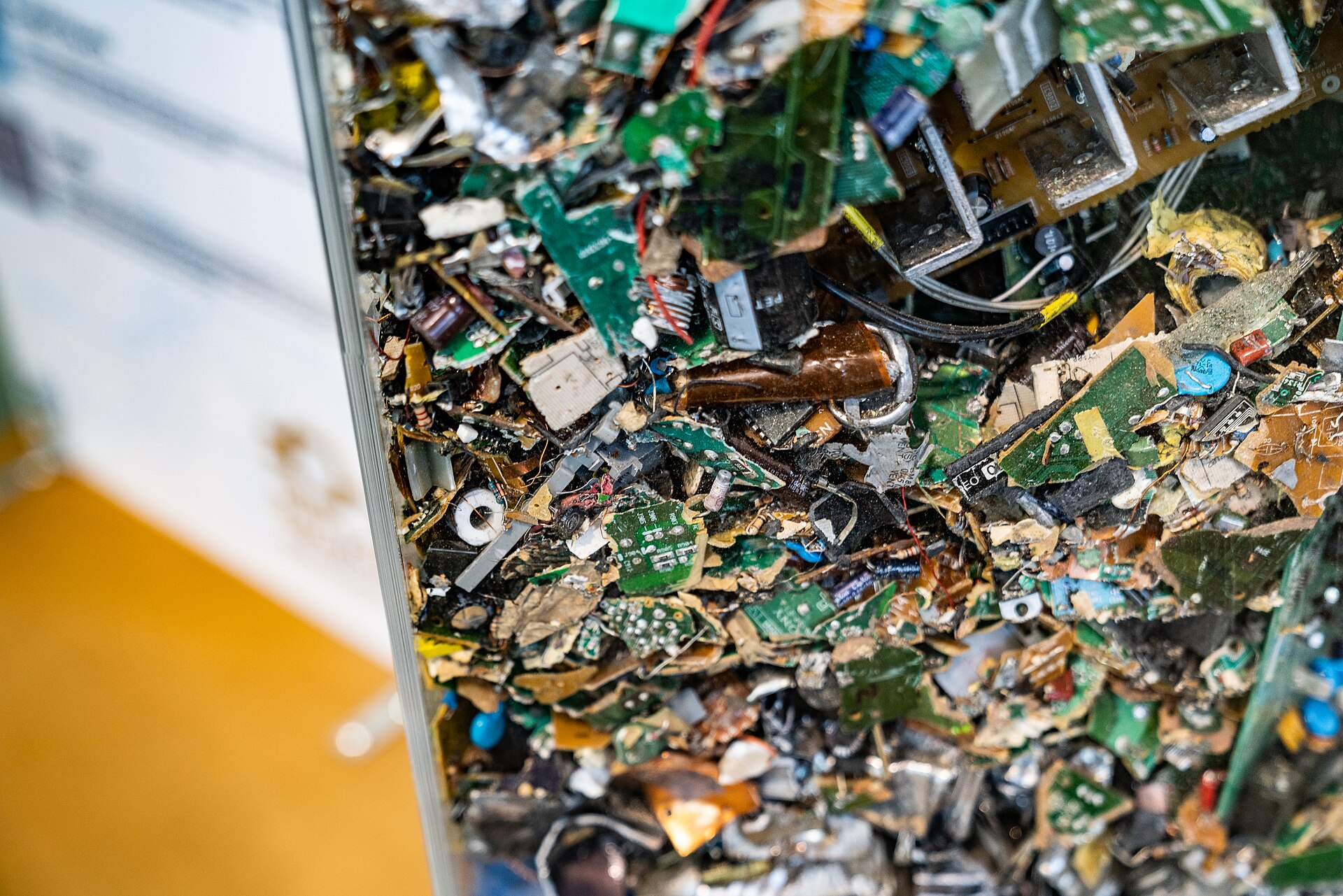
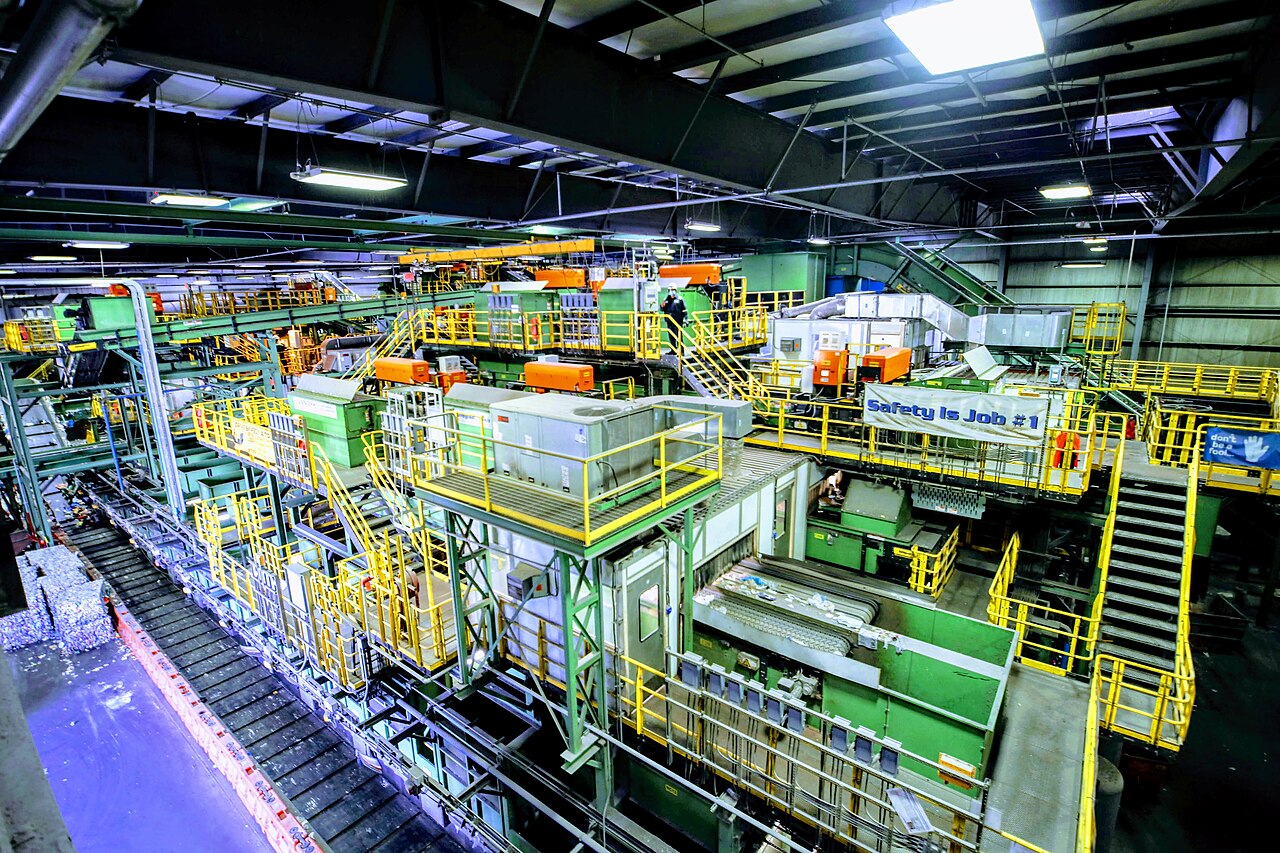
- Energy consumption benchmarks: Mechanical comminution—running hammer mills, shredders, magnetic separators and eddy-current systems—requires substantial electrical power. A shredding line cannot process hundreds of tonnes of dense white goods without showing commensurate kilowatt-hour spikes on utility meters.
- Mass balance reconciliation: White goods consist of predictable proportions of mild steel, copper, aluminium, mixed polymers and non-recyclable residues. If a facility reports processing discarded cooling equipment but records zero hazardous refrigerant capture or hazardous waste disposal manifests, the material balance fails.
- Downstream off-take validation: Shredded fractions do not disappear. Recycled copper and steel must be traceable to foundries, smelting operations or secondary converters with matching financial and physical ledgers.
Photographs can support inspection, but they are weak evidence on their own. Independent visits, dated records and checks for repeated or double-counted shipments offer stronger assurance. A digital ledger cannot make a fabricated weighbridge ticket true.
Staged site photographs have become notorious across environmental compliance monitoring. Taking a picture of a full warehouse, or posing equipment against a conveyor belt, proves only that machinery exists at a given coordinate. It does not establish continuous throughput or link that machinery to a specific producer's obligations.
Regulatory bottlenecks and verification gaps
An environmental audit that relies on invoices without checking electrical utility bills and weighbridge calibration is merely proof of financial literacy, not recycling.
The enforcement gap highlighted by tax inquiries illustrates a broader engineering bottleneck in environmental governance. Environmental agencies often lack the forensic resources to audit physical mass balances across hundreds of registered facilities. Tax authorities, conversely, possess deep forensic tools for tracing invoice chains and banking records, but rarely possess process-engineering expertise.
When compliance mechanisms rely entirely on self-declared certifications, fraudsters exploit the jurisdictional seam between environmental rules and tax codes. Producers outsource compliance to intermediary agencies or aggregators, who in turn contract registered recyclers. If the producer treats the certificate as a pure liability shield and exercises no physical chain-of-custody oversight, paper compliance flourishes while untreated waste leaks into informal scrap markets where open-air burning and acid leaching cause severe local contamination.
What this case does not prove
The reported amount does not establish the size of nationwide fraud. Nor does one investigation show that every certified recycler is dishonest. Generalising beyond the evidence would undermine the same accountability the article is asking for.
India has legitimate, highly capitalised recycling operators operating modern shredding and separation lines with rigorous mass tracking. Tarring an entire emerging industrial sector on the basis of a specific tax investigation obscures the distinction between compliant recyclers investing in genuine engineering infrastructure and paper traders exploiting enforcement loopholes.
The policy lesson is narrower and practical: producer compliance should connect financial records to physical flows and verified outputs. Certification establishes eligibility; ongoing reconciliation tests whether the claimed work actually happened.
References and image credits›
Photo: Syced, CC0, via Wikimedia Commons · Diagram: The Waste Stack · Photo: Tony Webster, CC BY 2.0 · Photo: CaptJayRuffins, CC BY-SA 4.0, via Wikimedia Commons