
Magnetic Microrobots for Microplastics: What the Numbers Actually Show
A magnetically driven MXene microrobot removes most microplastic particles from water and rather less from soil. The recovery figures are real; the retrieval and leaching questions are the ones that decide whether it ever leaves the lab.
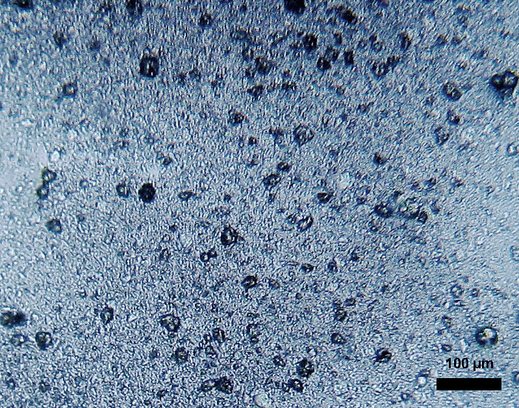
Microplastic removal has a shape problem. The particles are small, chemically varied, and spread through media that resist filtration — river water, sediment, agricultural soil. Filtration works where you can force everything through a barrier. Most contaminated environments do not let you do that.
The approach here is different: send the separator to the particle. Researchers built micrometre-scale robots from MXene — a layered two-dimensional carbide — coated with nickel so they can be steered by an external magnetic field. Plastic particles adsorb onto the surface. Move the field, and the robots carry their cargo out.
What was measured
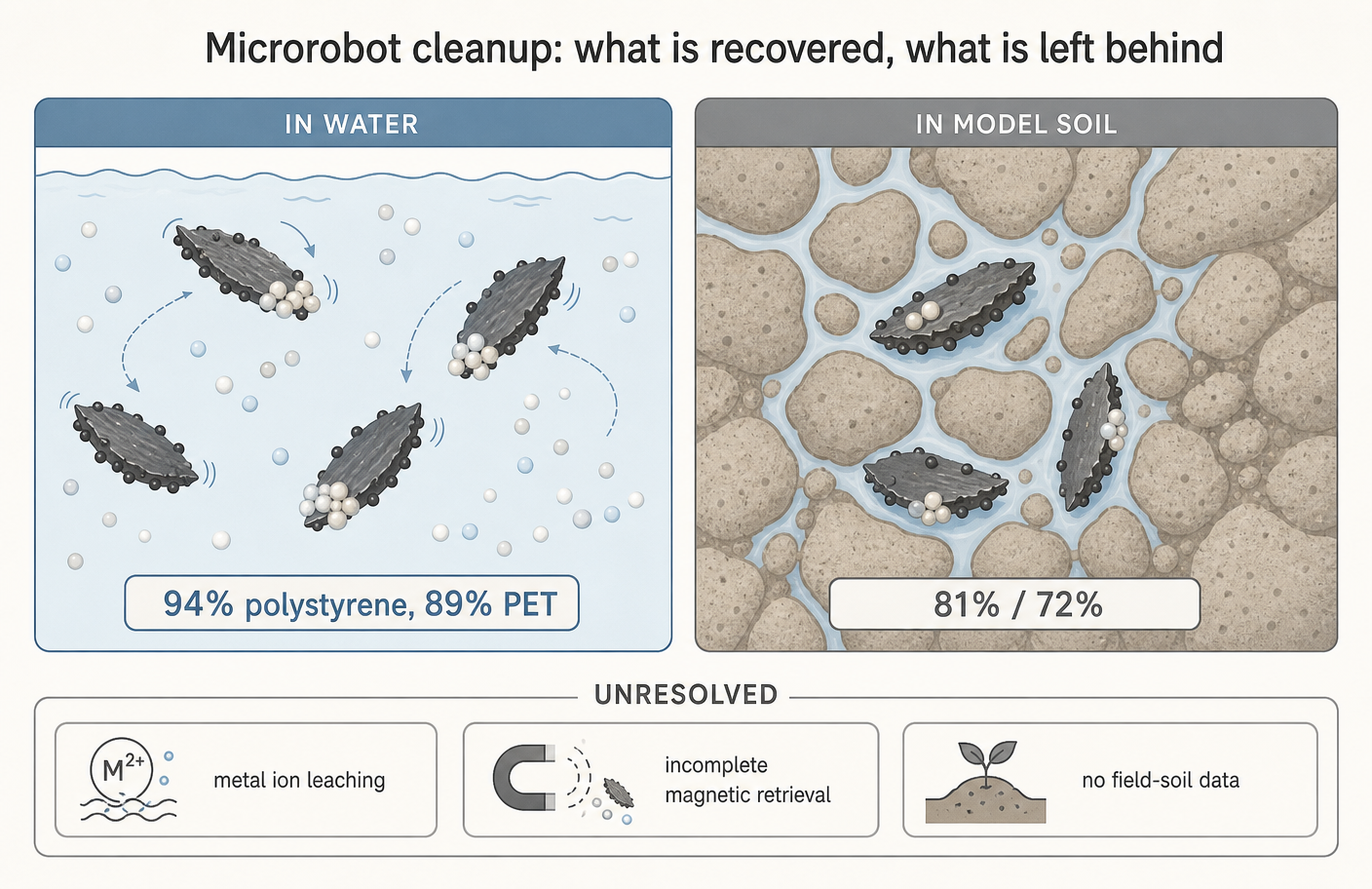
In water, the reported removals were 94% for polystyrene and 89% for PET. In a model soil, the same system fell to 81% and 72%. That drop is the interesting number, not the headline one. Soil is a porous solid; the robots have to travel through water-filled pore spaces, which restricts both movement and contact.
Why MXene
MXenes have very high surface area per unit mass and a surface chemistry that binds organic material readily. That is what makes adsorption fast. The nickel layer is what makes the particle steerable — without it there is no way to collect the robots again, and an uncollected microrobot is just another engineered particle in the environment.
That is the loop that has to close. Removal efficiency describes how much plastic attaches. It does not describe how much of the robot population comes back out.
The unresolved parts
Three things are missing from the published picture.
Metal ion leaching. Nickel and the MXene itself can release ions under environmental conditions. Nobody has published long-term leaching data for this system in soil.
Retrieval fraction. Magnetic collection is efficient in a beaker. In a field with heterogeneous soil, root systems and variable moisture, it is not.
Field soil. A model soil is graded, clean and reproducible. Real agricultural soil has organic matter, clay fractions and competing adsorbates that will occupy the same binding sites the plastic uses.
Where this could actually be useful
The realistic near-term application is not open environments. It is contained ones: process water in a treatment plant, wash water from textile manufacturing, effluent from plastics processing. Contained volumes give you a boundary, a retention time, and a place to put a magnet. That is a much easier engineering problem than a field, and it intercepts microplastics before they disperse.
Soil remediation is the harder claim, and the 81%/72% figures should be read as a demonstration that the mechanism works in porous media, not as a remediation performance figure.
References and image credits›
- 01MXene-based magnetic microrobots for microplastic removal — research summary
- 02Microplastics in agricultural soils — FAO assessment
Photo: Dantor, CC BY-SA 3.0, via Wikimedia Commons · Photo: DayakSibiriak, CC BY-SA 4.0