
Toray’s recovered carbon fibre: strong filaments are not a new aircraft wing
Chemical resin removal can protect fibre quality, but short-fibre products and structural composites answer different engineering questions.
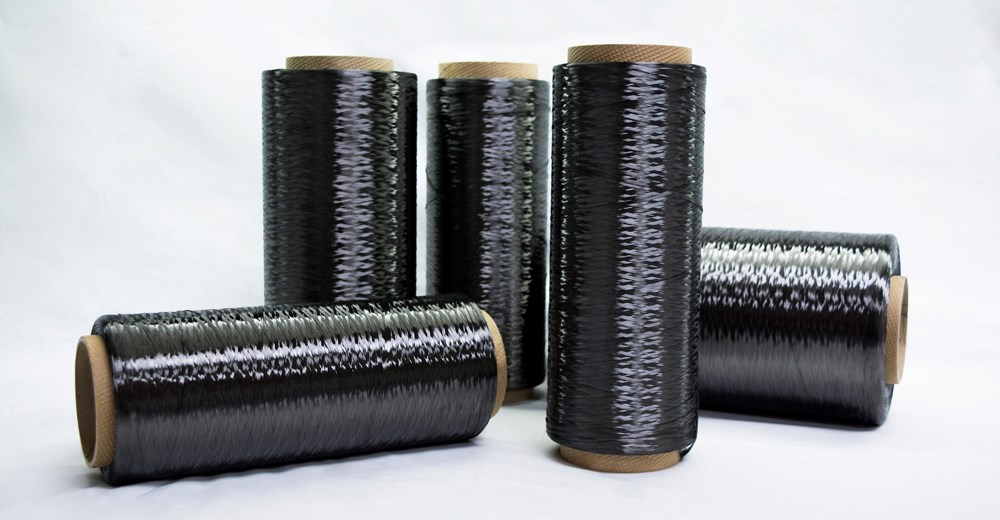
Carbon-fibre composites combine valuable reinforcing fibres with a polymer matrix. In thermoset composites the resin is crosslinked: heating does not simply melt it back into a mouldable liquid. Recycling must separate or break down the matrix while protecting the reinforcement.
The chemical bind of thermoset composites
The fundamental engineering paradox of carbon-fibre reinforced polymers (CFRP) lies in their durability. To construct lightweight, fatigue-resistant structures such as primary aerostructures, wind turbine blades, and pressure vessels, manufacturers embed high-modulus, high-tensile carbon filaments within a thermosetting polymer network—most commonly an epoxy. During manufacturing, curing agents trigger irreversible covalent crosslinking across the polymer chains. This three-dimensional molecular lattice provides superior chemical resistance, shear strength, and thermal stability.
However, that same chemical recalcitrance renders the composite virtually un-meltable at end-of-life. Unlike thermoplastics, which soften under thermal energy and can theoretically be re-extruded or re-moulded, a thermoset undergoes thermal degradation before it will flow. Historically, treating composite waste has defaulted to mechanical shredding or high-temperature thermal pyrolysis.
Mechanical grinding breaks the cured composite into short, low-value filler fragments where fibre lengths are severely degraded and resin remains clinging to filament surfaces. Pyrolysis, operating typically between 450°C and 700°C in an oxygen-depleted atmosphere, volatilises the resin matrix into gases and pyrolysis oil, leaving dry carbon fibres behind. Yet thermal recovery introduces significant penalties: high energy consumption, filament surface oxidation, the deposition of amorphous carbon char on fibre walls, and a notable reduction in filament tensile strength.
Attack the resin, preserve the fibre
Toray describes a chemical decomposition agent that breaks down thermosetting resin at lower temperatures than conventional thermal routes. The intended advantage is less damage and less residual resin on recovered fibre surfaces.
Reported single-fibre tensile tests show retention above 95% relative to virgin fibre. This is a meaningful material-quality measure, but it is one test on one component. It does not mean a recycled composite retains 95% of every structural property.
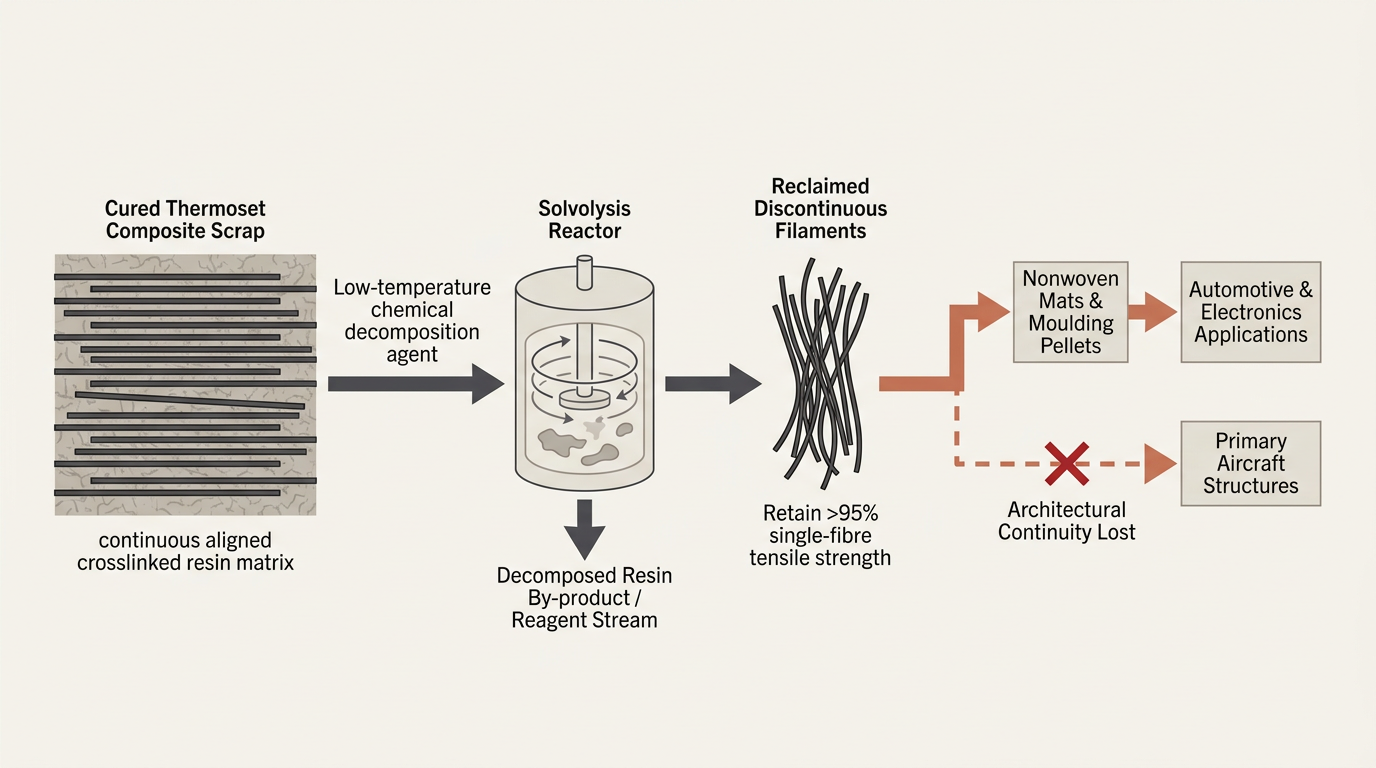
Chemical solvolysis or depolymerisation targets the ester, ether, or amine linkages within the cured resin backbone. By operating at reduced temperatures and moderate pressures, a selective chemical decomposition agent cleaves the matrix macromolecules without inflicting thermal etching or structural defect sites onto the graphitic crystal structure of the underlying polyacrylonitrile (PAN)-derived carbon fibres. Preserving filament integrity avoids the microcracking and surface pitting that typically degrade tensile performance during kiln-based pyrolysis.
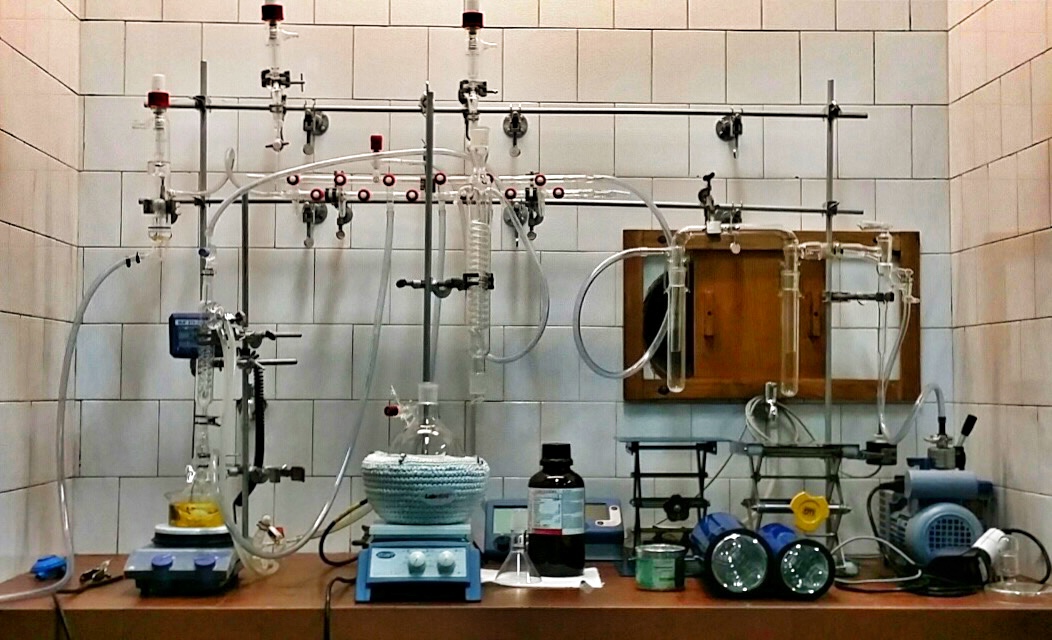
Yet retaining constituent filament tensile strength is only the initial technical hurdle. When resin is chemically cleaved, the original surface treatment—the thin polymeric sizing applied during primary filament production to promote adhesion with specific epoxy chemistries—is stripped away alongside the matrix. Without a tailored sizing re-applied to the recovered fibres, load transfer between the reclaimed filaments and a secondary polymer matrix cannot be guaranteed.
Geometry is part of performance
A continuous aligned fibre in an aircraft laminate behaves differently from short fibres dispersed into a nonwoven sheet. Length, orientation, surface treatment and the new resin interface affect stiffness, impact response and interlaminar behaviour. Strong recovered filaments can therefore produce a useful product without replacing their original application.
Reclaiming carbon filaments with >95% virgin tensile strength allows direct closed-loop replacement of primary aerospace composite structures.
Bulk composite performance depends on continuous fibre alignment, surface sizing chemistry, and void-free resin wet-out, meaning recycled nonwovens serve entirely different mechanical specifications in lower-stress components.
Primary aerospace laminates derive their extreme mechanical properties from continuous, unidirectional filament collimation. Tensile and compressive loads travel along perfectly straight carbon paths held tightly within structural ply architectures. When composite scrap—such as cured edge trimmings or retired components—enters a chemical recovery reactor, the architectural continuity is lost. The recovered filaments emerge as disordered, tangled masses or chopped bundles rather than continuous roving spools.
Converting these recovered filaments into a secondary material typically requires wet-laid or dry-laid nonwoven mat formation. In a nonwoven mat, fibre orientations are essentially planar-isotropic or quasi-random, and individual fibre lengths are necessarily truncated. Even if individual filaments retain over 95% of their initial tensile capacity, a nonwoven composite will exhibit substantially lower directional tensile modulus, compromised compressive performance, and altered interlaminar shear strength compared to the parent continuous laminate.
Downcycling versus functional cascades
Toray’s described prototype nonwovens target markets including automotive, electronics and consumer products. Those applications should be evaluated on their own requirements rather than called an aerospace closed loop by default.
In automotive sub-structures, laptop chassis, and electronic enclosures, the design requirements differ fundamentally from aerospace wings and fuselage barrels. Structural aerospace parts are dimensioned around extreme fatigue limits, open-hole compression resistance, and strict damage-tolerance criteria. In contrast, electronic housings demand electromagnetic interference (EMI) shielding, dimensional stability, thermal dissipation, and thin-wall mouldability.
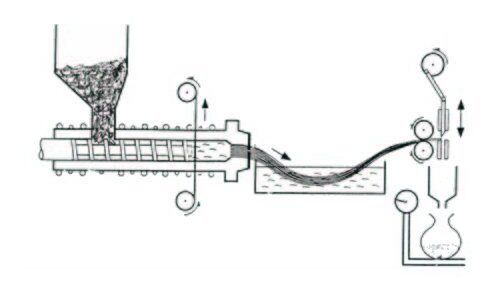
Channelling recovered carbon fibres into intermediate injection-moulding pellets or nonwoven compression-moulding sheets provides clear engineering utility in these secondary sectors. A nonwoven sheet infused with thermoplastic or thermoset resin offers lightweight stiffness, replacing unreinforced polymers, magnesium alloys, or sheet moulding compounds. Framing this transition as an aerospace closed loop is misleading; it represents a functional cascade where high-grade materials find appropriate lower-stress applications.
The missing process data
The reported emissions advantage needs a clearly defined comparison with virgin production. Collection, chemical manufacture, solvent recovery, residue treatment and the properties of the substitute product belong in that assessment.
Virgin polyacrylonitrile precursor synthesis, white-fibre spinning, and high-temperature oxidative stabilisation and carbonisation consume substantial energy—often estimated around several hundred megajoules per kilogram of finished fibre. Low-temperature chemical recovery theoretically bypasses this primary embodied energy. However, calculating genuine net carbon savings requires rigorous boundary definitions in life-cycle assessments (LCA).
A chemical recovery facility relies on solvent syntheses, reactor pressurisation, post-reaction washing steps, and distillation systems to purify and recycle chemical decomposition agents. Furthermore, the decomposed resin residues dissolved in the chemical solvent create a complex organic effluent that requires energetic recovery or treatment. If solvent recovery ratios fall short of near-complete containment, the embodied impacts of makeup chemicals rapidly erode the theoretical greenhouse gas benefit.
The public descriptions do not provide all the processing conditions, sustained throughput, recovery yield or repeated-cycle results needed for a full industrial judgement. Prototype samples are a development milestone, not a commercial supply chain. The mechanism is promising because it targets the expensive reinforcement; the next proof is consistent product quality and a transparent recovery balance at scale.
References and image credits›
Photo: Wikimedia Commons, CC BY-SA · Diagram: The Waste Stack · Photo: Miha Bukleski, CC BY 4.0 · Photo: Wikimedia Commons, CC BY-SA