
AI-designed zinc sponges for methane — and the gap before a landfill
A Chicago-led team closed the loop from data mining to synthesised, tested metal-organic frameworks for methane capture. Two new materials work at ambient conditions in a lab. Landfill gas is wet, dirty and nothing like a lab.
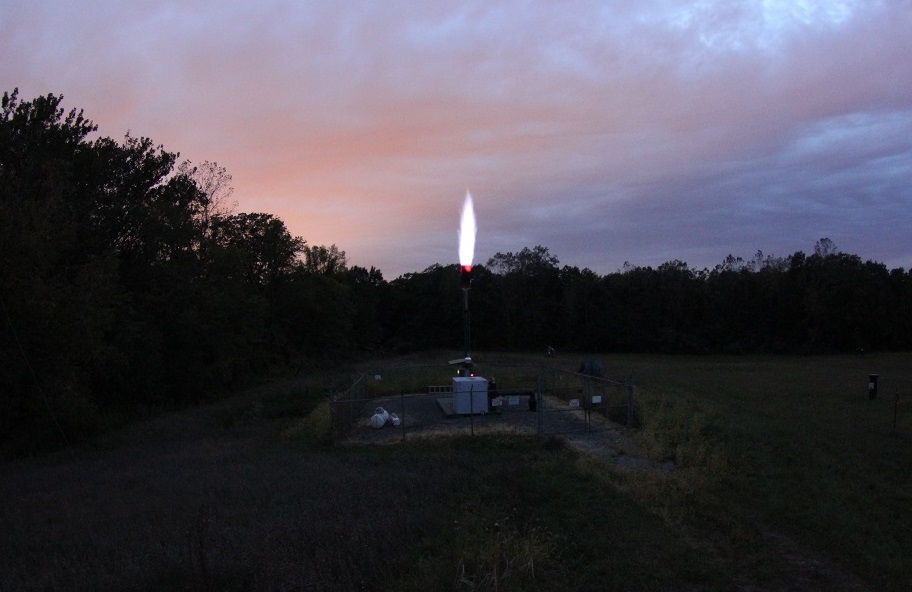
Landfill gas is one of the largest controllable methane sources in waste management, and most of it is either flared or vented. Flaring converts methane to CO2 — better, but it destroys a fuel. Capturing the methane instead requires separating it from nitrogen, which is chemically awkward because the two molecules are similar in size and neither is especially reactive.
A University of Chicago-led team has produced two new materials aimed at that separation — and, more interestingly, a method for producing them.
What a MOF is
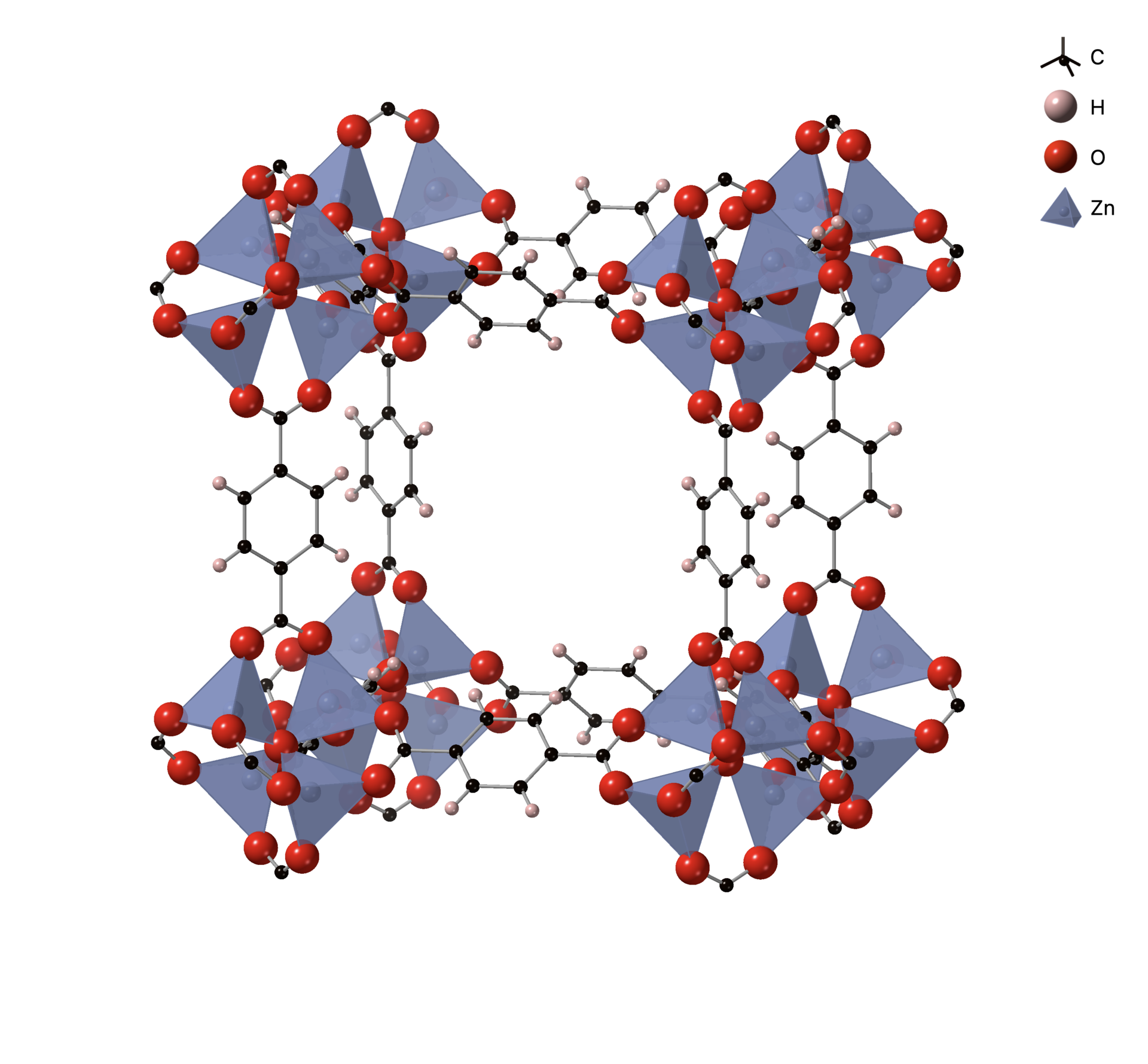
A metal-organic framework is a crystalline solid built from metal nodes connected by organic linkers, arranged into a rigid lattice full of regular pores. Because the pore geometry is set by the choice of node and linker, MOFs can be tuned to prefer one gas molecule over another far more precisely than a generic activated carbon.

The actual innovation: the loop, not the material
The design space for MOFs is effectively unbounded. Computational screening has been generating promising virtual frameworks for years. The chronic failure is that most of them are never made.
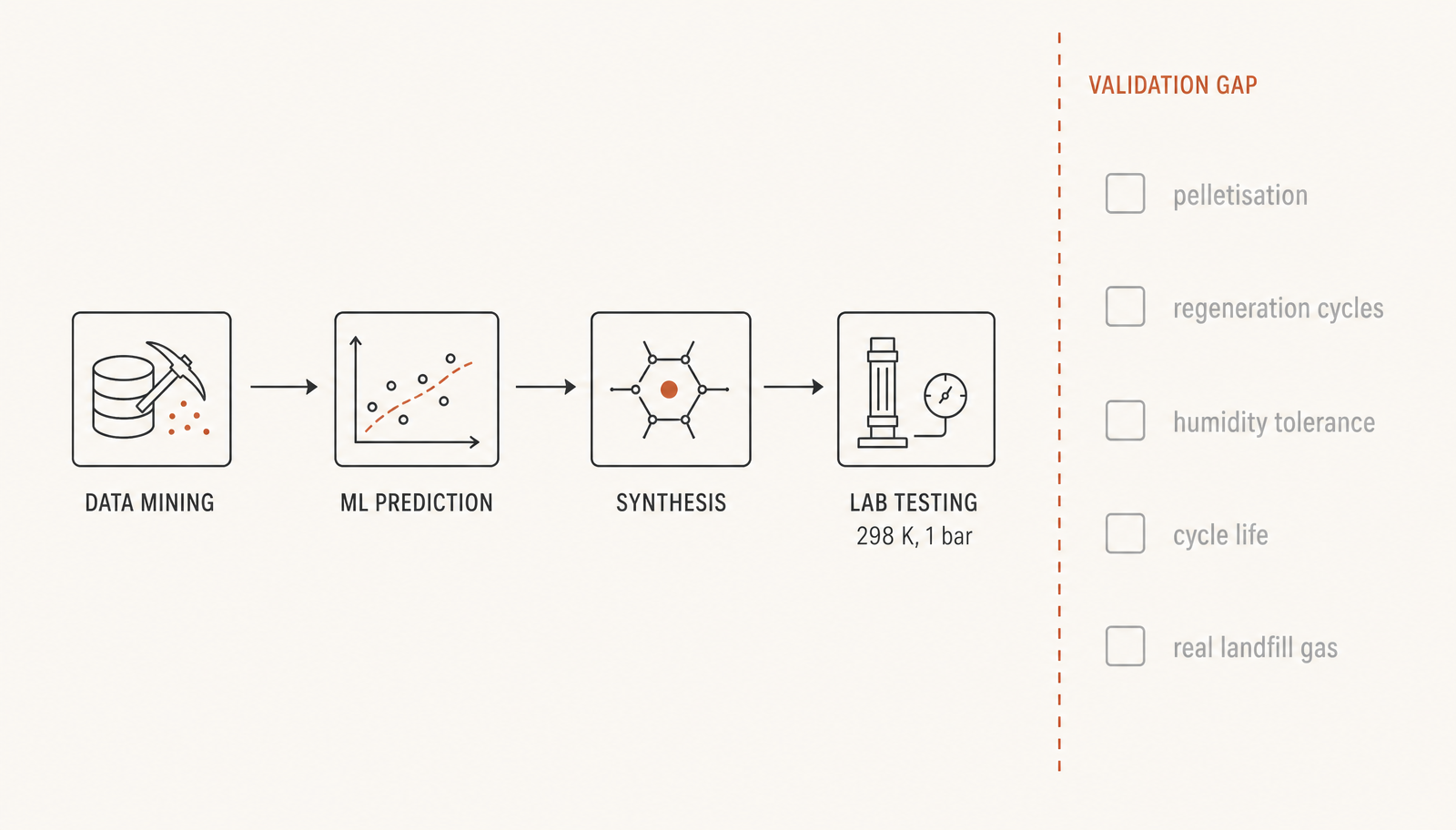
This team closed the loop end to end: mine existing data, predict which pore sizes, shapes, framework densities, linker functionalities and topologies should work, then synthesise the winners and measure them.

What UCHI-1 and UCHI-2 do
Both are zinc-based. At 298 K and 1 bar — room temperature and atmospheric pressure — they showed enhanced methane uptake and improved methane/nitrogen selectivity, slightly ahead of comparable literature examples.
The mechanism is geometric rather than chemical: pores tuned to methane's size, plus dispersive C–H/π and van der Waals interactions holding it preferentially over nitrogen. No strong binding means no energy-intensive regeneration — which is the whole appeal of physisorption over chemical capture.
Zinc was chosen deliberately. It is cheap and abundant, unlike the scarcer metals that appear in many high-performing frameworks. A material that only works with an expensive node is a paper, not a technology.
The distance to a landfill
The paper is explicit that this is a laboratory proof of concept — not a landfill-gas pilot, not a membrane module, not a demonstrated methane-destruction system. That distance is worth spelling out, because ambient adsorption data is the easiest condition a capture material will ever see.
Wet gas. Landfill gas is saturated with water. Water competes for adsorption sites and, in many MOFs, hydrolyses the framework outright. Humidity tolerance is the single most common failure mode between lab and field.
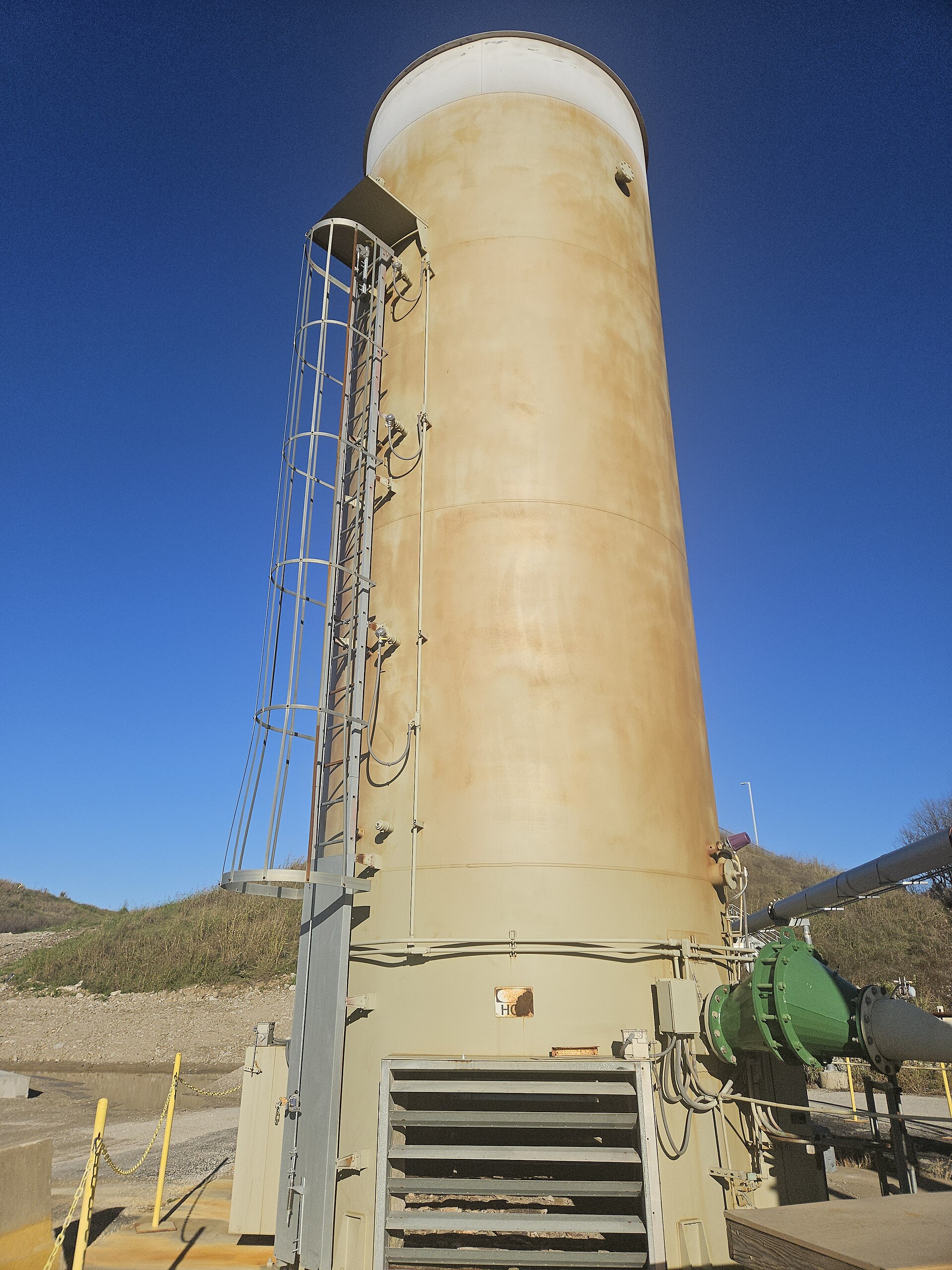
Contaminants. Hydrogen sulphide, siloxanes and halogenated VOCs foul adsorbents. Pretreatment is possible and routine, and it is also capital and operating cost that belongs in the comparison.
Form factor. Powder does not go in a vessel. The MOF has to be pelletised or shaped into a module, and shaping typically costs surface area and adds mass-transfer resistance.
Cycles. A pressure-swing or temperature-swing system regenerates the bed thousands of times. Cycle-life data under realistic conditions is what separates a working process from a single isotherm.
Process energy and slip. Any capture system must account for its own parasitic energy, and must measure methane slip. Capturing 80% of the methane while venting the rest is a materially different climate outcome from flaring it.
Why it still matters
Faster discovery genuinely changes what is affordable. If the loop from data to validated material can be run in months instead of years, the search for a humidity-tolerant, cheap, cycle-stable methane adsorbent gets many more attempts.
That is the honest version of this story: not a landfill technology, but a faster way to find one.
References and image credits›
- 01University of Chicago Institute for Climate and Sustainable Growth — End-To-End Discovery of MOFs for Ambient CH4 Adsorption
- 02Phys.org — End-to-end design creates two low-cost materials to capture methane
Vince Reinhart, Wikimedia Commons, CC BY-SA 2.0 · Axs154, Wikimedia Commons, CC BY-SA 4.0 · Snemani2023, Wikimedia Commons, CC BY 4.0 · CSIRO, Wikimedia Commons, CC BY 3.0 · DeVos Max, Wikimedia Commons, CC BY-SA 4.0