
An Enzyme From a Compost Heap Cuts Polyurethane. Slowly.
A Danish team found a bacterial enzyme that cleaves untreated polyurethane foam and nylon with no pretreatment. Three days of it removed 1.4 percent of a shoe sole.

Polyurethane foam is a thermoset. Once the urethane bonds are formed and crosslinked, the material will not melt and flow again, which removes mechanical recycling from the table. Nylon is a thermoplastic but arrives mixed into textiles nobody has separated. Between them they account for a large share of the plastic that recyclers simply do not attempt.
What the team actually did
A group from Aarhus University and the Danish Technological Institute bioprospected millions of bacteria drawn from four environments: a landfill in Kenya, a tropical zoo, the guts of waxworms, and a compost heap outside Aarhus. They screened using fluorescent plastic mimics and fluorescence-assisted cell sorting, which lets you pull out the single cells that light up when they cleave the target bond.
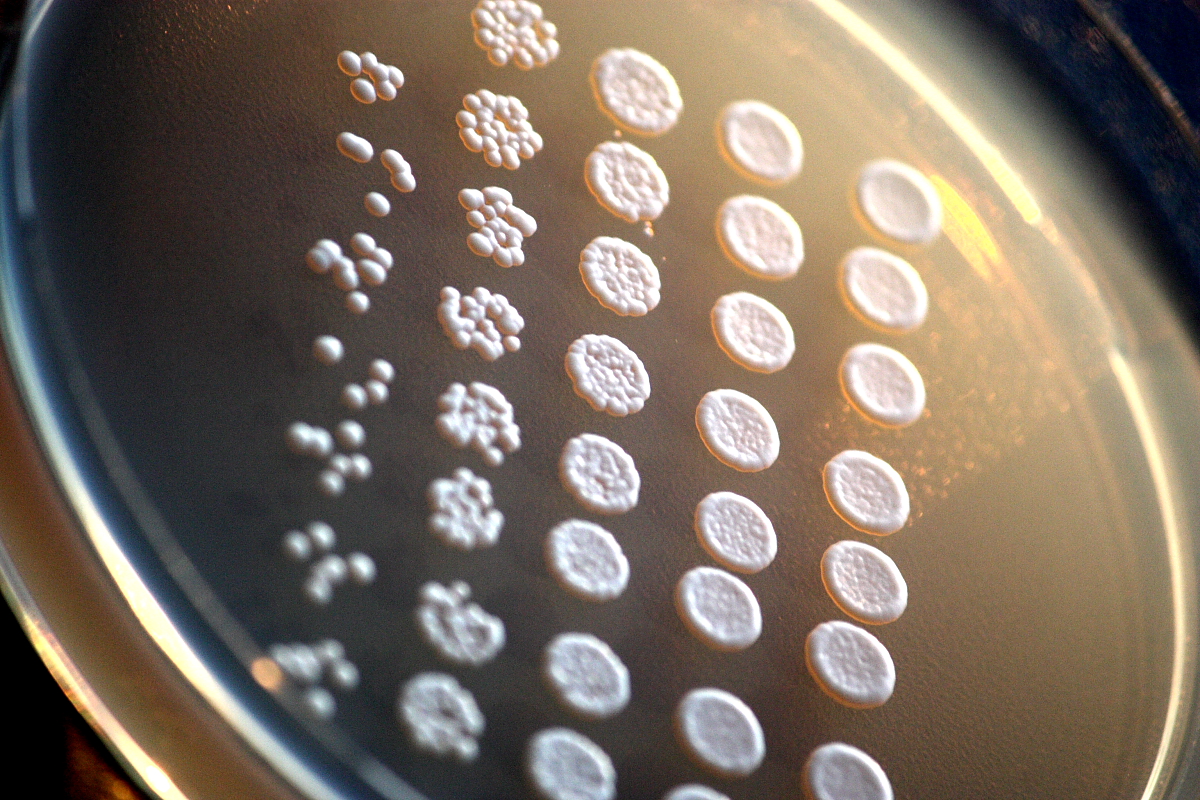
The screen returned 29 plastic-degrading bacteria and twelve candidate enzymes. The standout was CCPUR1, from Chelatococcus composti, the compost-heap organism.
Why this enzyme and not another
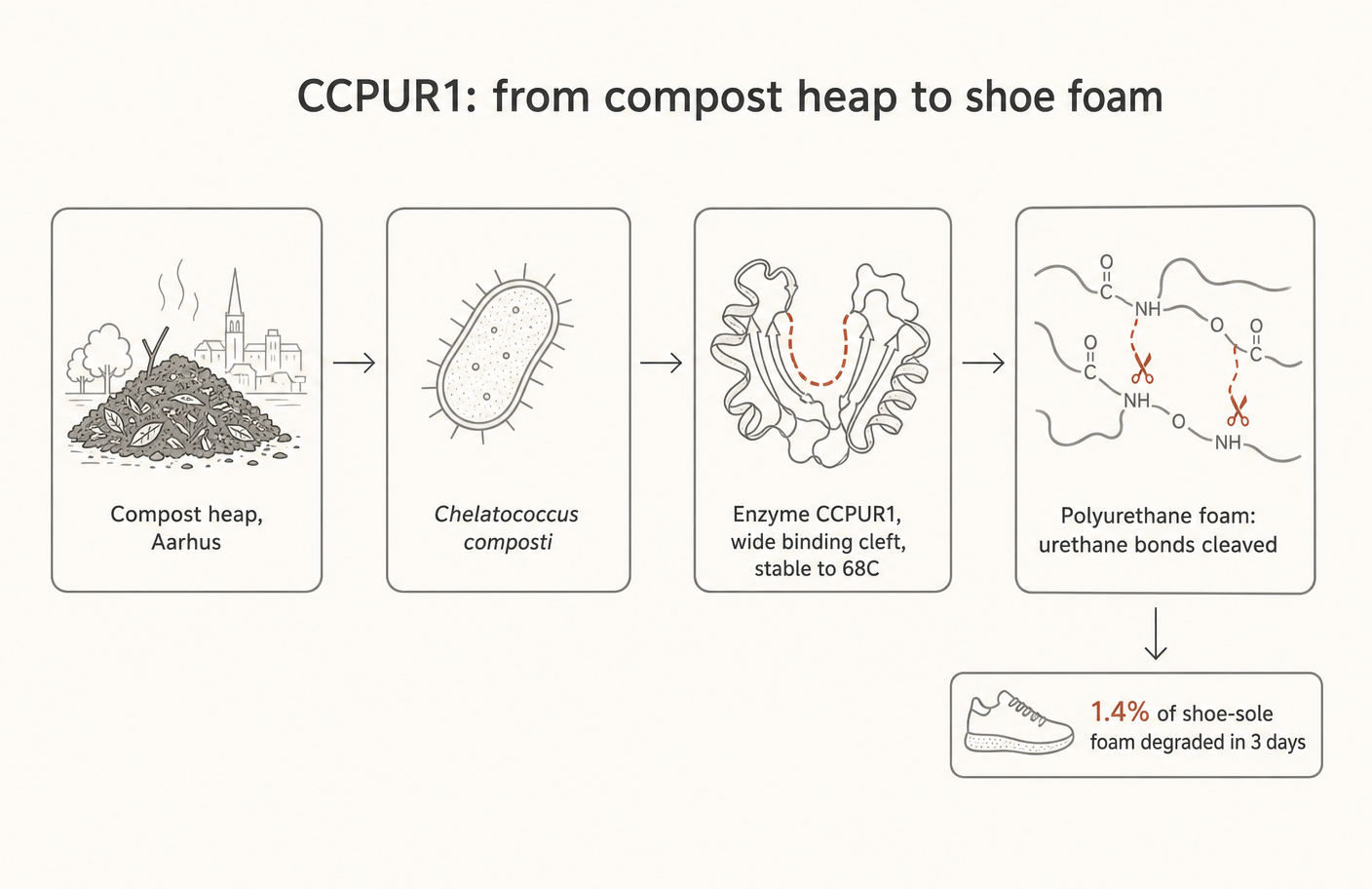
Two features. The binding cleft is unusually wide, which lets a bulky polymer chain sit in the active site rather than bounce off it. And the enzyme is thermostable and solvent-tolerant, which matters because any industrial process will run warm and wet with additives in it.
The evolutionary story is tidy: the bacterium developed this machinery to attack wax and lignin, tough natural polymers found in compost. Urethane bonds happen to be close enough to what it already eats.
The number that sets the pace
Working with the University of Porto, the team used molecular dynamics simulations to pick mutation targets and edited the gene accordingly. The improved enzyme degraded roughly 1.4 percent of the polyurethane in real shoe-sole foam in three days — with no chemical or mechanical pretreatment at all.
That is genuinely a first. Prior enzymatic work on PUR used soluble model compounds or pre-ground, pre-swollen material. This is crosslinked thermoset foam as it comes off a shoe.
It is also nowhere near a process. An industrial line needs most of the mass converted in hours, not one part in seventy in three days. The researchers say so themselves.
The nylon half is weaker
The nylonase candidate, PYNYL1 from Paracoccus yeii, ran at 0.44 µmol min⁻¹ µmol⁻¹ against 4.0 for the PUR enzyme — roughly a ninth of the activity. Nylon textiles are the harder half of the claim and currently the thinner evidence.
The ENCORE project, funded with 6M DKK from the Novo Nordisk Foundation under Daniel Otzen, is now working specifically on lifting nylonase activity.
What to watch
Rate per gram of enzyme, and whether the process still works when the foam is dirty. Shoe soles are filled, pigmented and glued to other materials. A clean lab foam that takes three days to lose 1.4 percent will take longer when there is adhesive in the way.
References and image credits›
- 01Phys.org — Compost microbe yields enzyme that tackles polyurethane foam and nylon
- 02Angewandte Chemie — Environmental identification of novel enzymes for polyurethane and polyamide degradation
Photo: Rainis Venta, CC BY-SA 3.0 · Photo: Mictlancihuatl, CC BY 4.0