
Pirelli, Pyrum, BASF and Synthos: A Tyre Loop With an Accounting Step in the Middle
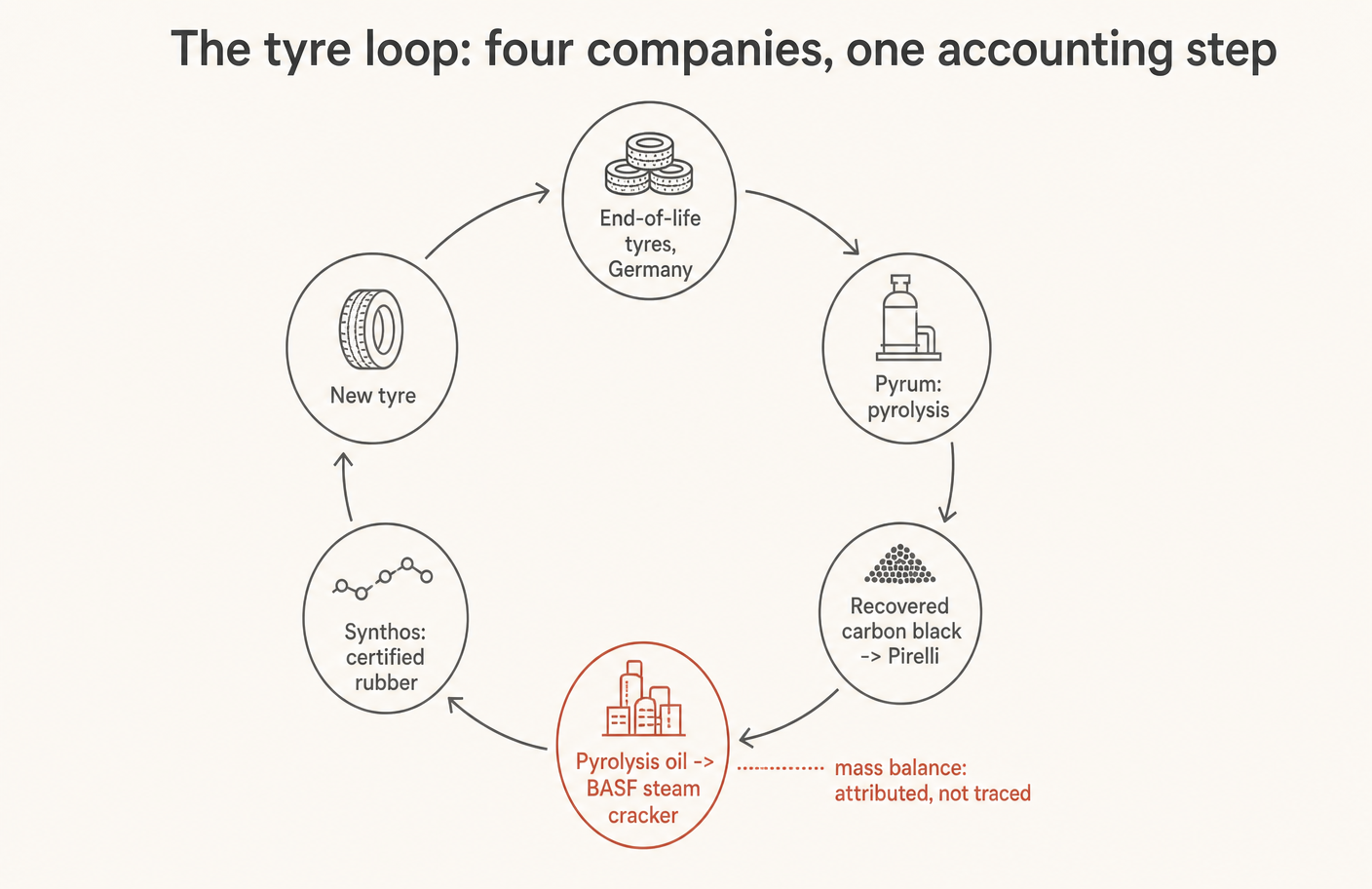
Four companies, six steps, and one link where the recycled content is attributed rather than physically traced. The pyrolysis is real. The loop is partly bookkeeping.
Announced on 22 July 2026 and described as Europe's most comprehensive tyre-to-tyre project. The chain is worth walking through carefully, because the strongest and weakest links are both in it.
The six steps
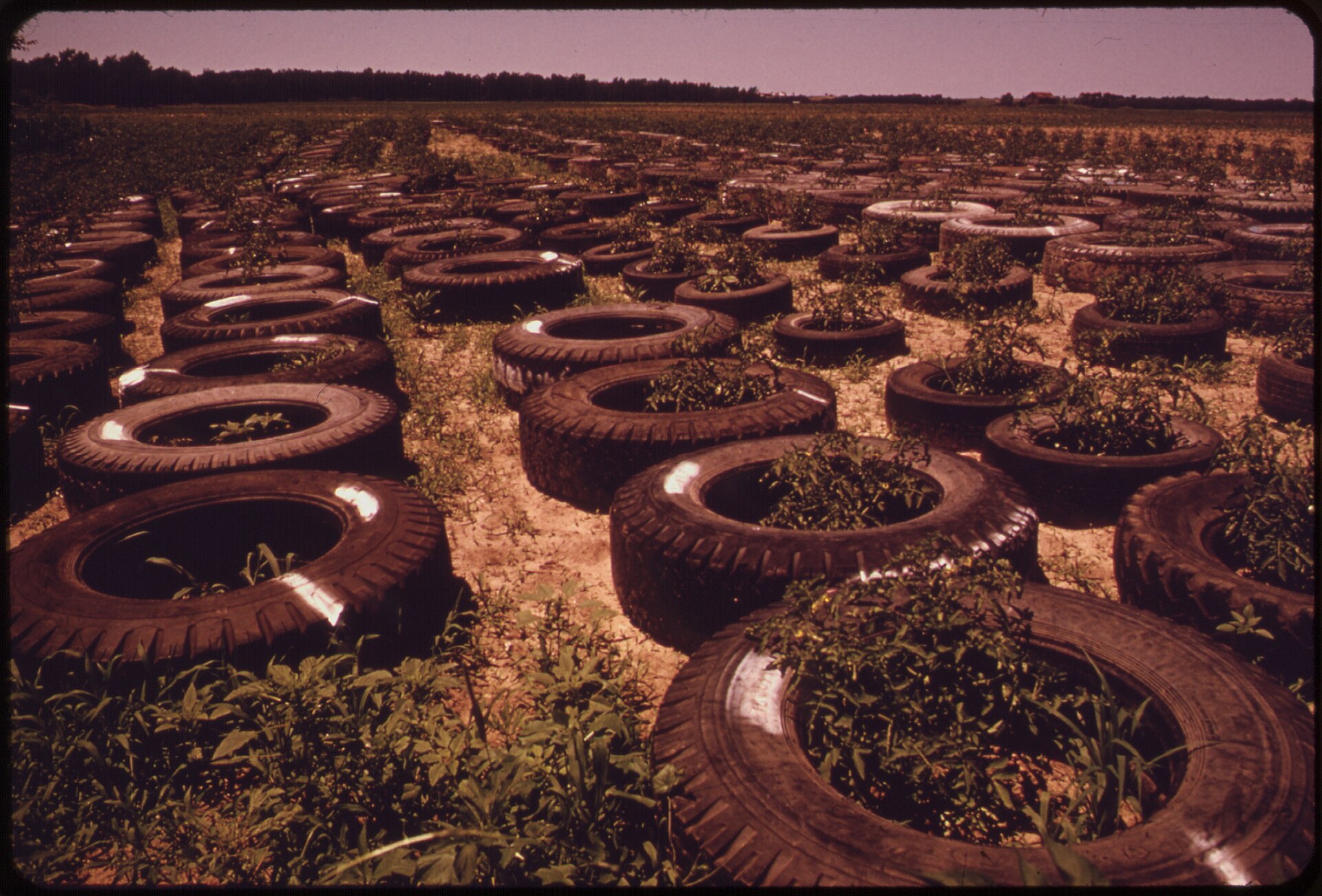
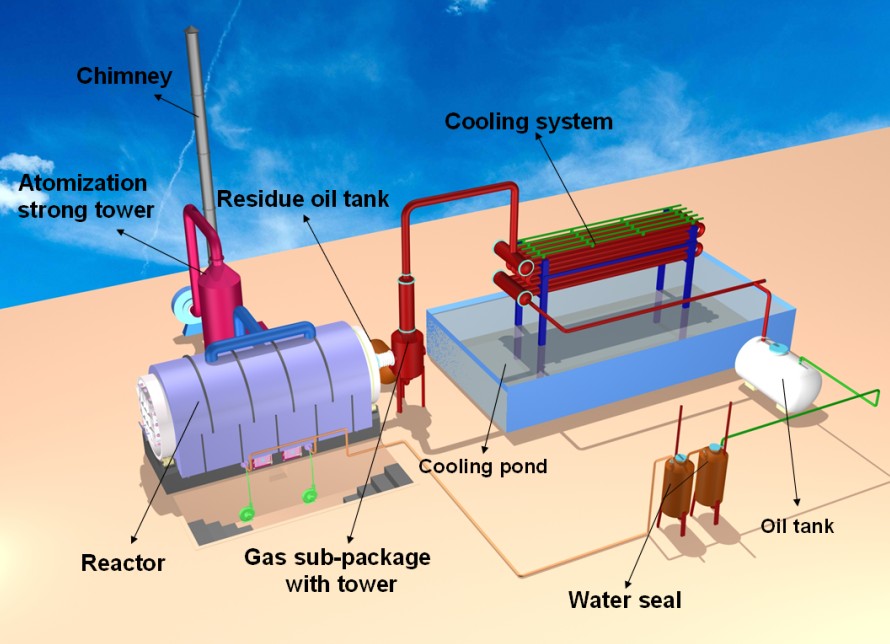
End-of-life tyres are collected across Germany from Driver retail outlets, motorsport, and Pirelli's Breuberg plant. Pyrum pyrolyses them — thermal decomposition without oxygen — producing recovered carbon black and tyre pyrolysis oil.
The recovered carbon black is upgraded and goes straight back into Pirelli's European tyre production, partially replacing virgin carbon black. That is a physical loop. A molecule from an old tyre ends up in a new one.
The oil goes to BASF, where it is co-fed with fossil feedstock into a steam cracker to make butadiene and styrene. Synthos turns those into ISCC PLUS-certified synthetic rubber. Pirelli puts the rubber back into tyres.
Where it stops being physical
Mass balance is a legitimate accounting convention, not a fraud. But a tyre sold as circular under it contains recycled molecules only in the sense that someone, somewhere in the system, put an equivalent amount in.
A steam cracker cannot keep one feedstock separate from another. Pyrolysis oil enters a stream carrying overwhelmingly fossil naphtha, and the outputs are chemically identical regardless of origin. BASF's Ccycled system therefore assigns the recycled share on paper: if 3 percent of the input was pyrolysis oil, 3 percent of the output can be sold as recycled.
The numbers that are not there
No tonnage. No yield. No share of virgin carbon black displaced beyond the word "partially". No third-party life-cycle assessment behind Pyrum's claim of virtually no emissions — a claim about a high-temperature thermal process that would normally be the first thing independently measured.
Fragility
Collection is Germany-only. Processing spans Germany, Belgium and Poland across four companies. Every link is a commercial agreement rather than an owned asset, which is efficient until one party's economics change. Pyrolysis oil markets in particular move with crude; when naphtha is cheap, the cracker has no cost reason to take it.
The fair reading
The carbon black route is a real, physical, displaced-virgin-material loop, and it deserves more attention than it is getting. The rubber route is an accounting construct layered on a chemical process that cannot do otherwise. Announcing them together as one closed loop flatters the weaker half.
References and image credits›
Photo: Zzkysb, CC BY-SA 3.0 · Photo: Lav Ulv, CC BY 2.0 · Photo: US National Archives, public domain