
Covestro’s foam loop: 99% aniline purity does not mean 99% recovery
A planned 2,000-tonne pilot targets a useful chemical from insulation waste; product yield and scale remain separate questions.

Rigid polyurethane foam is designed to last. As a core material in modern building insulation and commercial refrigeration, its low thermal conductivity and high mechanical rigidity stem from a densely crosslinked polymer network. That same chemistry makes end-of-life handling notoriously difficult. Unlike thermoplastics such as polyethylene terephthalate (PET) or polypropylene, which soften under heat and can be extruded into new pellets, rigid polyurethanes are thermosets. Exposing them to heat does not melt them; it degrades them.
Historically, post-consumer polyurethane from construction and demolition waste has had two primary destinations: energy recovery in municipal waste incinerators or landfill disposal. Mechanical downcycling—such as shredding insulation scrap into coarse filler for carpet underlay or low-grade composites—consumes only small volumes and does not preserve the functional chemistry of the polymer. True circularity requires chemical recycling, but breaking down a thermoset without destroying its chemical value is an intricate, energy-intensive challenge.
Recover a precursor, not the whole foam
Covestro and Fraunhofer describe “smart pyrolysis” producing an oil from polyurethane waste, followed by recovery of aniline. Aniline can enter MDI manufacture, which in turn supplies new polyurethane production. MDI (methylene diphenyl diisocyanate) is one of the two core reactive components used to formulate rigid polyurethane foams, alongside polyols.
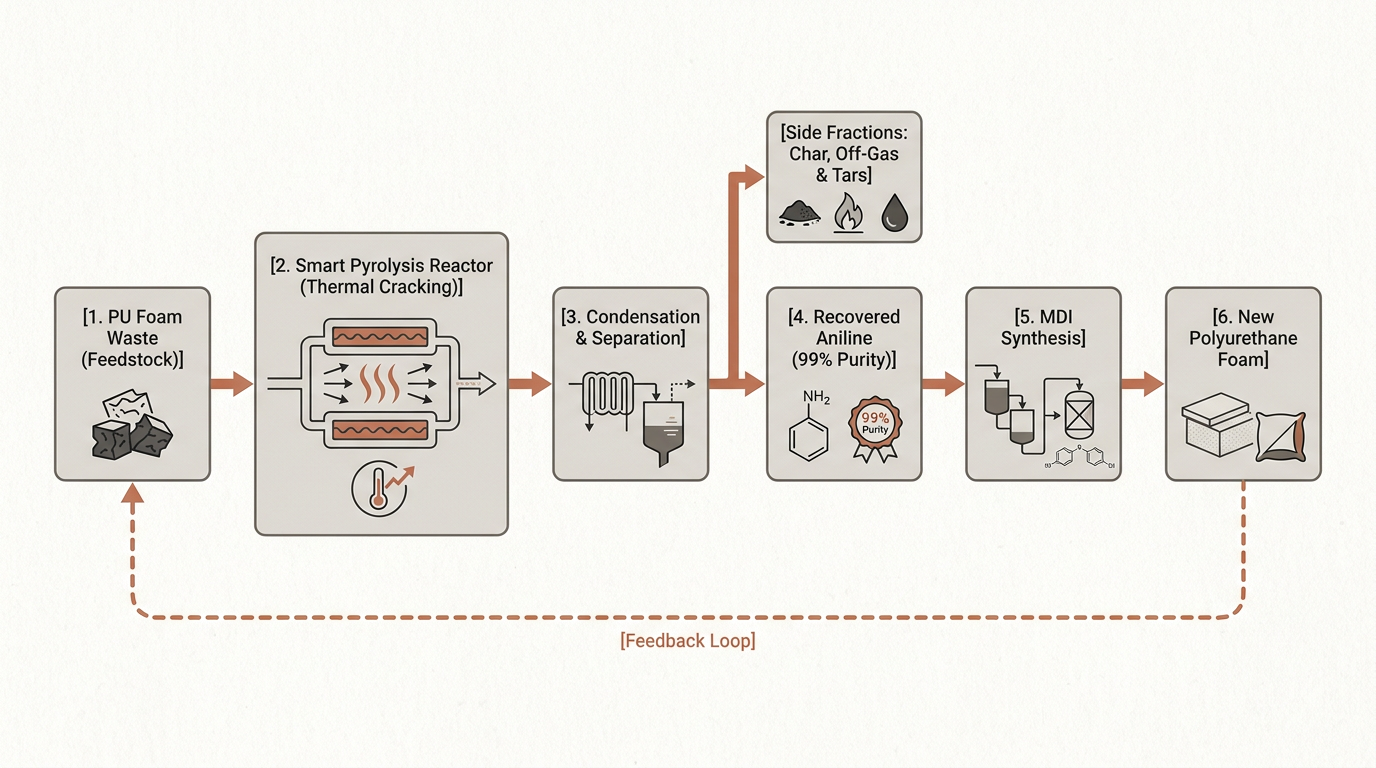
Pyrolysis involves the thermal decomposition of carbonaceous material in an oxygen-deprived environment. Conventional fast or slow pyrolysis often yields a wide spectrum of light gases, condensable pyrolysis oils, and carbonaceous char. Because polyurethane contains nitrogen and aromatic rings bonded into urethane linkages, uncontrolled cracking can lead to complex multi-ring tars, hydrogen cyanide, and recalcitrant pitch. Fraunhofer’s “smart pyrolysis” attempts to tune process temperatures, residence times, and catalytic stages to cleanly break the urethane bonds, liberating aromatic amine intermediates that accumulate in the liquid oil fraction.
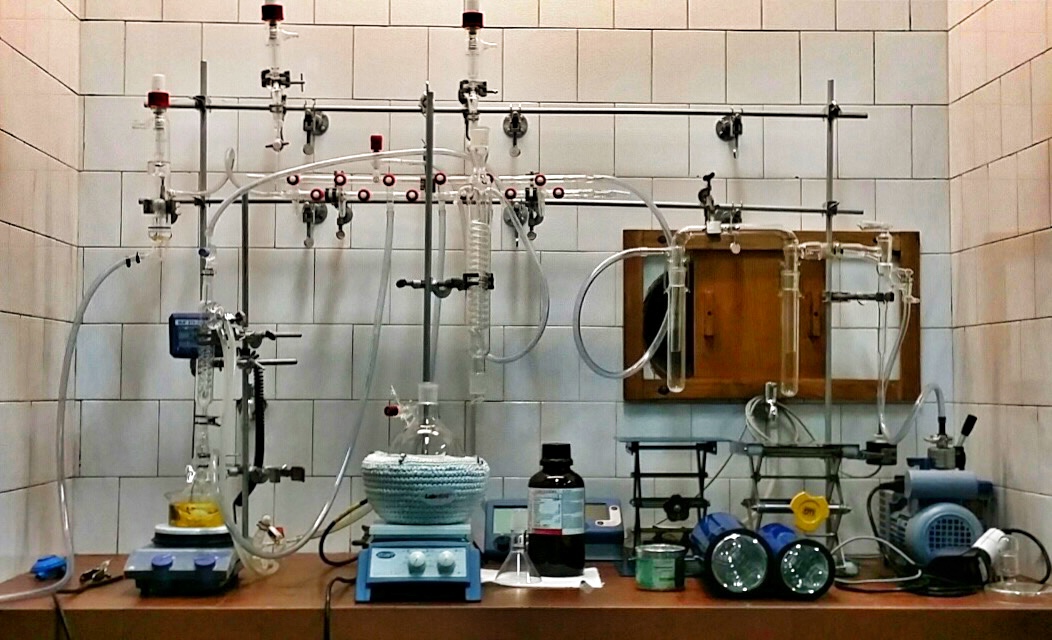
From this liquid stream, target intermediates like aniline must be separated and purified through downstream distillation and extraction stages before they can re-enter chemical manufacturing.
Purity versus yield: untangling the mass balance
High product purity confirms that the isolated chemical meets industrial specifications, but it reveals nothing about how much of the original waste ended up in the incinerator, as char, or lost in side reactions.
Reported aniline purity near 99% concerns the composition of the isolated product. It does not say that 99% of the foam becomes aniline, nor that every original ingredient returns to the same use. The input-to-product yield and remaining fractions need separate measurement.
Achieving 99% aniline purity means rigid polyurethane insulation can now be circularized with minimal material loss.
The 99% figure measures the purity of the distilled chemical fraction after extraction, not the conversion yield from the incoming foam mass.
In chemical separation, purity and yield describe fundamentally different parts of the balance sheet. High purity is essential for downstream applications. Commercial MDI synthesis operates under tight chemical tolerances; even trace amounts of organic impurities, chlorinated compounds, or water can deactivate catalysts, alter polymerization kinetics, or degrade product performance. Demonstrating that recovered aniline reaches 99% purity verifies that modern separation trains can eliminate unwanted byproducts from the pyrolysis condensate.
However, purity says nothing about how much aniline was extracted relative to the total mass fed into the reactor. A complete mass balance must account for:
- Pyrolysis off-gas: Light hydrocarbons, carbon dioxide, and other volatile fractions generated during thermal cracking, which are typically burned to supply process heat.
- Solid char: Carbon residue containing non-volatile mineral fillers, catalysts, and uncracked organic matter.
- Unrecovered liquid fractions: Heavy oils, tars, and polyol breakdown components that cannot be easily refined into aniline.
- Separation losses: Chemical volumes lost in distillation bottoms, filter cakes, and scrubber effluents.
Because polyurethane foam is composed of both isocyanate and polyol segments—alongside blowing agents, surfactants, and flame retardants—aniline represents only a portion of the original theoretical mass. Measuring the actual kilogram yield of qualified aniline per ton of raw scrap is the only way to evaluate the true resource recovery rate.
What is actually planned?
The announced pilot is designed for 2,000 tonnes a year and is scheduled for mid-2028. That is a scale-up milestone beyond laboratory and mini-plant work, not current commercial output.
Moving chemical processes from bench-scale autoclaves to continuous multi-ton units introduces major thermodynamic and mechanical hurdles. In pyrolysis, heat transfer across large volumes of insulating material is notoriously difficult; polyurethane foam is literally engineered to stop thermal energy from penetrating it. Continuous feeding, reactor fouling, tar deposition, and off-gas cleaning all become harder at volume.
Comparing tonnes of foam input directly with tonnes of European MDI demand is not an equivalent mass balance. They are different materials with different roles in the loop. It still illustrates why the project needs much more capacity for sector-wide impact.
A facility processing 2,000 tonnes of raw foam per year is an essential proving ground for equipment reliability, process stability, and continuous separation efficiency. Yet compared to the scale of global polyurethane markets, it remains a pilot installation designed to de-risk technical parameters rather than absorb regional demolition arisings.
Carbon claims and real-world boundaries
The reported “up to 40%” footprint reduction concerns recycled aniline under particular assumptions. Collection of bulky insulation, sorting, transport, energy, emissions control and further chemical manufacture affect the final result.
Rigid insulation foams present unusual logistics hurdles. Foam boards are lightweight and bulky, consisting largely of trapped gas pockets. Transporting uncompressed demolition insulation means hauling very low mass per truck, quickly inflating the logistics component of life-cycle carbon models unless localized shredding or densification takes place.
Old construction foams can also contain additives and legacy blowing agents requiring appropriate handling. Demolition waste from historical buildings often incorporates halogenated blowing agents—such as chlorofluorocarbons (CFCs) or hydrochlorofluorocarbons (HCFCs)—as well as brominated or organophosphorus flame retardants. If thermal decomposition releases these compounds into the oil or gas streams, they risk corroding equipment, generating toxic emissions, or poisoning purification catalysts.
A strong next report would publish representative feedstock tests, aniline yield, residual management and full lifecycle comparisons. High purity is a useful proof point; it is not the entire circularity claim.
References and image credits›
Photo: Retired electrician, CC0 · Diagram: The Waste Stack · Photo: Miha Bukleski, CC BY 4.0 · Photo: Wikimedia Commons, CC BY-SA