
tozero's Acid-Free Battery Recycling: Strong Chemistry, Small Numbers
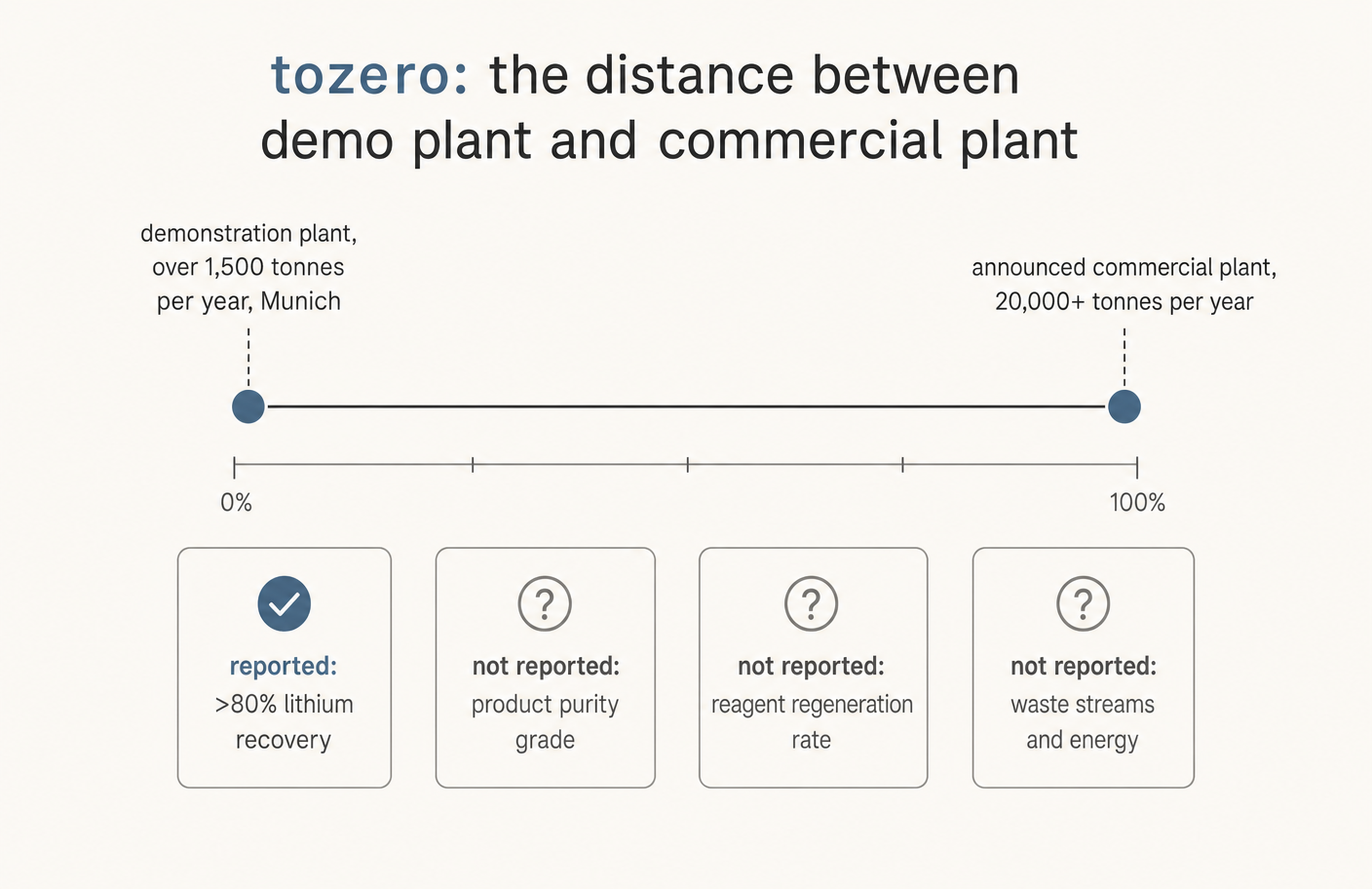
A pilot plant recovering lithium without mineral acid is a genuine contribution. The gap between pilot tonnage and the volume of batteries reaching end of life this decade is three orders of magnitude.
Lithium is the metal that conventional battery recycling handles worst. Pyrometallurgy loses most of it to slag. Hydrometallurgy recovers it, but late in the sequence and at lower purity than the nickel and cobalt that pay for the plant.
tozero's proposition is a hydrometallurgical route that avoids mineral acids and targets battery-grade lithium carbonate directly. That is aimed at the right problem.
Acid-free recycling producing battery-grade lithium, scaling toward industrial deployment.
Pilot-scale operation with tonnages measured in hundreds of tonnes per year. Commercial refineries operate at tens of thousands.
Why LFP makes this harder, and more necessary
The chemistry mix is shifting toward lithium iron phosphate. LFP contains no cobalt and no nickel, which is good for supply chains and bad for recyclers: it strips out the metals that historically funded the process. What is left worth recovering is lithium, and some iron and phosphate of marginal value.
A process whose economics rest on lithium alone is therefore the right architecture for the batteries arriving in the 2030s, and a difficult business today, when feedstock is still dominated by nickel-rich chemistries whose value can be captured by incumbents.
The four questions a pilot cannot answer
In battery recycling, the technology is rarely the bottleneck. Feedstock supply contracts and product qualification are.
Feedstock consistency. Pilots run on sorted, characterised black mass. Commercial plants take whatever arrives, including mixed chemistries, moisture, and contamination from mechanical processing.
Reagent regeneration. "Acid-free" describes what is absent. What matters is what is present, how much of it is consumed per tonne, and whether it is recovered. This is the cost line that decides everything, and it is not public.
Product qualification. Battery-grade lithium carbonate means meeting a cell manufacturer's specification on a list of impurities at parts-per-million level, consistently, batch after batch. Qualification with a cathode producer typically takes 12-24 months and is the real commercial milestone.
Residue. Every hydrometallurgical route produces a residue stream — graphite, binder, undissolved solids, precipitated impurities. Its volume and disposal route belong in the mass balance.
The fair reading
This is a credible pilot addressing the metal that the industry recovers worst, with a chemistry direction that matches where cell production is heading. It is also two to three orders of magnitude below the scale that would matter, with the hardest commercial steps still ahead. Both statements are true at once, and press coverage generally reports only the first.
References and image credits›
- 01European Commission Battery Regulation — recovery targets
- 02Recycling lithium-ion batteries from electric vehicles — Nature review
Photo: Santeri Viinamäki, CC BY-SA 4.0 · Photo: Yo-Co-Man, CC BY-SA 4.0 · Photo: Cjp24, CC BY-SA 3.0