
The missing phone loop: collection comes before urban mining
A $2.2 billion modelled mineral opportunity depends on retrieving phones, preserving reuse and building real downstream recovery.

A phone in a drawer contains useful materials. It is not, however, a recovered mineral resource. Between those two states are collection, safe handling, dismantling, separation and refining—and every step can lose value.
Popular discussions of "urban mining" treat consumer electronics as high-grade ore deposits sitting in domestic storage. In terms of chemical concentration, the analogy holds: a metric ton of printed circuit boards contains far higher concentrations of gold, copper, and palladium than natural ore extracted from hard rock mines. Yet an ore body in the ground is geographically consolidated and legally accessible to a mining operation. A dispersed inventory of handheld electronics sits behind millions of locked apartment doors, held by owners who have little financial incentive and no regulatory obligation to surrender them.
Until a phone is collected, logged, evaluated, and channeled through an industrial process, its mineral wealth is purely theoretical.
The functional hierarchy: why reuse precedes shredding
The Ellen MacArthur Foundation’s Missing Signal report follows phones through first use, passdown, repair, refurbishment and resale before material recovery. This order matters. An operable phone carries manufacturing effort and functional value that shredding cannot preserve.
Modern smartphones are among the most energy-intensive consumer products per unit mass on Earth. Producing a microchip requires ultra-pure silicon, complex lithography, vacuum deposition systems, and vast amounts of energy and water. When an intact device is fed into a hammer mill or an industrial shredder to reclaim metals, the functional utility of those silicon wafers, display panels, and power management modules is completely erased. The recovered material represents only a small fraction of the embodied carbon and capital invested during manufacturing.

The report estimates that 50–70% of phones leaving first use enter a second life in North America. The remaining 30–50% are not reliably recaptured. That is a tracing and collection gap, not proof that every missing phone has been landfilled. Some remain stored; others move through poorly tracked channels.
Devices that escape formal reverse logistics often circulate through informal person-to-person sales, family passdowns, or export markets. While informal reuse extends product life, it complicates end-of-life accountability. When an unmonitored device finally fails, it frequently ends up in municipal solid waste streams or accumulates indefinitely in domestic storage.
The drawer trap and consumer friction
The gap between first use and recovery is governed by consumer psychology and operational friction rather than technological capability. Most households accumulate retired electronics because the perceived cost of disposal exceeds the perceived benefit.
A collection programme also has to earn trust. Users need credible data erasure, a convenient handover and a clear distinction between devices suitable for reuse and devices ready for material recovery.
Old smartphones represent an immediate, highly profitable urban mining reserve ready for commercial extraction.
The economic value of individual devices is low relative to collection costs, and dormant devices remain trapped in households by data security fears and fragmented return systems.
Personal data security remains the primary barrier to voluntary surrender. Smartphones hold banking credentials, identity verification tools, personal photos, and sensitive communications. Consumers who are unsure how to perform a cryptographically secure factory reset routinely default to hoarding devices in drawers as a risk-mitigation strategy. Drop-off points in retail environments rarely offer certified data-wiping verification at the counter, which reinforces consumer hesitation. Without ubiquitous, trusted intake mechanisms, feedstocks for both refurbishment and recycling remain constrained.
What the $2.2 billion actually represents
Policy discussions frequently cite large economic figures to justify public and private investments in recycling infrastructure. The report models at least $2.2 billion in critical-mineral recovery potential through 2040. It is a cumulative opportunity under assumptions, not present recycler revenue, annual savings or a guaranteed return on investment. Metal prices, device composition, collection rates and actual refining yields all affect the outcome.
Translating modeled mineral quantities into realized revenue requires navigating severe thermodynamic and commercial constraints. A phone battery contains lithium, cobalt, and nickel, while its printed circuit board holds copper, gold, silver, and palladium. Rare earth elements such as neodymium and dysprosium reside in acoustic speakers, haptic motors, and camera actuators. However, extracting this spectrum requires distinct chemical pathways.
Furthermore, hardware architectures continuously evolve. Device manufacturers regularly alter internal chemistries to reduce costs, often substituting expensive elements like cobalt with cheaper alternatives or minimizing gold plating thicknesses. A recycling model calibrated on devices retired today may overestimate the material value of devices manufactured tomorrow.
Downstream fragmentation: from disassembly to refining
Bringing back phones is necessary but insufficient. Batteries, circuit boards and magnets do not all enter the same process. A recycler needs qualified outlets for separated fractions; a refinery needs consistent feedstock and buyers for its products.
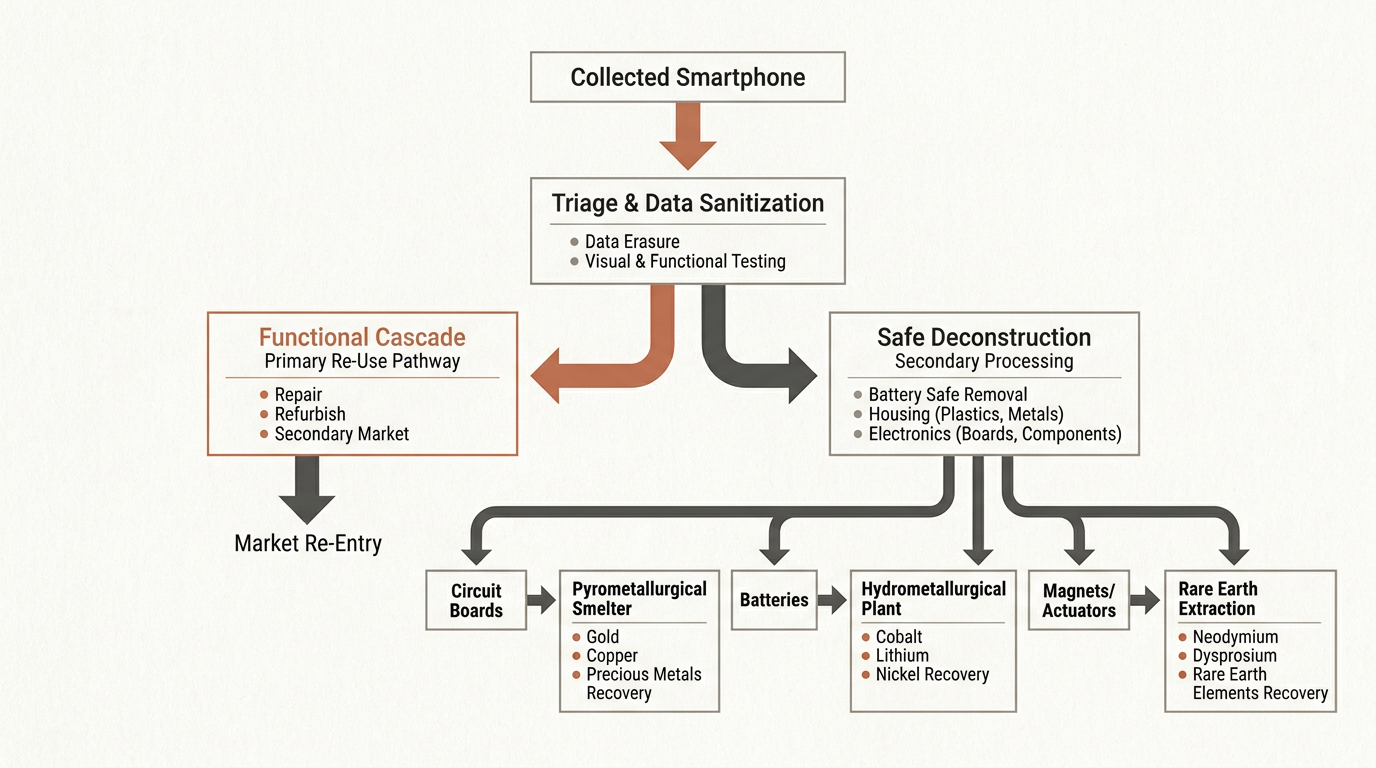
Once collected and cleared of functional reuse potential, a smartphone must be deconstructed. Automated bulk shredding presents substantial operational hazards: lithium-ion batteries crushed under mechanical shears can undergo thermal runaway, sparking fires that threaten recycling facilities and contaminate scrap streams. Consequently, safe handling requires pre-sorting or manual removal of battery cells before mechanical processing.
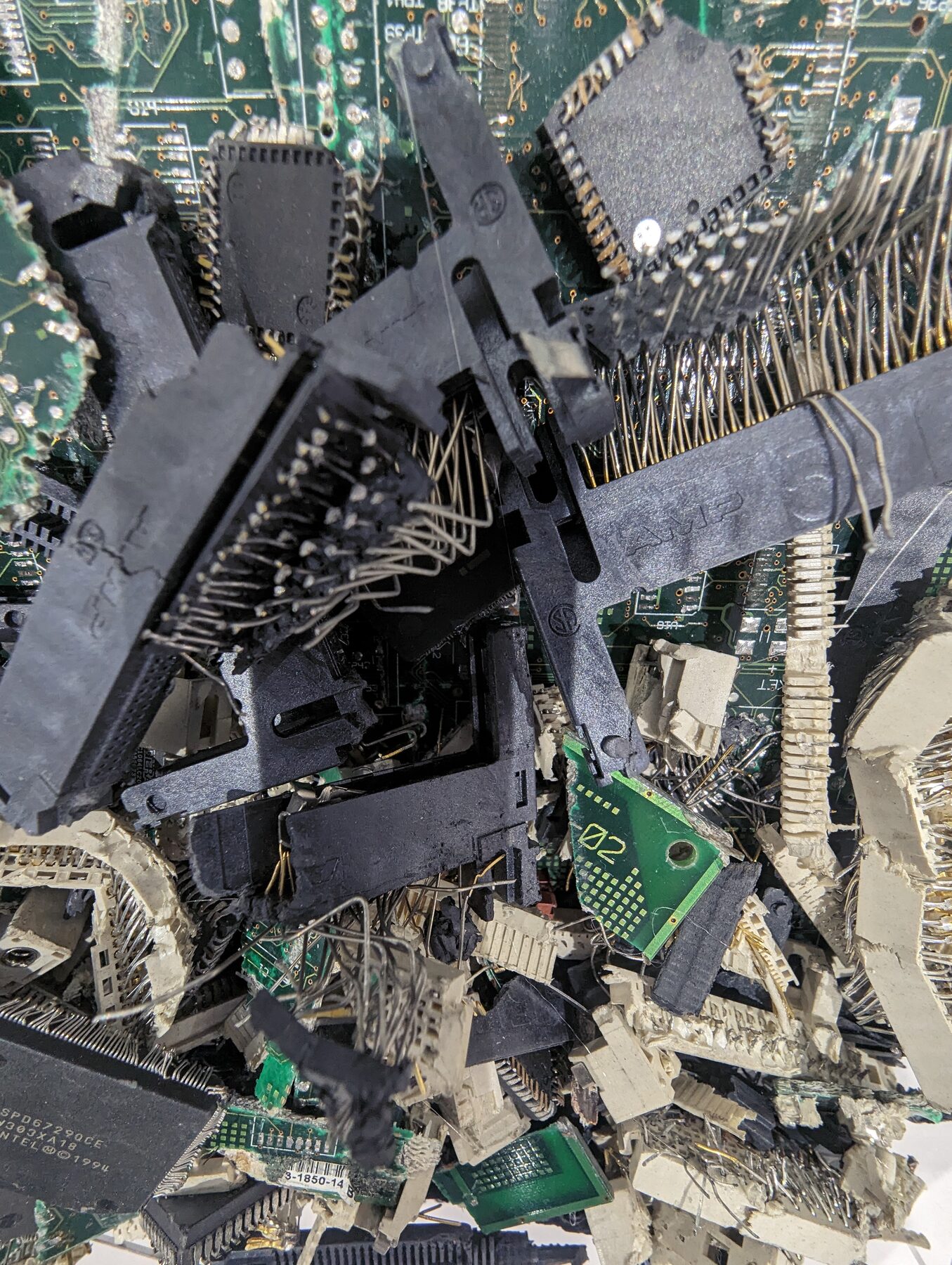
After depollution and separation, distinct fractions move to specialized metallurgical facilities:
- Integrated Smelters: Printed circuit boards are processed in pyrometallurgical smelters where copper serves as a collector metal for precious elements (gold, silver, palladium), while volatile metals are captured in flue dusts and organic plastics are incinerated as fuel.
- Hydrometallurgical Plants: Battery black mass (the concentrated powder of cathode and anode materials) is treated with acid leaches, solvent extraction, and precipitation to separate battery-grade lithium, cobalt, and nickel salts.
- Magnet Processors: Neodymium-iron-boron magnets require specialized chemical extraction or direct alloy reuse, processes that currently lack scaled infrastructure outside of specialized regional hubs.
If any link in this downstream chain lacks capacity or economic viability, collected material bottlenecks at scrap yards or is exported to regions with lower environmental standards.
Closing the loop requires institutional infrastructure
The report’s recommendations—longer-lived design, trusted collection, traceability, processing capacity and stable demand—describe a system rather than a single machine. Urban mining starts with retrieving the product, but circularity works best when the product remains a product for as long as practical.
Fixing the missing loop cannot be achieved simply by building more shredders or chemical refineries. Without universal design standards that facilitate non-destructive disassembly, mandatory deposit-return schemes that mobilize dormant drawer inventories, and auditable chains of custody from consumer drop-off to final smelt, secondary metals will continue to leak out of the industrial system.
References and image credits›
Photo: CC0 · Photo: Ilvy Njiokiktjien, CC BY-SA 3.0 · Diagram: The Waste Stack · Photo: Syced, CC0, via Wikimedia Commons