
Microwaves and Deep Eutectic Solvents: A Gentler Route to Battery Lithium
Conventional battery recycling dissolves cathodes in hot mineral acid. Microwave-assisted leaching in a deep eutectic solvent does the same job at lower temperature, in minutes, with a solvent you can in principle reuse.
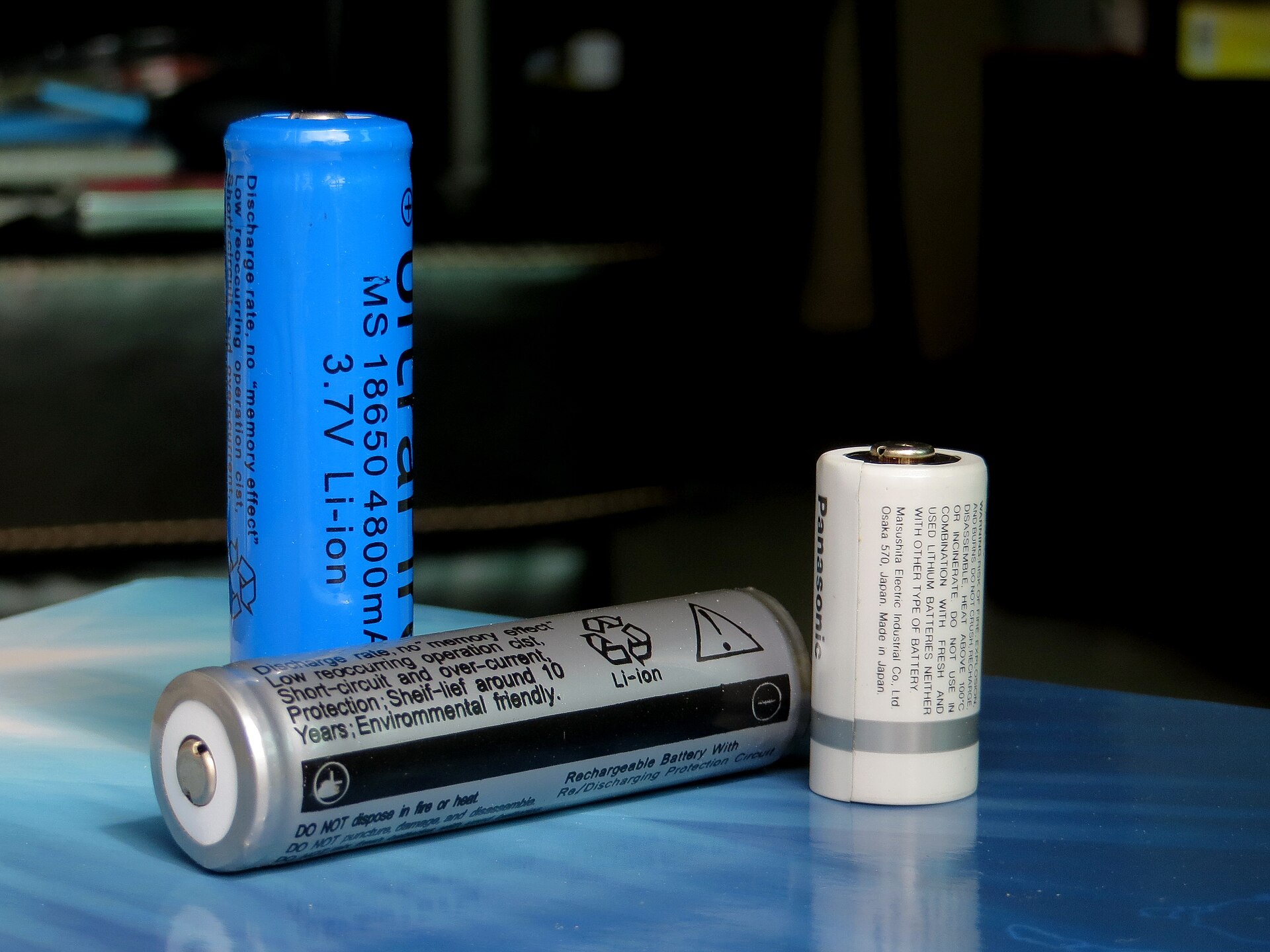
Hydrometallurgical battery recycling is chemistry from the mining industry, applied to a different feedstock. You dissolve the cathode in sulfuric acid with hydrogen peroxide at 60-90 °C, then separate lithium, nickel, cobalt and manganese from solution. It works, and it produces large volumes of acidic, metal-bearing wastewater.
What a deep eutectic solvent is
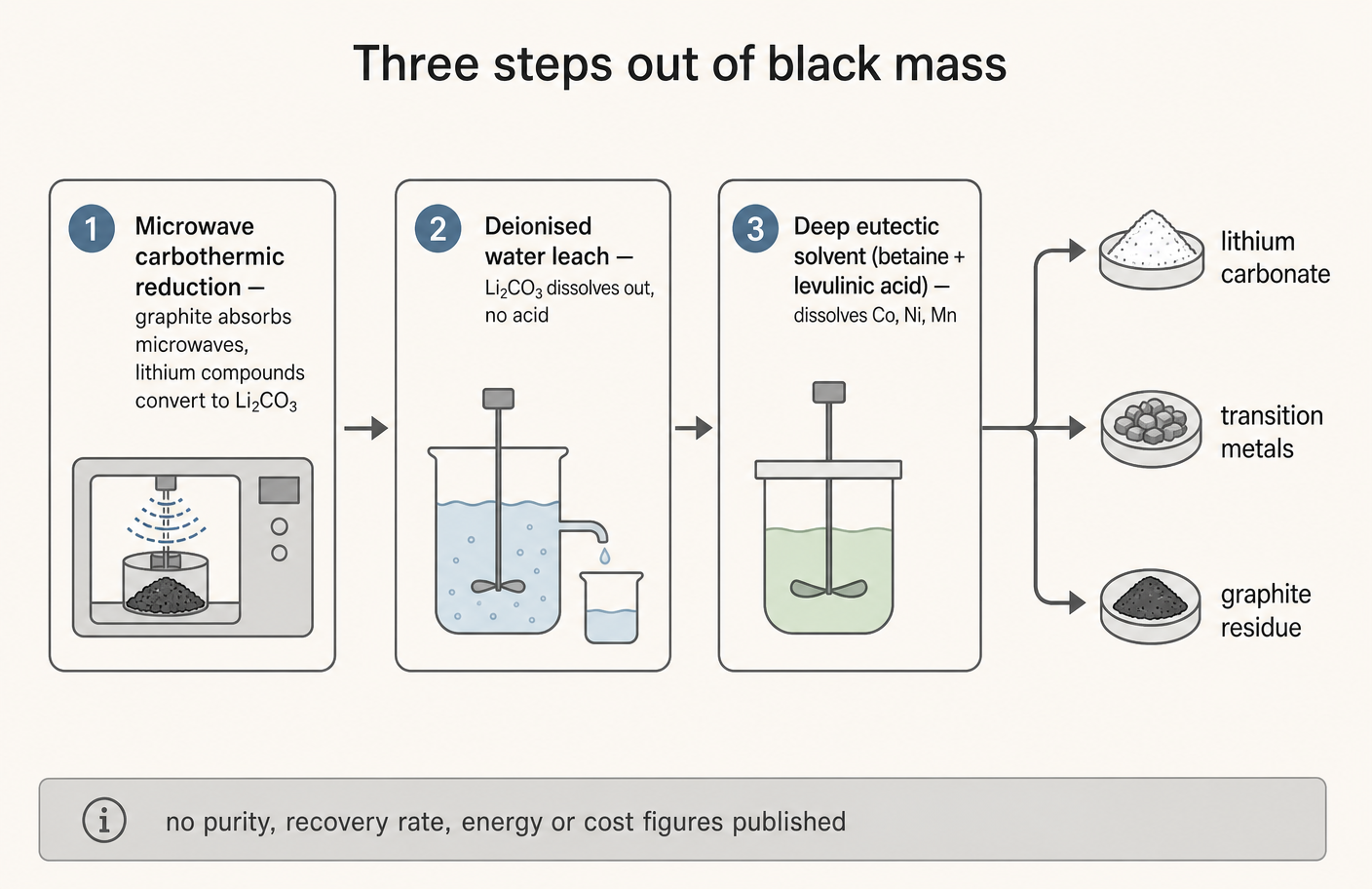
Mix two solids that hydrogen-bond strongly to each other — choline chloride and a carboxylic acid, typically — and the mixture melts far below either component's melting point. The result is a liquid with acid-like coordinating power, negligible vapour pressure, and no free mineral acid.
Those solvents dissolve metal oxides. They are slow at room temperature, which is where microwaves come in.
Why microwaves change the rate
Conventional heating warms a vessel from the outside and relies on conduction. Microwave heating couples directly into polar molecules throughout the liquid, so the whole volume heats at once and local hot spots form at solid-liquid interfaces — exactly where the dissolution happens.
The practical effect is that leaching that takes hours conventionally can be done in minutes, at lower bulk temperature.
What is genuinely better
No mineral acid inventory on site. No acidic vapour. Lower operating temperature. Solvent that is, in laboratory demonstrations, recoverable and reusable across several cycles. Selectivity that can be tuned by choosing the hydrogen-bond donor, which opens the possibility of pulling lithium out preferentially rather than dissolving everything and separating afterwards.
What is not solved
Solvent cost. Choline chloride is cheap. The acid partners are less so, and the economics collapse if the solvent is consumed rather than recycled.
Viscosity. Deep eutectic solvents are thick. Pumping, mixing and solid-liquid separation at plant scale are harder than with dilute acid, and viscosity rises as dissolved metal loading increases.
Microwave scale-up. Penetration depth in a lossy liquid is centimetres. Scaling a microwave reactor means continuous flow through narrow channels, not a bigger box — a well-known constraint in industrial microwave chemistry.
Metal stripping. Getting the metals back out of the solvent, cleanly enough to sell and cleanly enough to reuse the solvent, is the step that determines whether the loop closes.
How to read it
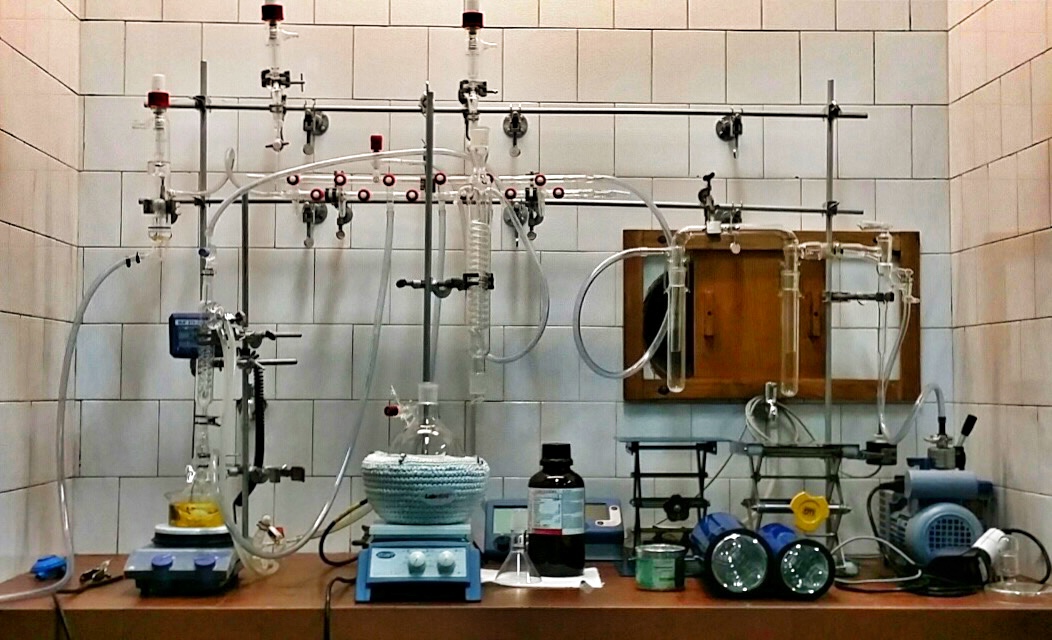
This is a real improvement in the leaching step, not a complete recycling process. Collection, discharge, disassembly and black mass production still sit upstream, and refining still sits downstream. The leach is one unit operation of eight or nine — a cleaner one is worth having, and it does not by itself change the economics of the plant.
References and image credits›
- 01Deep eutectic solvents in metal recovery — review
- 02IEA — the role of critical minerals in clean energy transitions
Photo: Mk2010, CC BY-SA 3.0 · Photo: Robert M. Lavinsky, CC BY-SA 3.0 · Photo: Miha Bukleski, CC BY 4.0