
Acrylic Is the One Plastic That Really Does Unzip
PMMA depolymerises back to its own monomer at high yield with nothing more exotic than heat. It is the clearest existing example of true chemical recycling — and the reason it stays rare is collection, not chemistry.
Most chemical recycling is difficult because most polymers do not come apart the way they went together. Polyethylene is a carbon backbone with no weak link; heating it gives you a distribution of fragments, not monomer.
Poly(methyl methacrylate) is the exception. Heat it above roughly 400 °C in the absence of oxygen and it unzips — each chain end sheds one monomer unit at a time, releasing methyl methacrylate vapour that can be condensed, distilled and repolymerised into material indistinguishable from virgin.
Why it unzips and others do not
The mechanism is a chain-end depolymerisation whose thermodynamics favour monomer above a ceiling temperature. PMMA has a quaternary carbon in the backbone with a bulky ester group attached, which makes the polymer strained and the monomer comparatively stable. Once the reaction starts, it propagates.
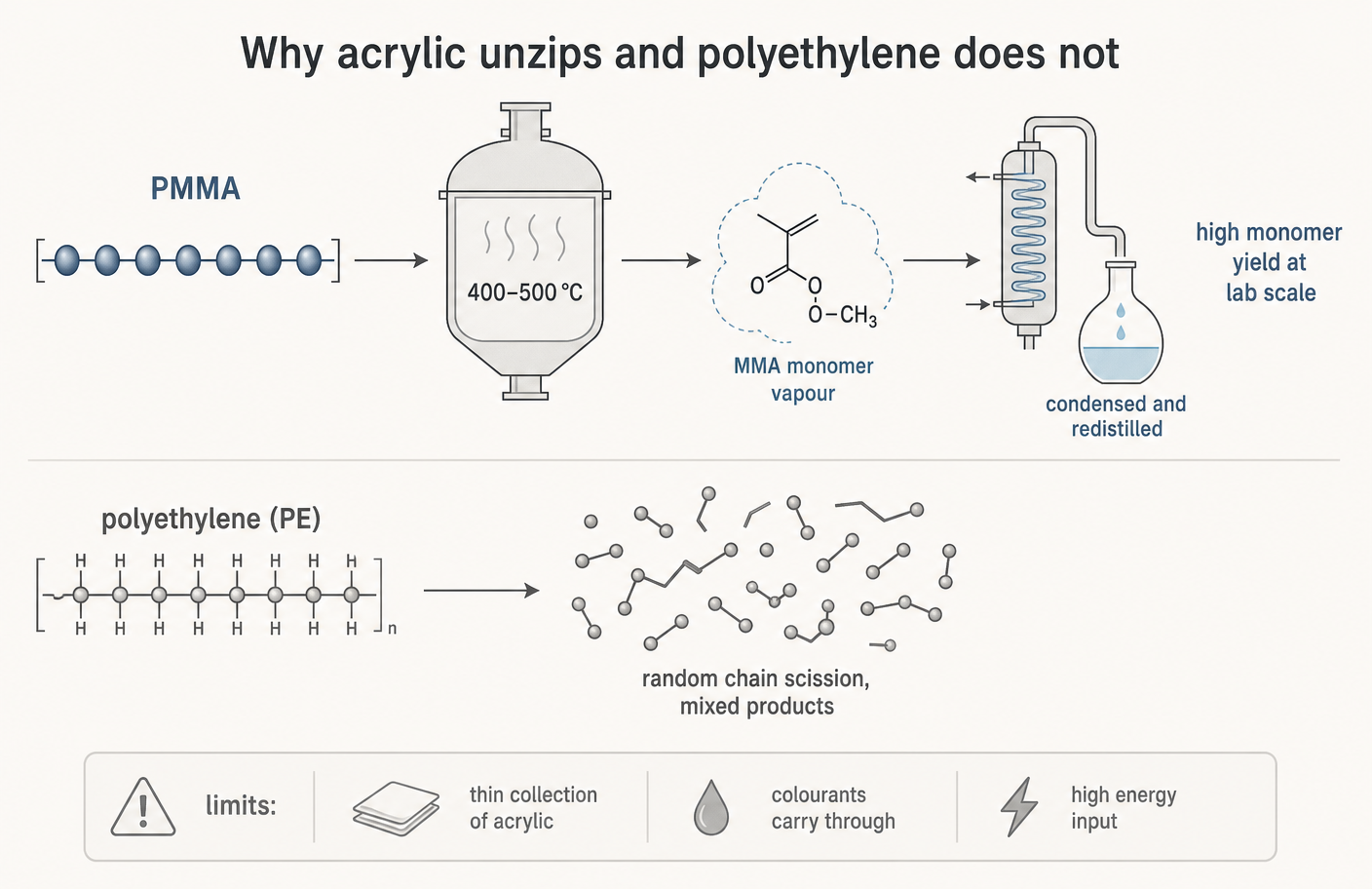
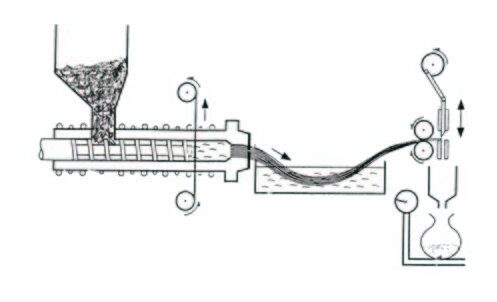
Historically this was done in a molten lead bath, which is exactly as unattractive as it sounds. Modern routes use fluidised beds, extruder reactors or molten salt, and the engineering question is heat transfer into a viscous melt rather than reaction chemistry.
The real constraint is the feed
Cast acrylic — signage, display cases, sanitary ware, aircraft glazing — depolymerises cleanly. Extruded and impact-modified grades contain comonomers and rubber phases that lower yield and contaminate the distillate. Pigments, adhesives and mounting hardware all reduce quality.

So the limiting factor is not whether the reaction works. It is whether enough clean acrylic can be aggregated in one place to feed a plant. Acrylic waste arises in small quantities from many different sectors, is not separately collected anywhere at national scale, and is easily confused with polycarbonate at the sorting line.
What good looks like
The successful cases are all closed loops with a known custodian: aircraft glazing returned by the operator, sanitary ware taken back by the manufacturer, museum and retail fit-outs returned at end of contract. In every case someone knew what the material was and where it was.
The wider lesson
PMMA is often used to argue that chemical recycling can work for plastics generally. It argues the opposite. It works here because of a specific and unusual thermodynamic property, and the polymers that dominate the waste stream — polyethylene, polypropylene, PET — do not share it. PET has its own routes through hydrolysis and glycolysis; the polyolefins have none that produce monomer at comparable yield.
The right conclusion is narrower and more useful: build acrylic take-back schemes, because for this one material the technology is finished and the logistics are the only thing missing.
References and image credits›
Photo: Leiem, CC BY-SA 4.0 · Photo: Helene.3160, CC BY-SA 4.0 · Photo via Wikimedia Commons, CC BY-SA