
"It's Paper, So It's Recyclable": What Actually Happens to a Coffee Cup
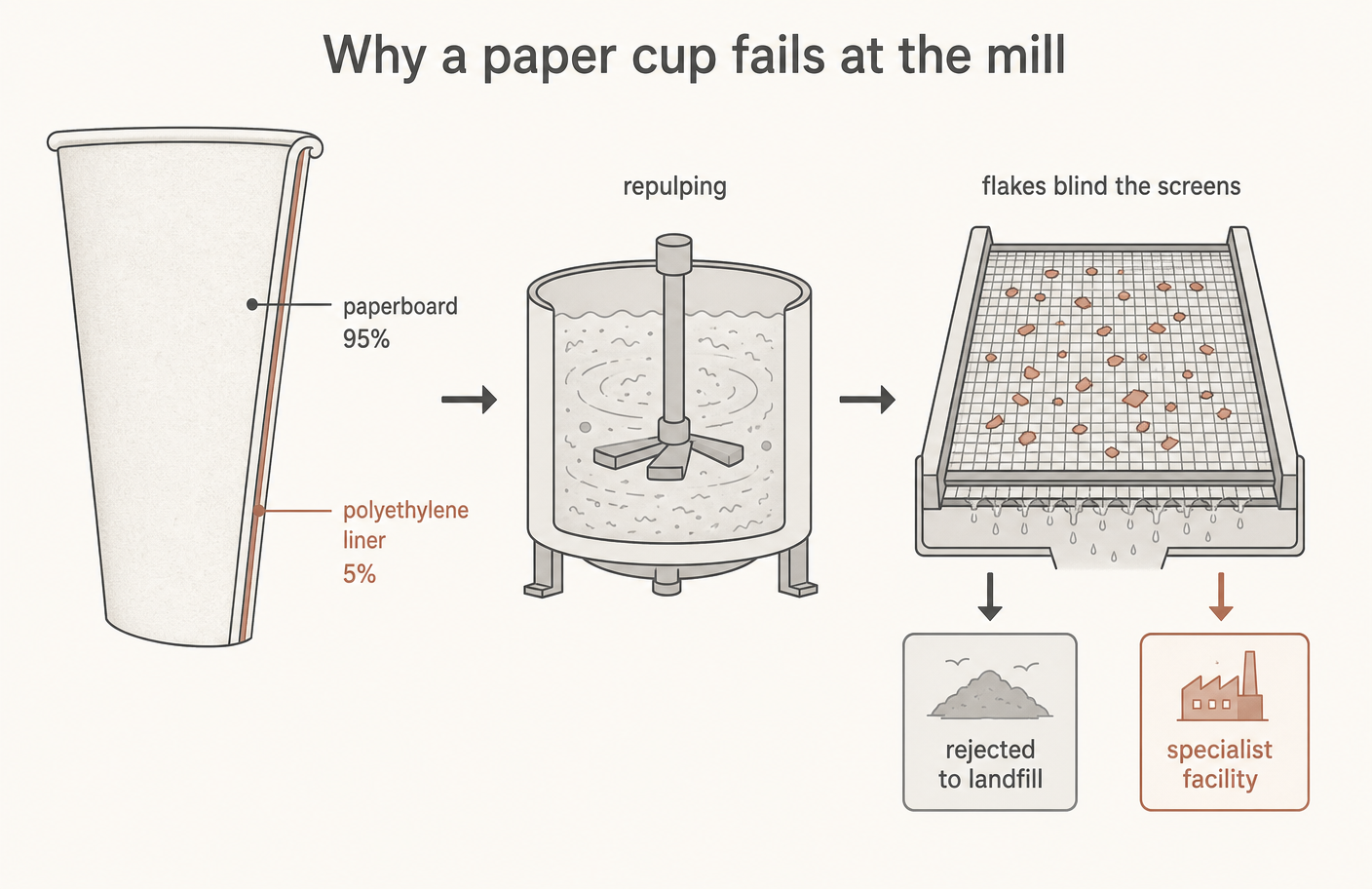
A hot-drink cup is about 95% paperboard. The other 5% is a polyethylene liner, and that 5% is why most mills reject the cup outright — even when you put it in the right bin.
Over 50 billion paper cups a year go through US hands alone, and almost everyone sorting them is working from a reasonable-sounding assumption that turns out to be wrong.
The claim and the mechanism
A coffee cup is made of paper, so it belongs in the paper recycling bin like any other paper product.
A hot-drink cup is a laminate. A thin polyethylene film is extruded onto the board to make it hold liquid, and that film turns the cup into a material most paper mills are not equipped to process.
The proportions are what make this counterintuitive. The plastic is roughly 5% of the cup by mass. It is not a coating you can wash off, and it is not visible. But paper recycling is a wet mechanical process, and 5% of the wrong material in the wrong place is enough to break it.
Why 5% stops the mill
Repulping puts the fibre into water and agitates it until the cellulose separates. The polyethylene does not dissolve and does not pulp. It shears into flakes, and those flakes travel with the slurry to the fine screens that remove contaminants before the fibre goes to the paper machine.
Flakes blind those screens. Throughput drops, cleaning cycles increase, and if any get through they show up as defects in the finished sheet.
Given a choice, a mill takes the mixed paper load without cups in it. So cups are screened out upstream, or the whole load is downgraded. The cup goes to landfill or incineration regardless of which bin it started in.
It is solvable, and it has barely been solved
Specialist facilities exist, so the cups you put in the bin get to them.
Industry group PCRRG counts two facilities in the entire UK equipped to process cups. Independent estimates put the share of UK paper cups actually recycled at around 0.25%.
The machinery to separate liner from fibre is real and it works. There is just almost none of it, and no collection system routing cups toward the units that exist. Shops that run dedicated cup take-back schemes do recover them; cups in a general recycling bin mostly do not travel that route.
The alternative liners, honestly
Compostable cups fix the problem.
PLA-lined cups need industrial composting at elevated temperature. In a home heap they persist, in a paper mill they are a different contaminant, and in a plastics bale they are a defect.
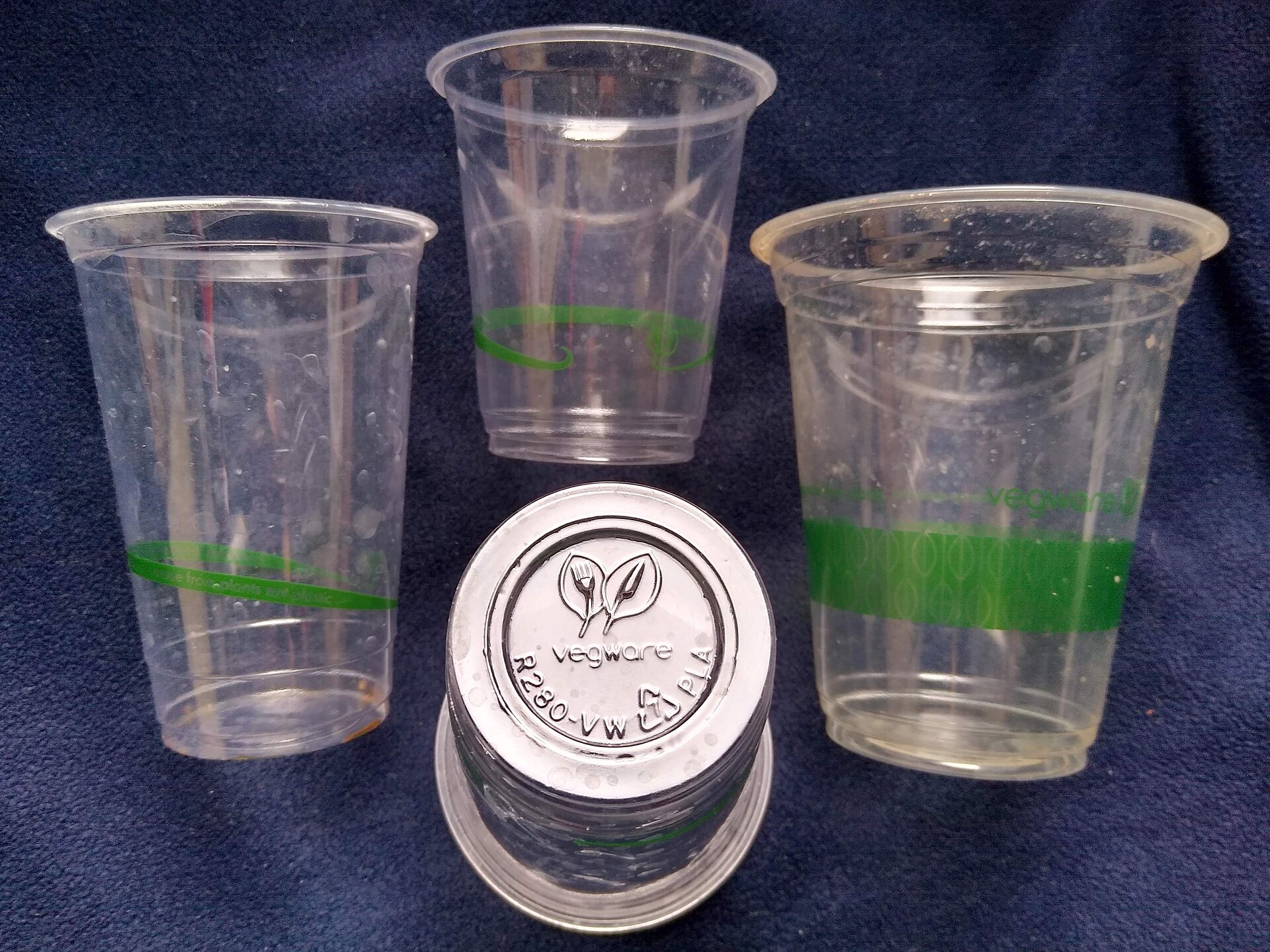
The more promising direction is a water-based polymer barrier designed to disperse during repulping, so the cup behaves like ordinary board on existing mill equipment — no new infrastructure, no separate stream. Several are in development, including BASF's. None is deployed at the scale of the problem.
What this means in practice
Unless your café operates a dedicated cup take-back, the cup goes in general waste — putting it in the paper bin does not improve its odds and can hurt the load it lands in. The lid, if it is rigid PET or PP, is usually the genuinely recyclable part. And the reusable-mug discount remains the only option that avoids the problem entirely, taken up by under 2% of Starbucks customers.
References and image credits›
Photo: My Alchemist, CC BY-SA 3.0 · Photo: Work With Sounds, CC BY-SA 4.0, via Wikimedia Commons · Photo: Giovanna 27, CC BY 4.0 · Photo: Cmglee, Wikimedia Commons, CC BY-SA 4.0