
Paper bags are not automatically the lower-impact choice
Bag weight, reuse and disposal change lifecycle comparisons; litter is a separate impact, not a reason to ignore production.
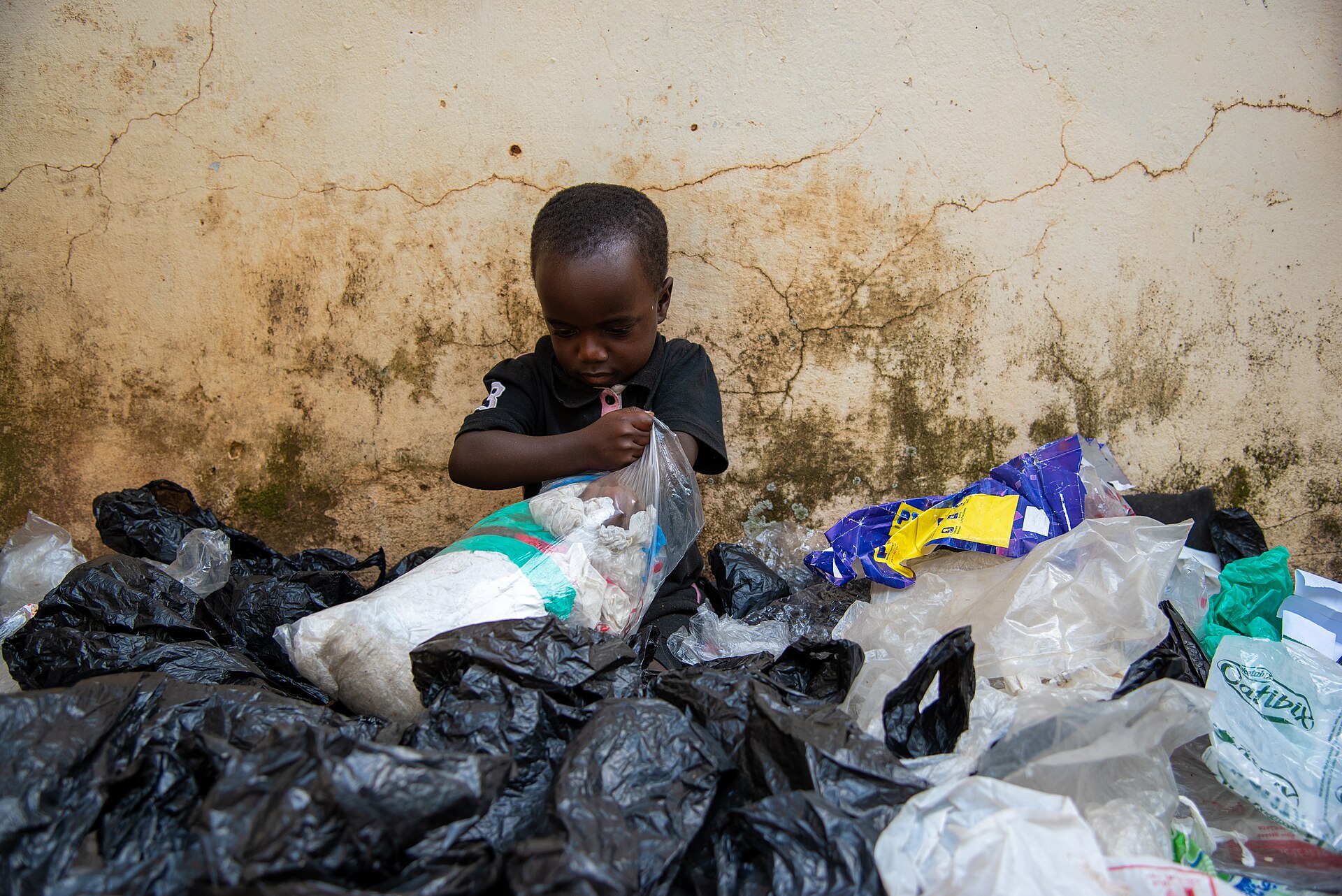
A paper bag is renewable and recyclable, so it must always be better than a plastic bag.
Different materials trade off different impacts. A fair comparison needs the same carrying service, realistic reuse and a defined disposal route.
Retailers around the world have spent the past decade swapping high-density polyethylene checkout bags for kraft paper sacks. The move is intuitive to shoppers. Paper comes from trees rather than fossil fuels, it degrades readily in soil and compost, and it carries none of the visual horror of marine plastic debris. In consumer brand marketing, the paper bag has become an effortless shorthand for environmental responsibility.
Yet environmental engineering rarely rewards intuition. In comparative life cycle assessments (LCAs), paper bags frequently perform worse than standard thin plastic carrier bags across key indicators such as primary energy demand, greenhouse gas emissions, and industrial water consumption. Understanding why requires dismantling the assumption that bio-based materials are inherently low-impact. Environmental impact is driven by mass, chemical processing, logistics, and functional durability, not merely the origin of the raw feedstock.
Compare the service, not one object
A thin plastic bag and a heavier paper bag may not carry the same load or survive the same number of trips. Life cycle assessment compares the resources and emissions needed to provide an equivalent function. Production, transport, reuse and end-of-life all matter.
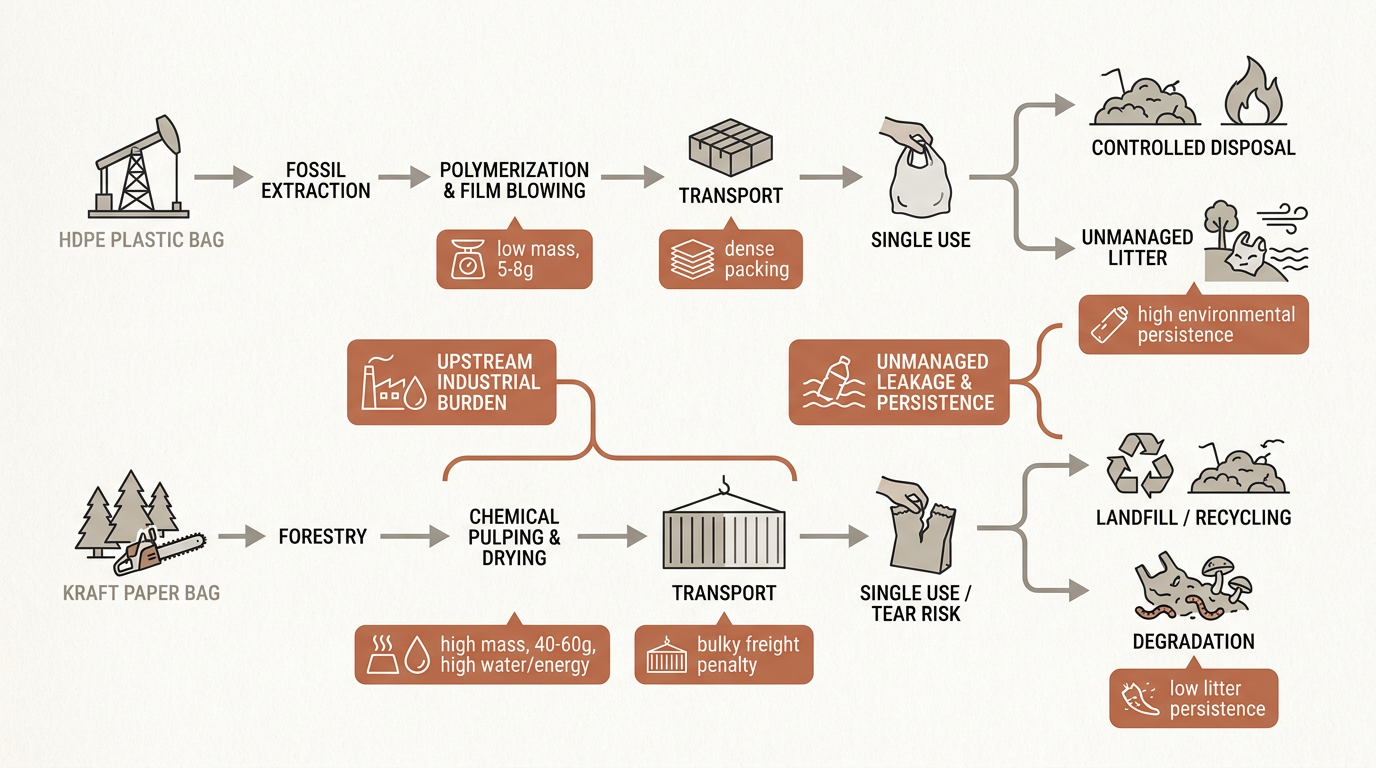
In LCA methodology, analysts define a "functional unit"—typically carrying a set volume and weight of groceries over a specific distance without mechanical failure. Comparing one paper bag directly against one plastic bag introduces an immediate distortion. Standard single-use plastic carrier bags, manufactured from blown high-density polyethylene (HDPE) film, generally weigh between 5 and 8 grams. A standard kraft paper bag with folded handles designed to carry the same load typically weighs between 40 and 60 grams.
Because of this mass differential, delivering the same carrying service requires manufacturing and moving roughly five to eight times as much raw material by weight when switching from plastic to paper. Every downstream logistics stage—from palletizing at the converter to freight transport and retail backroom storage—scales directly with this added mass.
Paper manufacture can require more energy and water than manufacturing a lightweight plastic bag. That does not prove plastic wins every category or location: paper sourcing, energy mix and recycled content alter the balance.
The industrial reality of pulping and conversion
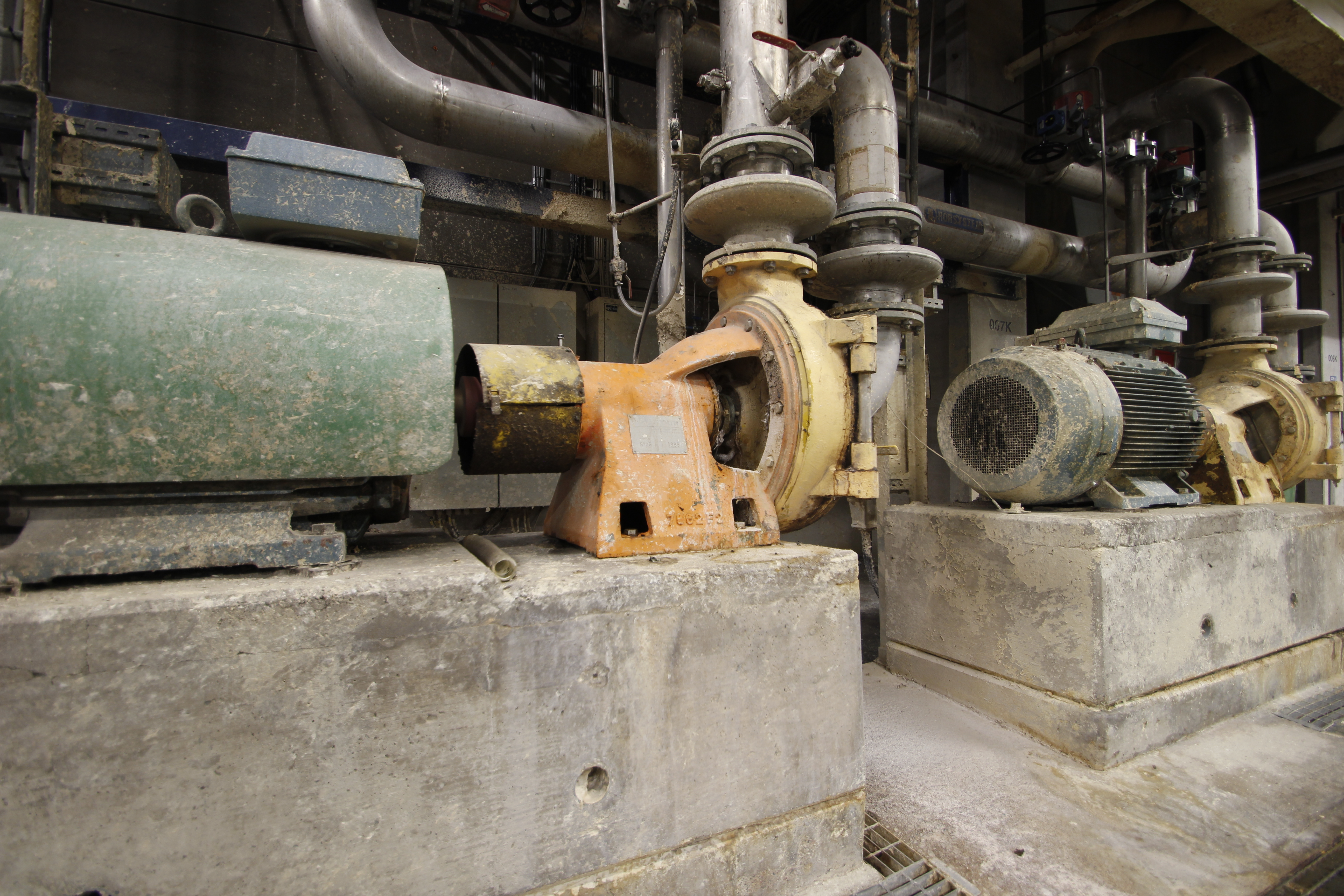
The disparity in upstream production emissions stems from the basic chemistry and thermodynamics of pulping. Transforming standing timber into high-tensile kraft paper requires intensive thermo-chemical processing. In the kraft pulping process, wood chips are digested in a pressurized solution of sodium hydroxide and sodium sulfide (white liquor) at elevated temperatures to dissolve lignin and liberate cellulose fibers. While modern pulp mills recover and burn black liquor to co-generate process heat and electricity, the broader supply chain—including logging machinery, chemical bleaching, wet-end papermaking, and thermal drying cylinders—consumes massive quantities of thermal energy and water.
Polymer conversion, by contrast, is remarkably energy-lean on a per-unit basis. Ethylene derived from natural gas or naphtha is polymerized into polyethylene pellets, which are then heated and extruded through a circular die as a continuous thin film bubble. Because film blowing operates at relatively moderate temperatures and yields exceptionally high tensile strength at minimal thickness, the primary energy input per carrier bag remains very low.
Furthermore, paper's bulk introduces a transport penalty. A diesel freight truck loaded with shopping bags cubes out or reaches its axle weight limit far faster when transporting bulky paper sacks than when moving densely packed reels of plastic film. More truck trips mean higher local particulate emissions and transport-related carbon dioxide per thousand bags delivered to the retail floor.
Why reuse numbers disagree
To compensate for its higher manufacturing footprint, an alternative carrier bag must be reused multiple times. However, published studies present wildly diverging break-even thresholds, confusing consumers and policymakers alike.
Widely circulated figures such as dozens, hundreds or thousands of required reuses often come from different studies and different environmental indicators. A climate-only threshold is not interchangeable with the highest threshold across every category. Cotton bag weight and assumptions about replacing bin liners can change the result substantially.
When an LCA assesses global warming potential alone, a standard virgin kraft paper bag may need to be reused three to four times to match the carbon footprint of an HDPE bag. Yet paper bags have poor mechanical durability: they degrade rapidly when exposed to moisture, rip along stress points, and lack handle elasticity, making four reliable grocery trips difficult in practice.
Heavy organic cotton totes sit at the extreme end of this dynamic. Cotton cultivation requires intensive irrigation, land use, and pest control, pushing the break-even reuse requirement into hundreds or even thousands of cycles when evaluated against freshwater ecotoxicity and ozone depletion metrics.
Another critical modelling variable is secondary use. In regions without mandatory bag fees, households routinely repurpose HDPE grocery bags as trash bin liners. If a consumer switches to buying dedicated low-density polyethylene (LDPE) bin liners, the environmental advantage of adopting a paper or cotton grocery sack drops sharply, because the fossil polymer was merely shifted from the checkout counter to the cleaning aisle.
There is no honest universal reuse number for every paper, cotton or plastic bag. A threshold without the study boundary is more slogan than guidance.
A lower production footprint means plastic litter does not matter.
Persistence, wildlife harm and litter pathways can be poorly captured by conventional lifecycle indicators. They still matter.
The boundary problem: litter versus carbon
The fundamental conflict in the carrier bag debate is not simply bad math; it is a mismatch of accounting frameworks. Standard life cycle assessment methodology was designed to quantify controlled industrial flows: kilograms of fossil resources extracted, kilowatt-hours consumed, and atmospheric emissions released through a chimney or exhaust pipe.
LCAs struggle to quantify unmanaged end-of-life leakage. When an HDPE bag escapes formal collection, it does not dissolve. It fragments into microplastics, clogs storm drains, entangles marine fauna, and persists in aquatic ecosystems for decades. A paper bag that escapes into the environment degrades via biological action into cellulose and benign organic matter within months.
Policymakers who mandate paper bags are often attempting to manage municipal litter costs and ocean pollution, while assuming climate impacts will remain neutral. Conversely, analysts who cite carbon-focused LCAs to defend plastic are ignoring environmental persistence. Both models are incomplete if viewed in isolation.
The practical choice
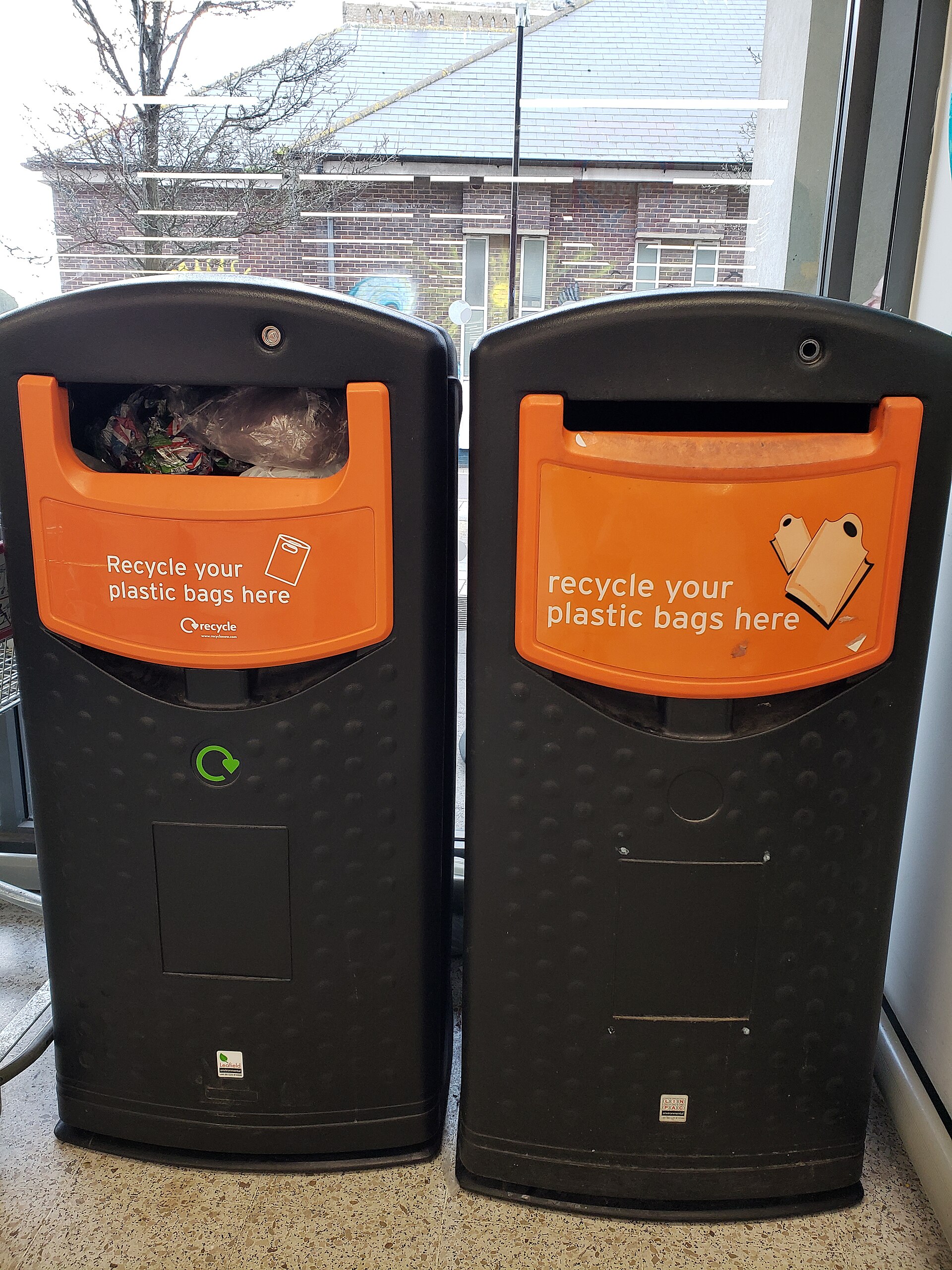
Managing bag impacts effectively requires moving past consumer guilt and material moralizing. The physical reality of collection infrastructure dictates end-of-life recovery far more than theoretical recyclability.
Use the durable bags you already own, avoid acquiring unnecessary new ones and keep them in service. Where a disposable bag is unavoidable, local acceptance and how the bag is actually managed matter. A theoretical recycling route cannot compensate for a bag that is littered or never collected.
The point is not to replace “paper good” with “plastic good.” It is to replace a material slogan with a service comparison. Less single-use consumption and genuine reuse usually offer a more reliable direction than repeatedly buying a supposedly greener substitute.
References and image credits›
Photo: via Wikimedia Commons, CC BY-SA · Diagram: The Waste Stack · Photo: Work With Sounds, CC BY-SA 4.0, via Wikimedia Commons · Photo: Wikimedia Commons, CC BY-SA