
A Catalyst That Dissolves a Plastic Designed Never to Melt
pDCPD is a cross-linked thermoset with no recycling route. A ruthenium catalyst and a stirred solvent take it apart - and leave the carbon fibre intact.
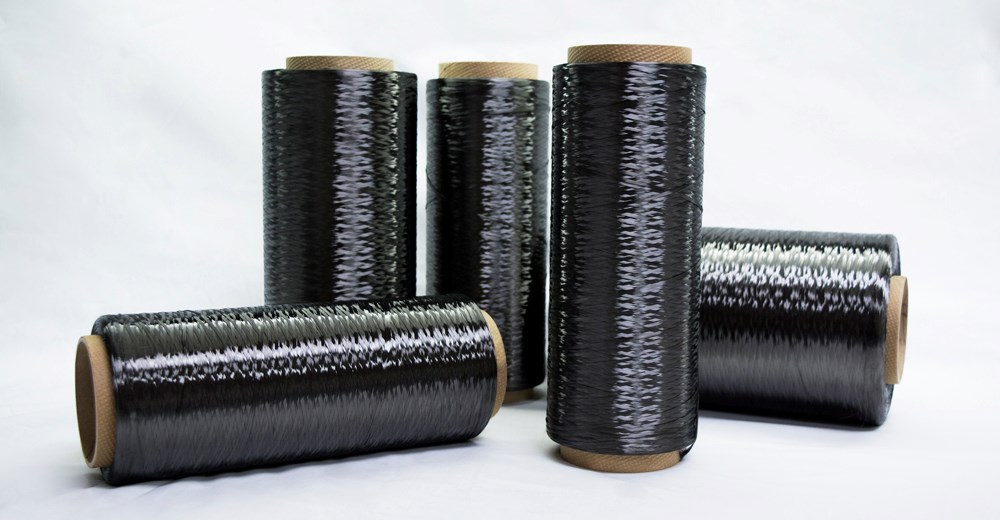
Thermoplastics melt and reform. Thermosets do not: their chains are cross-linked into a single permanent network, which is exactly why they are used for bumpers, excavator panels and chemical tanks. It is also why they are incinerated at end of life.
What the UT Austin team found
Poly(dicyclopentadiene) was considered too thermodynamically stable for a breakdown reaction to proceed at all. Associate professor Zak Page's group, with graduate student Keldy Mason, found otherwise - while trying to make the material more durable.
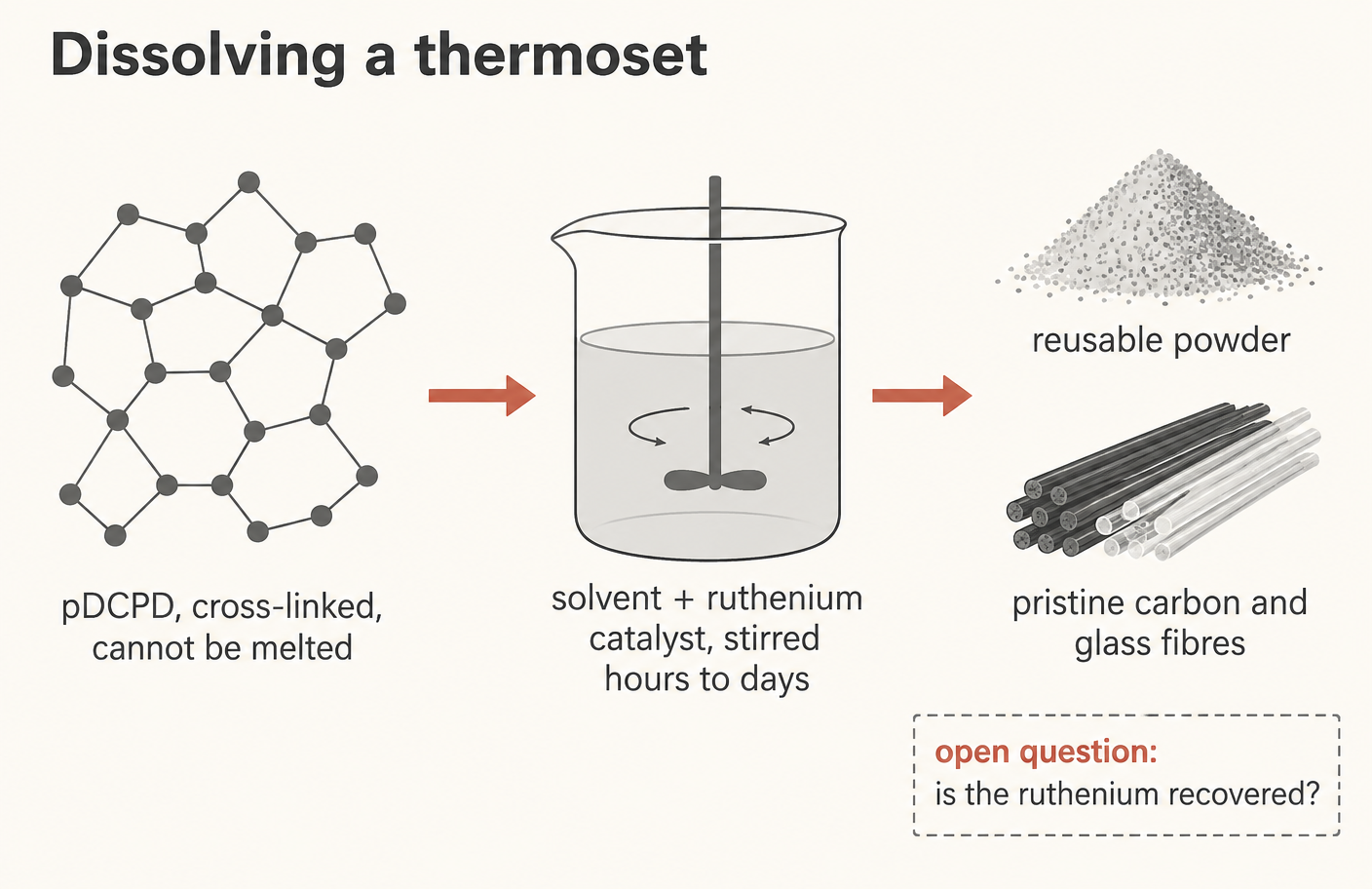
An object goes into a solution containing an eco-friendly solvent and a ruthenium-based catalyst. It is stirred for hours to days depending on size, and the pDCPD deconstructs and dissolves - the researchers compare it to a sugar lump in water. What is left is a powder that can be used to make new plastics, plus any carbon or glass fibre that was blended in, recovered in pristine condition.
Why this is interesting beyond one polymer
Thermosets are chosen when a part has to survive; the end-of-life penalty is accepted as the cost of that durability. A viable deconstruction route changes the calculation for a whole material class, not just one resin. A patent application has been filed by UT Austin, Sandia National Laboratories and four of the study's authors, with primary funding from the Department of Energy.
What is missing
No powder yield. No fibre recovery percentage. No pilot, no cost, no throughput. The solvent is described as eco-friendly but not named. And the biggest open question is the catalyst: ruthenium is a rare and expensive precious metal, and the team has not determined whether it can be recovered and reused. A process that consumes ruthenium stoichiometrically is a chemistry result, not a recycling route.
That question has an answer somewhere in the lab notebooks. Until it is published, this belongs in the promising-mechanism column rather than the solved-problem one.
References and image credits›
Photo: Wikimedia Commons, CC BY-SA · Photo: Wikimedia Commons, CC BY-SA · Photo: Wikimedia Commons, CC BY-SA