
"Recycling is always better than reuse"
Recycling has become the default green answer, which quietly skips two better options sitting above it. The waste hierarchy is not a slogan — it is a ranking, and it puts reuse first for a specific reason.

Put a recycling symbol on something and most people stop asking questions. That instinct is understandable and, in ranking terms, wrong: recycling sits on the second rung, not the first.
The myth
Once an item is recyclable, recycling it is always the environmentally preferable choice.
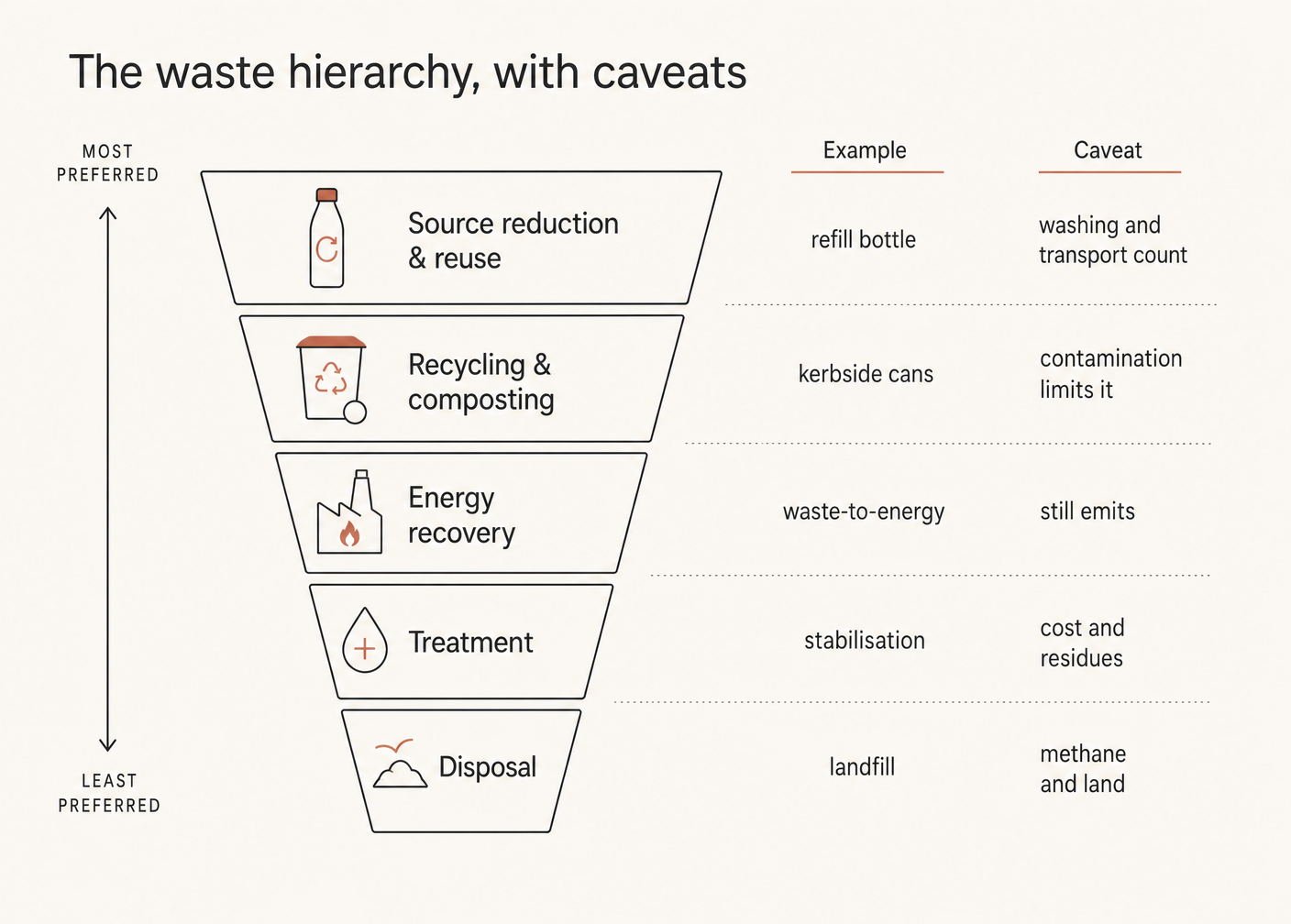
The US EPA ranks source reduction and reuse as the most environmentally preferred strategy, above recycling and composting, then energy recovery, and finally treatment and disposal.
The logic behind the ranking is mechanical rather than moral. Reusing an item avoids manufacturing a replacement — the mining, the refining, the forming, the packaging, the freight. It also avoids the collection, sorting and reprocessing energy that recycling requires before a material becomes useful again.
Recycling is a manufacturing process with a truck fleet in front of it. Reuse skips both.
The qualification most campaigns skip
Reuse is not automatically impact-free, and treating it as a moral absolute produces bad decisions.
Washing uses water and heat. Return logistics use fuel. Durable containers are heavier, so shipping them empty costs something. Breakage and low return rates can wipe out the advantage entirely — a heavy "reusable" item used once is worse than the disposable it replaced.
There are also cases where reuse is simply inappropriate: hygiene-critical items, contaminated packaging, food-safety limits, damaged products with a safety function. For those, a well-run recycling system genuinely is the better option.
What the hierarchy is actually for
The point of ranking prevention and reuse above recycling is to stop recycling from becoming a licence to keep producing disposables. If everything is recyclable, nothing has to change upstream.
The hierarchy pushes attention to where the leverage is: product design, packaging reduction, repairability, and systems that make repeated use realistic rather than aspirational.


The practical rule
Ask the questions in order:
- Can I avoid buying it at all?
- Can I repair, refill, share, donate or reuse it safely?
- If not, is it actually accepted by the local recycling programme?
That last one matters more than the symbol on the base. Acceptance is set locally, by what a given facility can sort and what a given market will buy. Follow local rules rather than assuming the chasing-arrows triangle guarantees anything.

References and image credits›
Photo: Derzno, CC BY 3.0 · Photo: Ilvy Njiokiktjien, CC BY-SA 3.0 · Photo: Vogler, CC BY-SA 4.0