
99.9% pure CO2 from sewage sludge — reading Rhinoflux's proof-of-concept closely
A Kyoto University spinout says its aqueous chemical looping process turns wet sewage sludge into power at 2–4× biomass efficiency with near-pure CO2 capture. The target problem is real. The disclosed evidence is a feasibility study and a set of conditional verbs.
The announcement
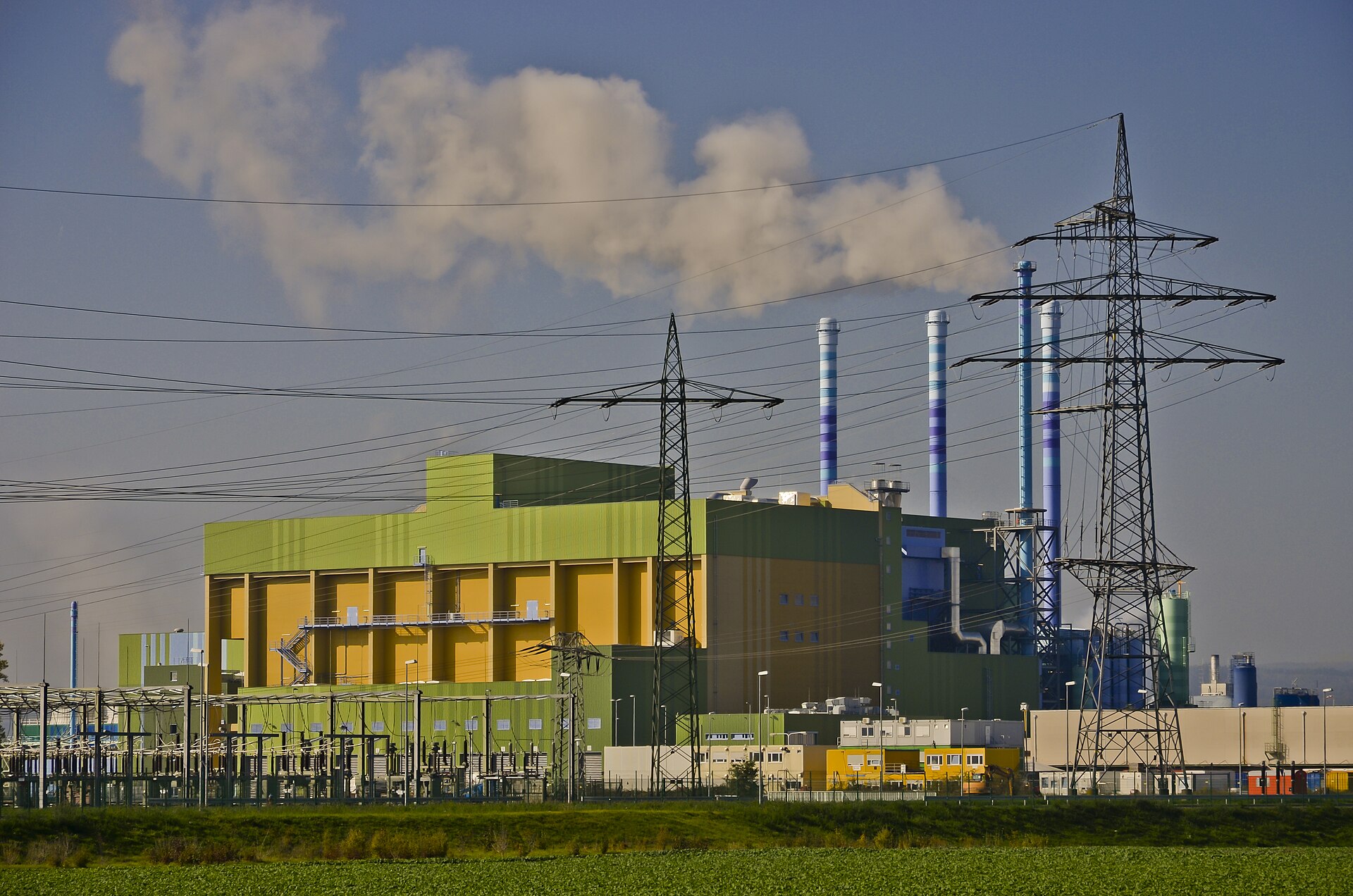
On 25 August, Kyoto University spinout Rhinoflux and Japan's Swing Corporation launched a proof-of-concept trial converting sewage sludge into electricity while capturing CO2 at better than 99.9% purity. The process is called Hydro Chemical Looping. The headline claim is that power-generation efficiency could be roughly two to four times that of conventional biomass power systems, and that the conversion happens in aqueous solution rather than by combustion.

Why the target is a good one
Start with what is genuinely right about this. Sewage sludge is one of the hardest energy feedstocks in the waste system, and the reason is water.
Dewatered cake still runs 70–80% water. Evaporating that water costs roughly 2.3 MJ per kilogram, which is why thermal sludge routes spend so much of the fuel value of the sludge on drying it before it will burn. That single term is what kills most sludge-to-energy economics, and it is why plants default to anaerobic digestion, incineration, or cement kiln co-processing instead.
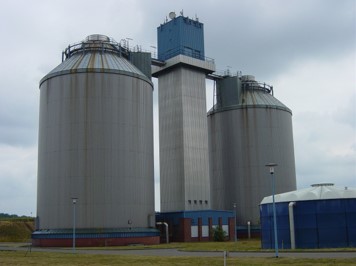
An aqueous, non-combustion route that extracts energy without first driving off the water genuinely sidesteps that penalty. That is a real problem to attack, and attacking it is worth attention.
Hydro Chemical Looping converts wet sewage sludge to electricity at 2–4× the efficiency of conventional biomass power, while capturing 99.9%-pure CO2.
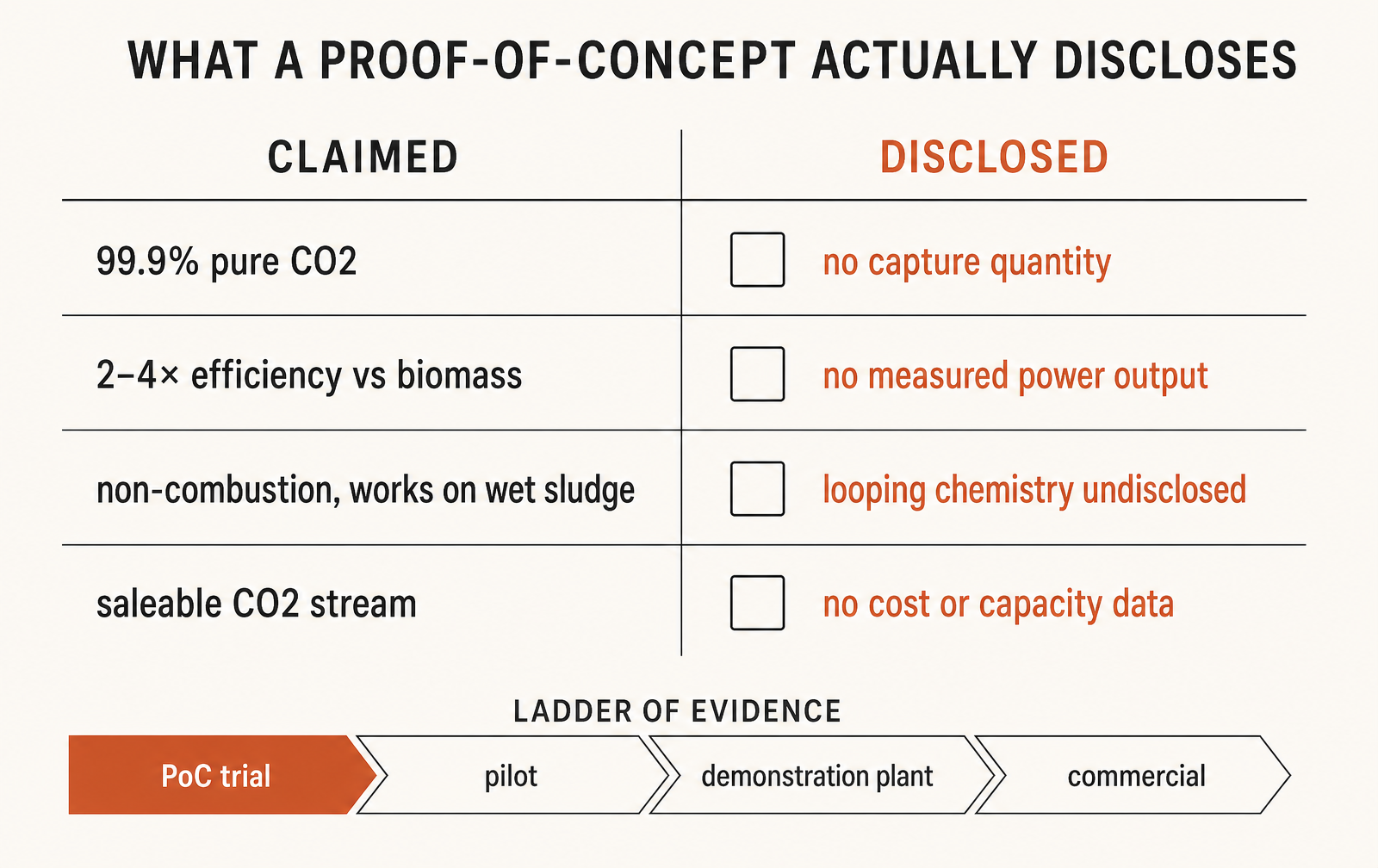
The release contains no measured power output, no sludge-to-energy conversion rate, no captured CO2 quantity, no processing capacity, and no emissions-reduction figure. Every headline number is framed as "potential" or "could".
The efficiency number has no denominator
"Two to four times more efficient than conventional biomass power" is not a claim you can check, because "conventional biomass power" spans everything from a 20% net-efficiency grate boiler to a co-fired unit at 35%. Multiplying an unspecified baseline gives you a range, not a measurement.
More to the point, efficiency relative to what input? Sludge-to-energy comparisons live or die on system boundaries: whether you count dewatering, whether you count the energy to regenerate the looping medium, whether you count parasitic load. None of those boundaries are stated.
The chemistry is undisclosed
A pure CO2 stream is an output, not a business. Monetising it requires compression, liquefaction, transport and either an offtaker or a verified sequestration route — all energy and capital that a plant-level efficiency claim tends to quietly exclude.
Chemical looping is a real and well-studied family of processes — a carrier material is oxidised in one reactor and reduced in another, which separates the fuel from the air stream and gives you a concentrated CO2 product almost for free. The 99.9% purity claim is plausible on those grounds alone; that is the normal payoff of looping architectures, not evidence of a breakthrough.
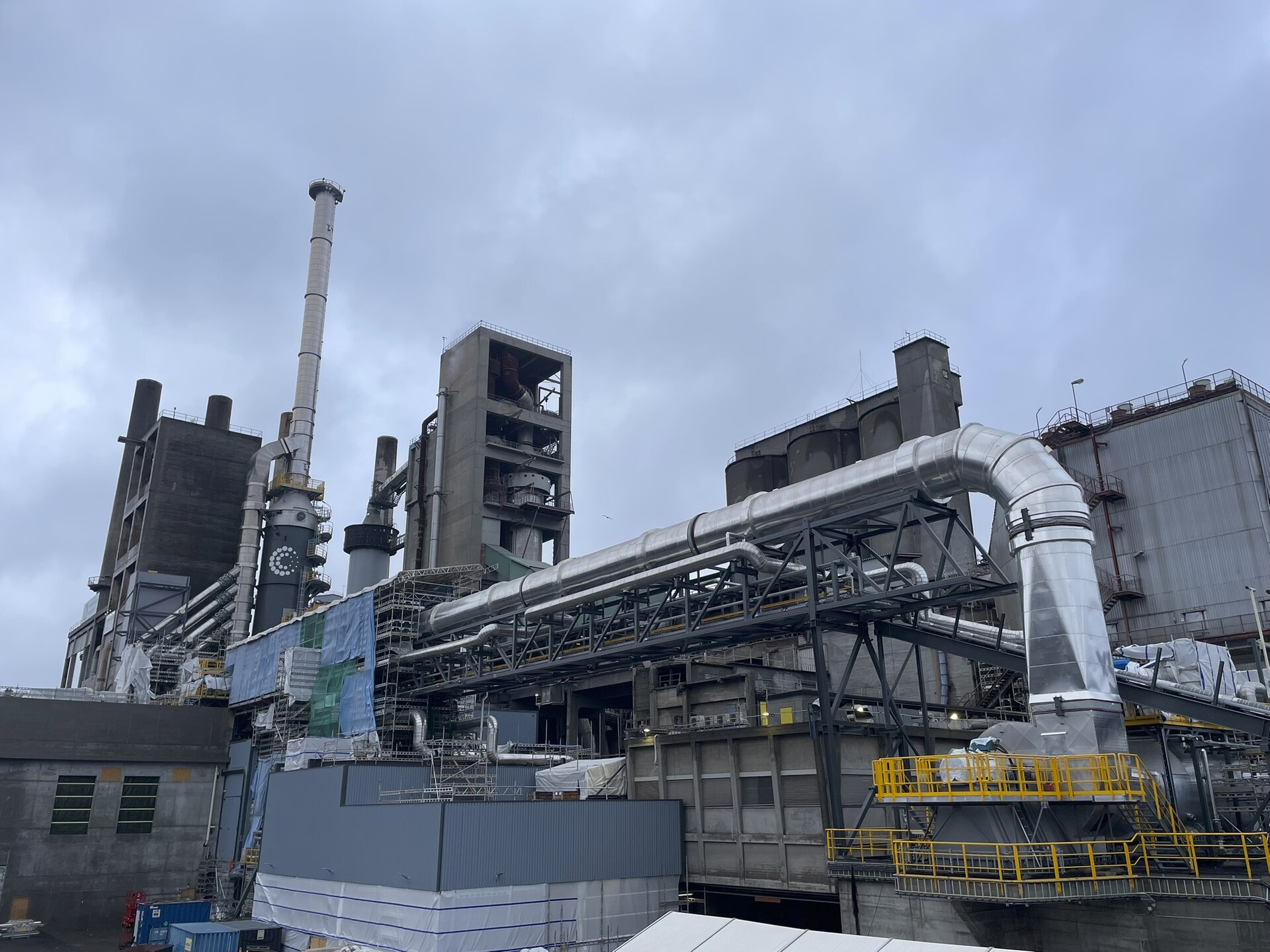
But the "hydro" part — an aqueous variant operating on wet sludge — is where the novelty would have to be, and that is exactly what the release does not describe. No looping materials, no reactor design, no operating temperature or pressure, no individual reaction steps. Without them, nobody outside the company can assess whether a 2–4× efficiency figure is thermodynamically plausible or where the energy inputs sit.
What "PoC trial" actually means
The companies completed a feasibility study and began collecting practical data in July 2026. That is the first rung. A proof of concept establishes that the reaction sequence runs on real feedstock at bench or skid scale; it says nothing about continuous operation, fouling from grit and hair and fibre in real sludge, carrier attrition over thousands of cycles, heavy metals partitioning, or cost per tonne.
Real sludge is also not one material. It changes with rainfall, with industrial dischargers upstream, with the season. Processes that work on a characterised sample frequently do not work on Tuesday's sample.
The fair verdict
A distributed, non-combustion sludge-to-power technology with built-in carbon capture is ready to turn treatment plants into generators.
A feasibility study finished and a data-gathering trial started. That is the starting line. The concept deserves to be watched precisely because it targets the drying-energy problem — but there is currently no measured, independent performance data of any kind.
The minimum a release like this should carry is small: a measured net electrical output for a stated sludge mass and moisture content, a captured CO2 mass over a stated period, and the system boundary used. None of those disclose proprietary chemistry. Their absence is a choice.
References and image credits›
Photo: Hirho, CC BY-SA 4.0 · Photo: Marcos von Sperling, CC BY-SA 4.0 · Photo: Marcos von Sperling, CC BY-SA 4.0 · Photo: PutTheKettleOn, CC BY 4.0 · Photo: Norbert Nagel, CC BY-SA 3.0 · Photo: public domain