
"Hundreds to thousands of times faster" — reading Rice's capture-and-destroy PFAS material
A copper–aluminium clay that traps PFAS and then burns them off is a genuinely good idea. The announcement reports partial destruction as elimination, a speed multiple with no baseline, and no cycle-life curve.
Rice University announced on 26 August a material that, in its own framing, captures and destroys PFAS "hundreds to thousands of times faster" than current filters — in river water, tap water and wastewater — and then regenerates itself for reuse. The underlying idea is genuinely good. The sentence is doing more work than the data.
What the material actually is
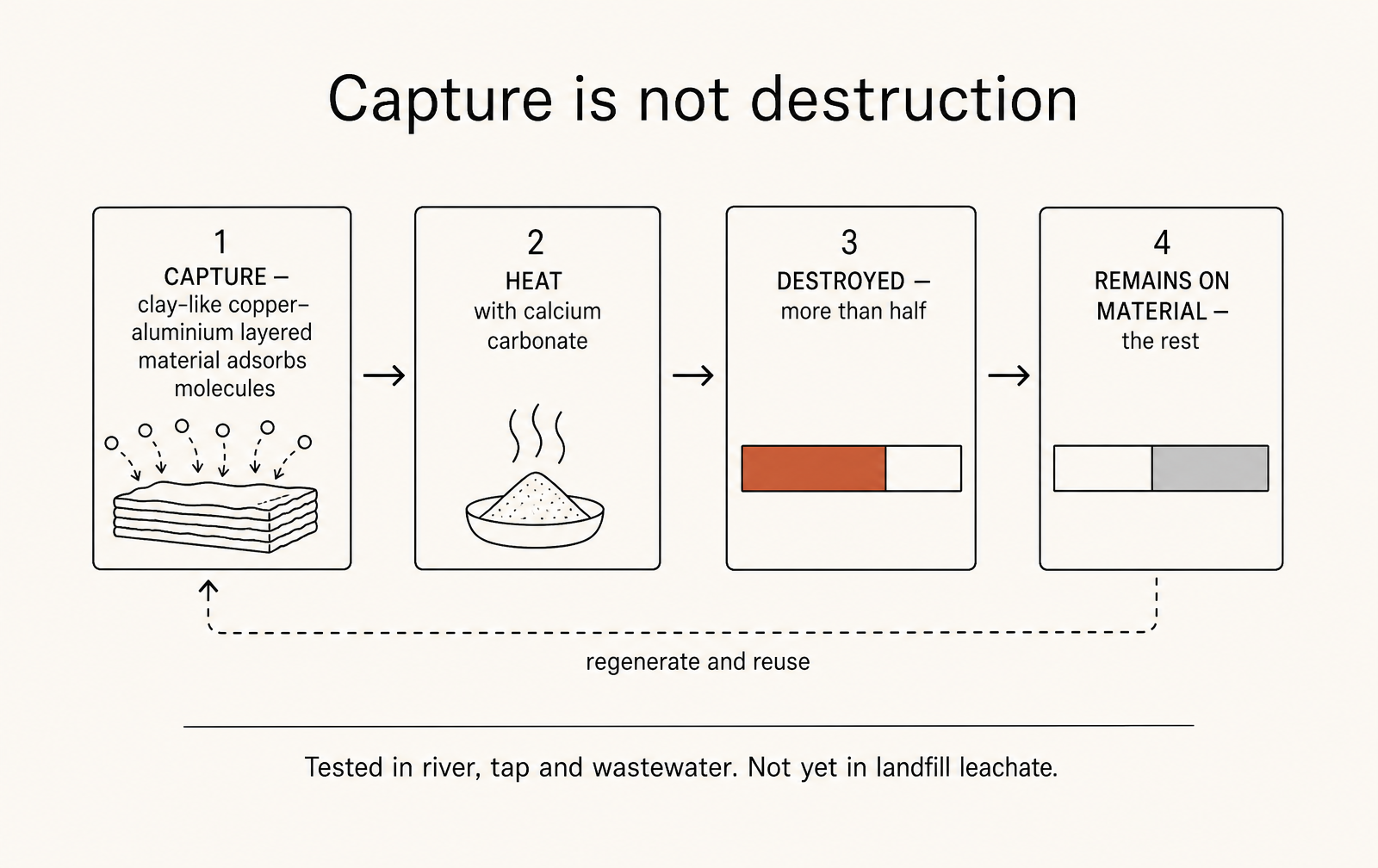
A layered double hydroxide: a synthetic clay-like solid built from alternating sheets of copper and aluminium hydroxide with exchangeable anions held between the layers. The specific nitrate-intercalated version adsorbs PFAS unusually well, because the interlayer anion swaps readily for a perfluorinated carboxylate.
A single material both captures and destroys PFAS, hundreds to thousands of times faster than existing filters.
The material captures fast — that part is the measured claim. Destruction is a separate, subsequent thermal step with calcium carbonate, and it removes more than half of what was captured. Two different processes are being reported under one headline.
What is genuinely strong here
Three things deserve credit, and they are not small.
It attacks the right bottleneck. Almost every deployed PFAS technology is a capture technology, and every capture technology ends with a loaded solid that someone must incinerate or bury. Putting destruction onto the sorbent itself is a real design idea, not a marketing one.
It was tested in real water. Most PFAS papers report performance in spiked laboratory water, where nothing competes for adsorption sites. Rice reports river, tap and wastewater matrices.


Regeneration changes the economics. A single-use sorbent is a consumable with a disposal liability attached. A sorbent that survives the destruction step and goes back into service is a capital item. Those are different businesses.
Where the claims outrun the evidence
The technology eliminates forever chemicals.
More than half destroyed means a substantial fraction survives on the material and re-enters the next cycle. For a compound class defined by persistence, partial destruction is an accumulation problem deferred, not an elimination.
Hundreds to thousands of times faster than current filters.
No baseline is specified. Faster than granular activated carbon or than ion exchange? At what influent concentration, what contact time, what particle size? Adsorption kinetics scale strongly with all of these, and a fine powder will out-kinetic a granular bed almost trivially without being deployable in the same configuration.
Proven across real water matrices.
River, tap and wastewater are real, but they are not the hard case. The ITRC states that destructive technologies remain largely unproven on landfill leachate, where matrix effects are severe. Leachate is the stream with the highest PFAS concentrations and the fewest options.
The regeneration question nobody asked
If destruction is partial and the material is reused, the residual load compounds. Cycle one leaves a fraction behind; cycle two adds to it. Either the destruction efficiency climbs toward completion, or capacity decays cycle over cycle and the "regenerable" sorbent has a finite life that has to be stated in cycles, not in principle. Rice has not published that curve, and it is the single most decision-relevant dataset in the whole announcement.

Fair verdict
The useful reform is boring: every PFAS breakthrough claim should state defluorination percentage, water matrix, and starting concentration. Three fields. It would settle most of these arguments before they start.
A legitimately interesting capture-and-destroy material addressing a real gap, with better-than-average testing discipline. The framing oversells it: partial destruction reported as elimination, a speed multiple with no named baseline, no leachate data, and no cycle-life curve. Treat it as a strong laboratory advance with a clear path to a pilot — and treat "eliminates forever chemicals" as a press office sentence, not a result.
References and image credits›
- 01ScienceDaily / Rice University — New technology eliminates forever chemicals with record-breaking speed
- 02The Guardian — New filtration technology could be game-changer in removal of PFAS
- 03Rice News — New roadmap advances catalytic solutions to destroy forever chemicals
- 04ITRC — PFAS-1, Section 12: Treatment Technologies
Cjp24, Wikimedia Commons, CC BY-SA 3.0 · Cjp24, Wikimedia Commons, CC BY-SA 4.0 · Mount Rainier National Park, Wikimedia Commons, CC BY 2.0 · Yasmine.shal, Wikimedia Commons, CC BY-SA 4.0 · P e z i, Wikimedia Commons, CC BY-SA 3.0 · PhilMacD, Wikimedia Commons, CC BY-SA 3.0 · USEPA, public domain