
The sewage lagoon that still leaks methane
A lagoon treatment train can strip pollution out of sewage and still push methane into the air. A paper published on 10 August measured one facility at roughly 2.0-2.3 times its reported estimate. Here is where the gas escapes.
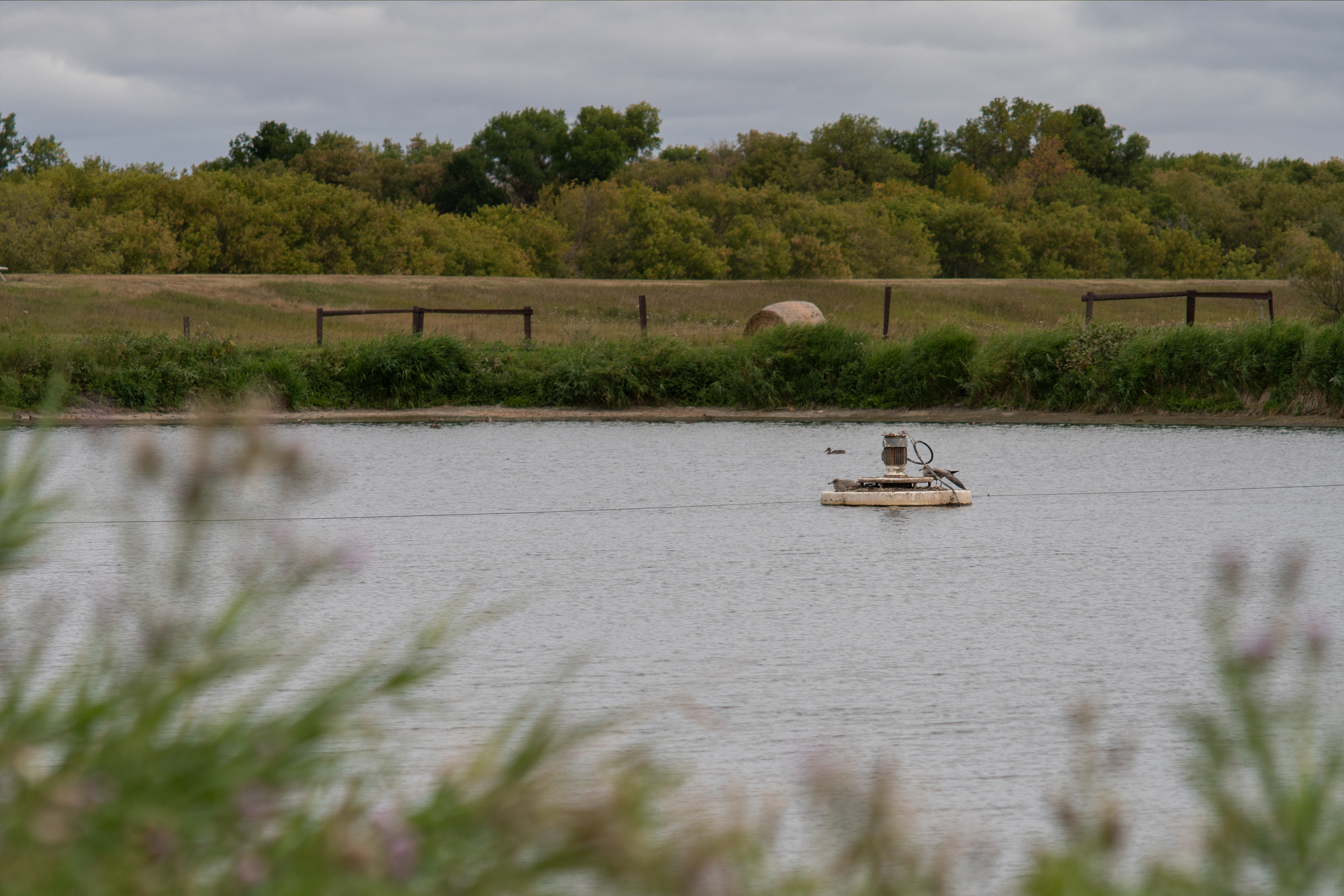
Wastewater treatment is usually judged on what comes out of the pipe. A peer-reviewed paper published on 10 August in Atmospheric Measurement Techniques judged a large lagoon system on what came off the surface instead, and found methane emissions roughly 2.0 to 2.3 times higher than the facility's own reported estimate.
Treatment worked. The methane still left. Here is the chain, stage by stage.
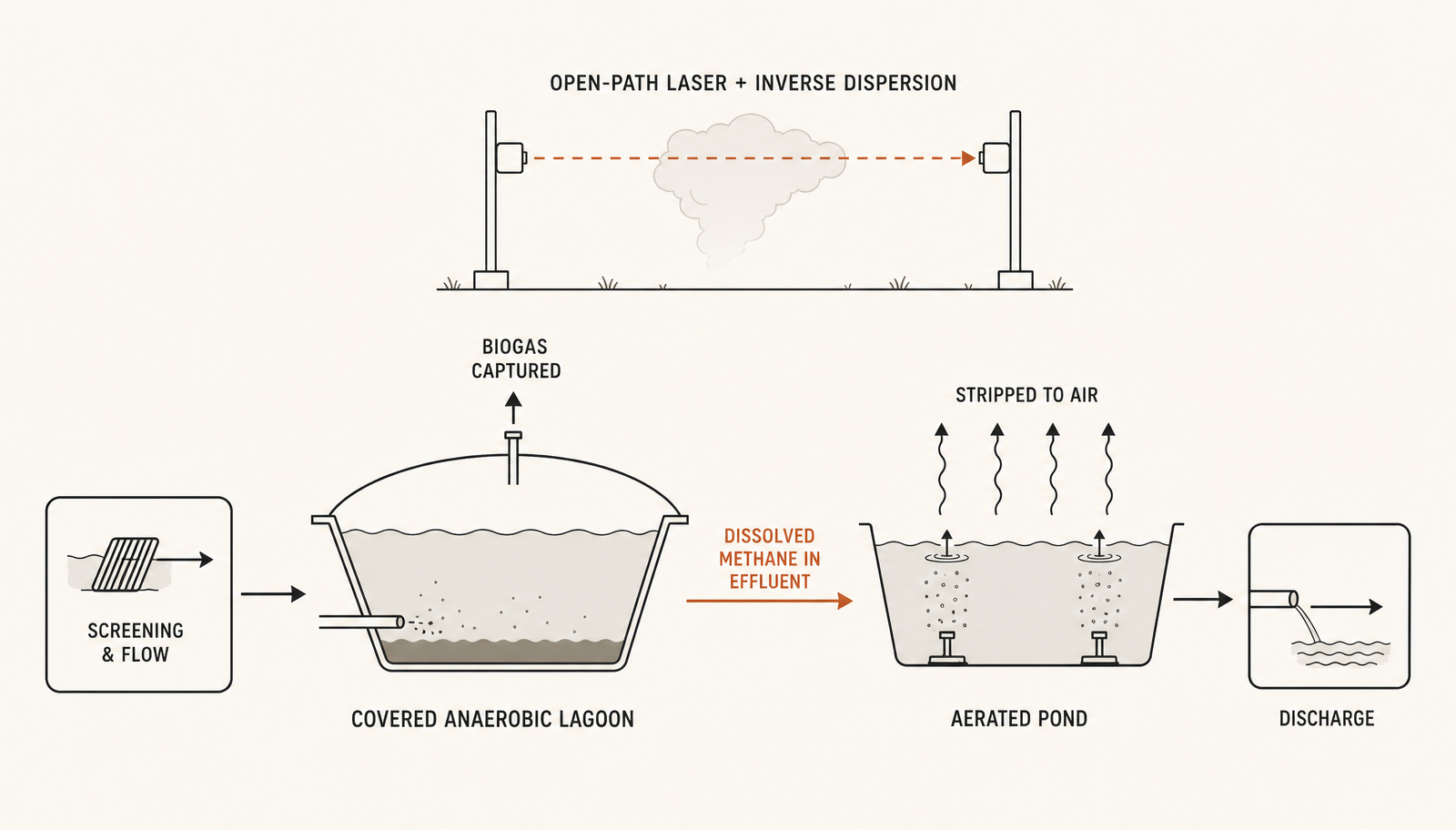
Stage one: screen and measure
Incoming sewage is screened to pull out rag, grit and anything that would foul the works downstream, and flow is measured before treatment begins. In an anaerobic lagoon the wastewater then enters near the bottom of a deep basin, well below the surface.
That inlet depth is deliberate. It keeps the incoming load in the oxygen-starved zone where the biology you want actually happens.
Stage two: let oxygen-starved microbes work
With no oxygen available, a chain of microbial communities takes the organic load apart in stages. Complex organic matter is broken into acids. Those acids are converted to acetate, hydrogen and carbon dioxide. The final stage, methanogenesis, produces methane plus carbon dioxide.
Stage three: capture what can be captured
A covered anaerobic lagoon can collect that biogas and send it to heat, engines or electricity generation. This is the part that appears in the emissions inventory, because it is the part with a meter on it.
The problem is what stays in solution. Liquid leaving the anaerobic stage can still carry dissolved methane, and dissolved methane does not show up in a gas capture number.
Stage four: aerate the next pond
The effluent moves to an aerated pond, where surface aerators drive oxygen in to support aerobic treatment. That is good for the water quality target and bad for the methane balance: the agitation and the pressure change strip dissolved methane out of the liquid and into the air.
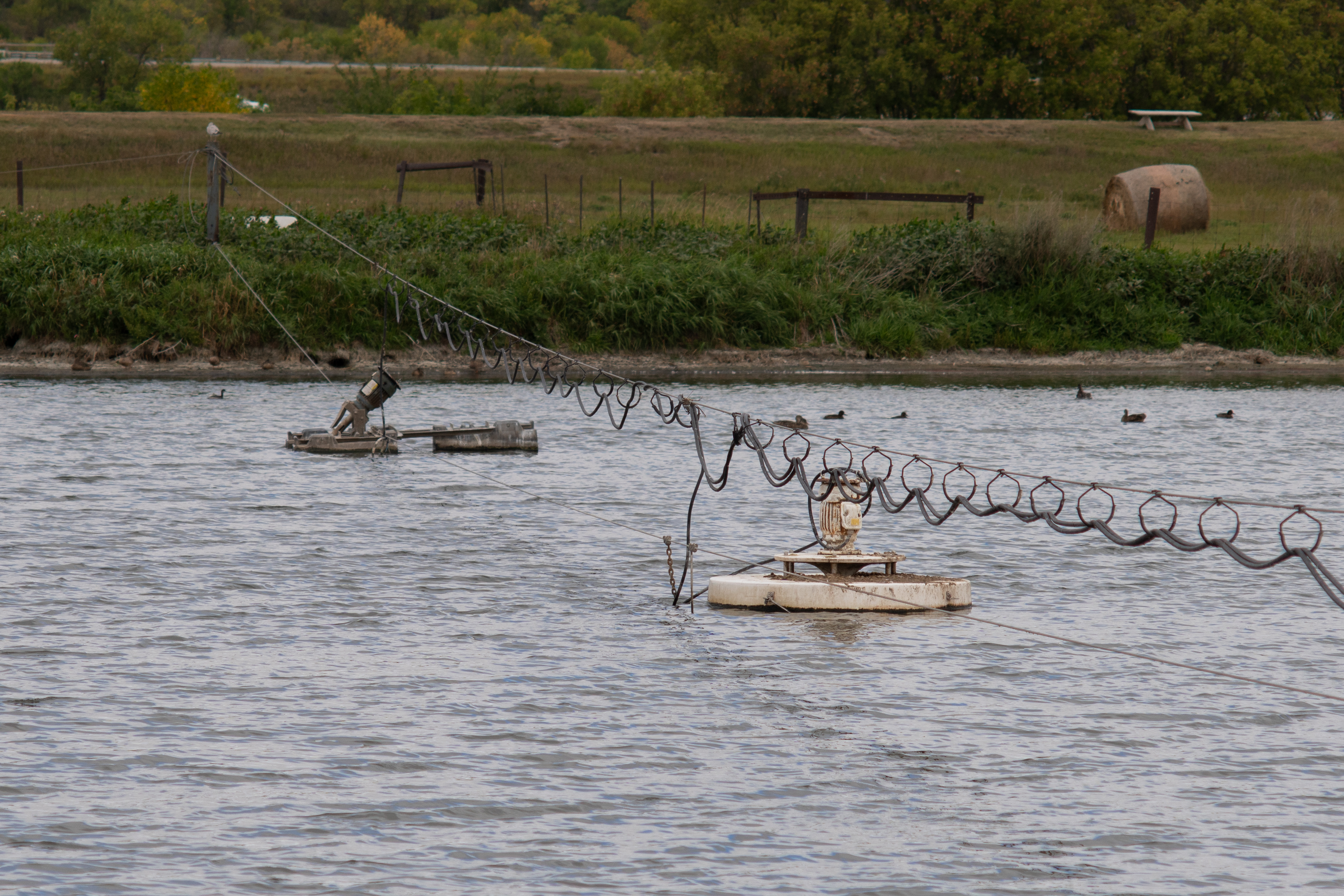
Emissions from this stage are not constant. They vary with flow, with how the aerators are being operated, with the condition of the sludge blanket and with position across the site.
Stage five: measure the invisible plume
You cannot put a flow meter on a pond surface. The 2026 study used open-path infrared lasers to measure methane concentration along a beam path, then ran inverse-dispersion modelling to work backwards from those concentrations and the local meteorology to a source flux.
That is the measured figure, and it is roughly two to two and a bit times what had been reported.
Stage six: reduce the leak
The authors set out options rather than answers: improved methane capture, dredging to deal with accumulated sludge, changes to aerator scheduling, and eventually redesigning the treatment train so the dissolved-methane handoff does not happen in an open pond.
The promise
Anaerobic lagoons are attractive for good reasons. They need no aeration, no heating and no mixing in the anaerobic stage, and the methane they generate can be captured and used as an energy source rather than bought in. The US EPA notes that anaerobic lagoons can deliver substantial BOD removal.
The catch
They also need land, can generate odour, are sensitive to temperature, may need long retention times, and normally require downstream aerobic or facultative treatment before discharge. And the measurement itself has limits: the study's site-specific estimate carries roughly 20.6% relative uncertainty, so the ratio is a solid finding about direction and rough magnitude rather than a precise audit figure.
The useful takeaway is structural. A treatment train can be doing exactly what it was designed to do for water quality while quietly running a methane release pathway that its own inventory does not see, because the capture point and the release point are in different parts of the site.
If a lagoon removes the pollution but releases more methane than reported, what should be fixed first: gas capture, aerator operation, or the treatment design itself?
References and image credits›
- 01Atmospheric Measurement Techniques, methane flux measurement at a wastewater lagoon (2026)
- 02US EPA, Wastewater Technology Fact Sheet: Anaerobic Lagoons
Photo: Dunn17, CC BY-SA 4.0, via Wikimedia Commons · Diagram: The Waste Stack · Photo: Dunn17, CC BY-SA 4.0, via Wikimedia Commons