
A sunlit bin lid can attack acetic acid — not every garbage smell
Lithium-modified manganese oxide links light and catalysis, but conversion, mineralisation and real odour control are different results.

Odour control can trap a molecule or destroy it chemically. For decades, practical domestic and municipal odour management has defaulted to the former approach. Activated carbon canisters, zeolites, and masking fragrances dominate the market because they require no external energy input and operate reliably at ambient temperatures. Yet physical adsorption carries an inherent drawback: media saturation. Once every internal pore and surface binding site is occupied, the filter ceases to capture volatiles, eventually releasing them back into the headspace if temperatures rise.
The reported solar bin-lid research explores the second route using a lithium-modified manganese oxide catalyst. Rather than capturing volatile organic compounds until a cartridge requires replacement, the system attempts heterogeneous catalytic oxidation driven by ambient and concentrated sunlight. By converting noxious gaseous byproducts directly into benign terminal oxides at the lid interface, such a device promises a passive, maintenance-free waste barrier. Translating surface chemistry demonstrated in a laboratory reactor into the chaotic, wet environment of an outdoor wheelie bin, however, requires examining what this catalyst actually does—and what it leaves untouched.
Bring vapour, light and catalyst together
A transparent insert concentrates sunlight onto a thin catalyst layer. A gas-permeable arrangement allows vapours to reach that surface. The researchers modify the manganese oxide structure with lithium, changing the electronic environment of lattice oxygen and improving its reaction with acetic acid.
Manganese oxides (MnOx) have long served as effective oxidation catalysts due to their variable oxidation states and high lattice oxygen mobility. In traditional thermo-catalysis, oxygen species embedded within the metal oxide crystal lattice attack adsorbed organic molecules via Mars–van Krevelen mechanisms. The lattice is reduced during the oxidation of the target gas and subsequently re-oxidised by ambient molecular oxygen.
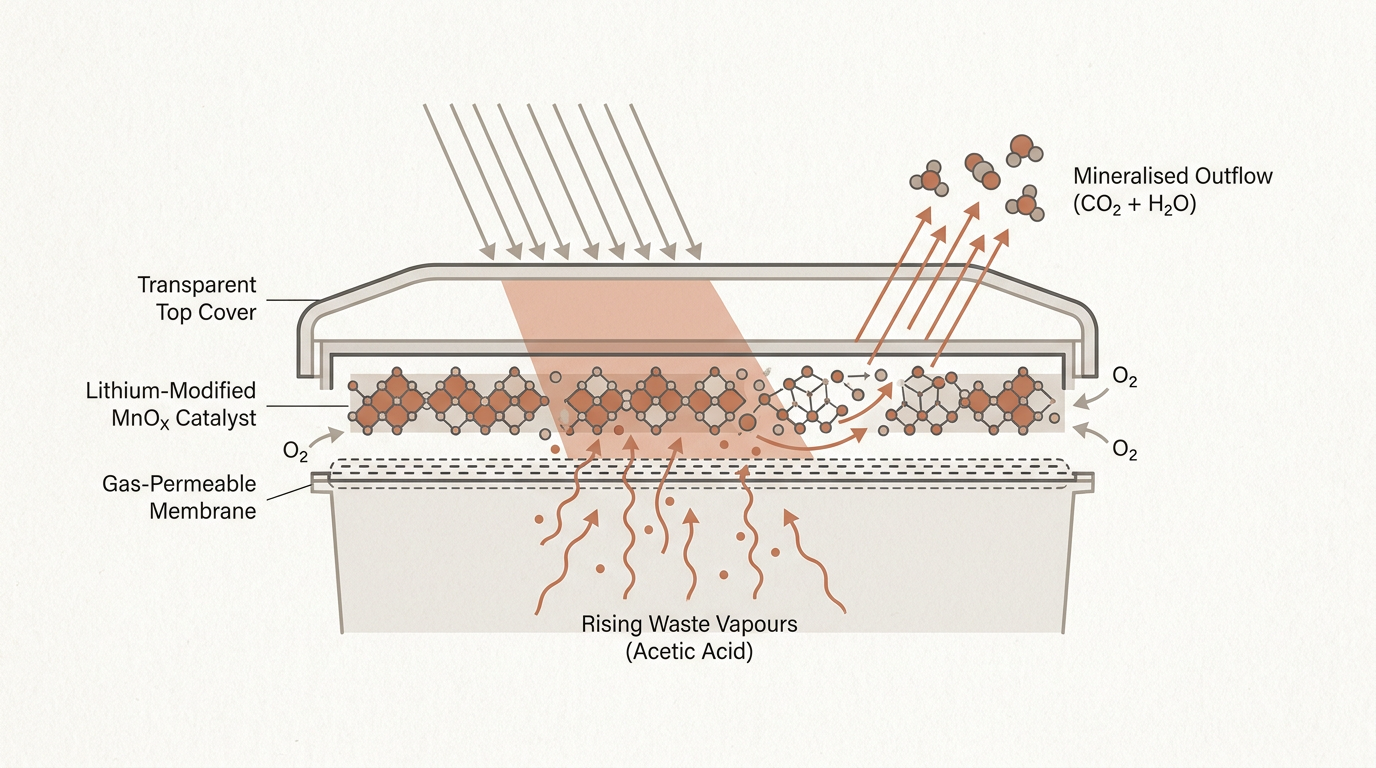
Introducing lithium cations into the manganese oxide framework alters the local electronic band structure. Lithium's low electronegativity and small ionic radius distort the crystal lattice, lowering the vacancy formation energy for surface oxygen. This electronic modulation accelerates the activation of surface-adsorbed oxygen, generating reactive oxygen species under light exposure. Combined with a transparent, light-concentrating window that focuses solar irradiance onto the catalytic bed, the system leverages both photothermal heating and photo-assisted catalytic reaction pathways to oxidise volatile vapours as they rise toward the bin lid.
Acetic acid is a relevant decomposition odour. It is a universal marker of aerobic and early-stage anaerobic fermentation, commonly generated when yeasts and bacteria ferment sugars in fruit, vegetables, and carbohydrate-rich kitchen scraps. It is not the only one: ammonia, sulfur compounds and other volatile substances can also contribute to a mixed bin’s smell.
Disappearance is not complete mineralisation
A reported 100% acetic-acid conversion in a heated laboratory test does not mean 100% of its carbon became carbon dioxide under ordinary sunshine. Mineralisation measures that further outcome; intermediate products can remain after the original molecule disappears.
A bin insert achieving 100% acetic acid conversion solves household food waste odour.
Converting a primary volatile organic acid under high-intensity lamps does not guarantee complete mineralisation to carbon dioxide, nor does it address the diverse sulfur- and nitrogen-based compounds driving putrefaction smells.
In chemical engineering, conversion defines the disappearance of the parent reactant as it passes through a catalytic zone. Mineralisation, by contrast, refers to the complete oxidation of an organic molecule into carbon dioxide and water. The distinction is critical. Partial catalytic oxidation of acetic acid can produce intermediate species such as acetaldehyde, formaldehyde, formic acid, or carbon monoxide. Some of these intermediates possess lower human olfactory thresholds and higher chemical toxicity than acetic acid itself. Unless a catalyst demonstrates high selectivity toward complete mineralisation under varying flow velocities, treating waste headspace risks trading a vinegar-like smell for irritant aldehydes.
The study includes elevated temperature and concentrated-light conditions. Its high-intensity lamp results should not be presented as ambient full-sun performance. Photothermal catalysts require specific irradiance thresholds to reach operating temperatures capable of sustaining rapid catalytic turnover. Under diffuse daylight, overcast skies, or winter solar angles, a passive collector may fail to achieve the thermal activation recorded under controlled solar simulators.
The reported test exceeding forty days with fruit, bread and wine is a separate, useful demonstration under more representative conditions. This extended trial showed that even when exposed to a continuous stream of genuine fermentation off-gases, the lithium-doped catalyst retained reactivity without immediate catastrophic deactivation. Demonstrating multi-week survival in the presence of natural moisture and organic vapour plumes is a meaningful step beyond pristine laboratory gas cylinders.
What the lid cannot promise yet
Shaded bins, night-time use, fouling, weather and the diversity of household waste all affect performance. Catalyst durability over weeks does not prove zero maintenance over years.

First, residential waste storage is frequently nocturnal or shaded. Bins spend their working lives tucked beside north-facing walls, inside garages, or sheltered under roof overhangs. Heterogeneous photothermal catalysis shuts down after sunset, precisely when warm summer evenings accelerate bacterial decomposition and volatile production within the bin core. Without an active storage mechanism or auxiliary power, the insert acts as an inert plastic barrier during hours of darkness.
Second, putrefaction chemistry extends far beyond simple carboxylic acids. While fruit, bread, and wine ferment primarily into ethanol, esters, and acetic acid, mixed municipal food waste rapidly introduces proteins and lipids. Proteinaceous degradation releases reduced sulfur species (such as hydrogen sulfide, methanethiol, and dimethyl sulfide) alongside volatile nitrogenous compounds (including ammonia, putrescine, and trimethylamine). Transition metal oxides like manganese oxide are notoriously vulnerable to sulfur poisoning: sulfur atoms bind strongly to active metal sites, forming stable, unreactive surface sulfates that block oxygen exchange.
Finally, the physical waste environment generates dense water vapour, particulate grease, and mold spores. A gas-permeable arrangement and optical window exposed directly to rising warm compost vapours will inevitably face condensation, droplet formation, and aerosol deposition, which extinguish optical focus and coat catalytic pores.
This is an interesting targeted treatment concept, not a commercial guarantee of odour-free rubbish. The next evidence is measured mixed-odour performance, byproduct analysis, realistic sunlight exposure and long-term maintenance and cost data.
References and image credits›
Photo via Wikimedia Commons, CC BY-SA · Diagram: The Waste Stack · Photo: P e z i, Wikimedia Commons, CC BY-SA 3.0 · Photo: Nick Saltmarsh, CC BY 2.0